

Trustee Resignation
A Trustee Resignation is a legal document through which a trustee formally steps down from the responsibility of administering a trust. Trustees may resign for many reasons, including retirement, health concerns, relocation, increased personal obligations, conflicts with beneficiaries, or the complexity of trust administration. Trustee Resignations are commonly used in family trusts, revocable living trusts, irrevocable trusts, charitable trusts, special needs trusts, and business succession trusts. Because trustees hold significant fiduciary responsibilities and often manage valuable assets on behalf of beneficiaries, disputes can arise when the transition of authority is not handled properly. A well-prepared Trustee Resignation helps ensure continuity of trust administration while protecting the interests of trustees, beneficiaries, and successor trustees.
The Trustee Resigns During a Family Dispute
A trustee has administered a family trust for several years following the death of the grantor.
Initially, the trustee works cooperatively with the beneficiaries and successfully manages trust assets. Over time, however, disagreements emerge regarding distributions, investment decisions, and the interpretation of certain trust provisions.
The beneficiaries begin questioning many of the trustee's decisions, while the trustee feels increasingly caught between competing demands and expectations. Communications become strained, and trust administration becomes more difficult with each passing year.
Eventually, the trustee concludes that continuing to serve may no longer be in the best interests of either the trust or the beneficiaries. The trustee decides to resign so that a successor trustee can assume responsibility and potentially restore confidence among the parties.
The transition itself becomes a source of concern because beneficiaries worry about delays and uncertainty during the change in leadership.
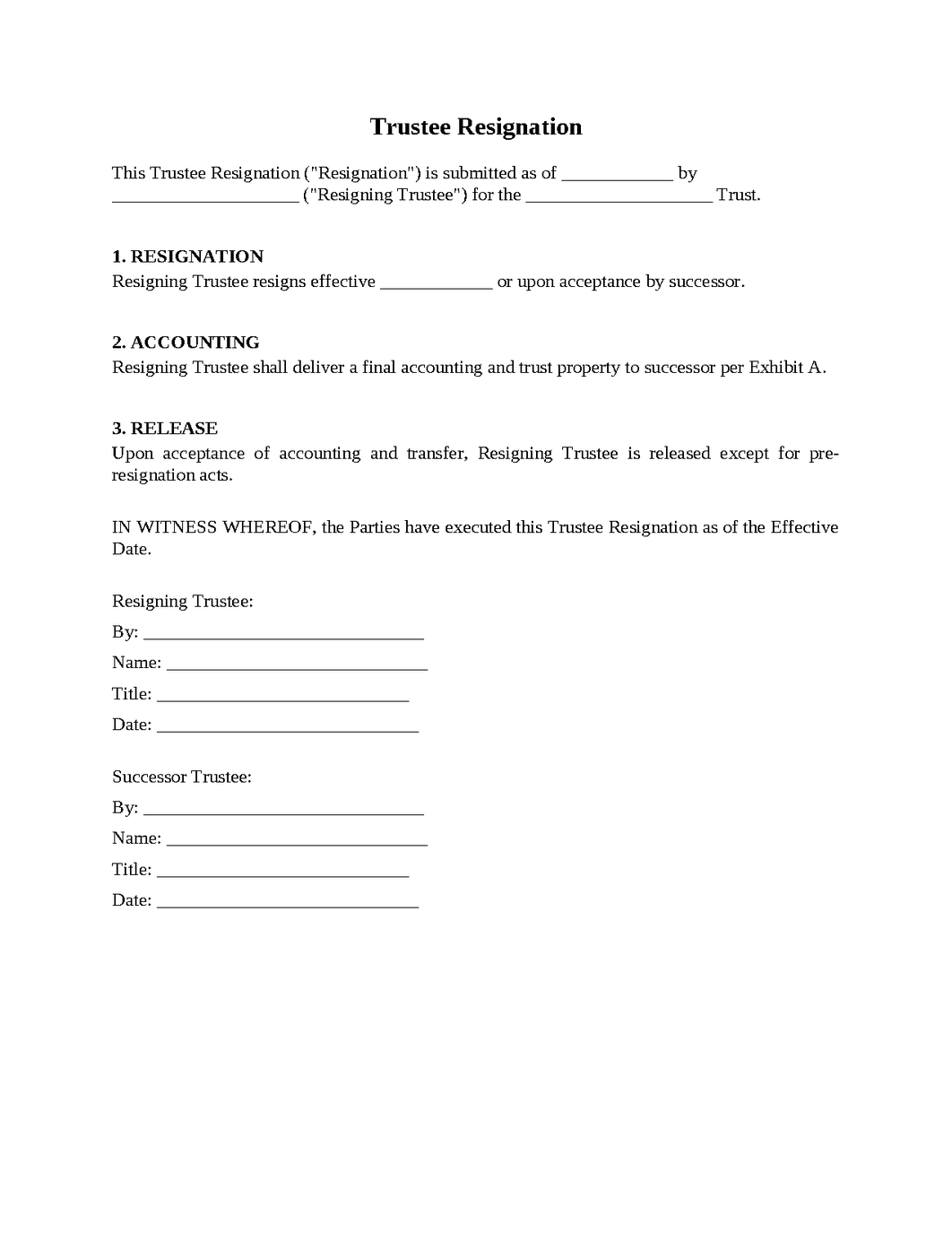
To help avoid these problems, a Trustee Resignation should clearly identify the effective date of the resignation, address the transfer of records and assets, and coordinate with the trust's successor trustee provisions.
No Successor Trustee Is Ready to Serve
A trust names several successor trustees in the event the original trustee can no longer serve.
Years later, the trustee decides to resign due to health concerns and personal obligations. The trustee expects the transition to proceed smoothly because successor trustees were identified in the trust agreement.
As preparations begin, however, each successor trustee declines the appointment for personal, professional, or financial reasons. The trust suddenly faces the possibility of having no active trustee available to administer its affairs.
Beneficiaries become concerned because investment decisions, tax filings, and distributions require ongoing oversight. The resigning trustee wants to step down but recognizes that the trust cannot simply be left without management.
The situation creates uncertainty and delays while the parties determine who will assume responsibility.
To help prevent these issues, a Trustee Resignation should coordinate carefully with the trust's succession provisions and ensure that appropriate arrangements are in place before the resignation becomes effective.
Trust Records Are Not Properly Transferred
A trustee manages a trust for many years and accumulates extensive records relating to investments, tax filings, distributions, and beneficiary communications.
When the trustee decides to resign, attention focuses primarily on selecting a successor. Less attention is given to organizing and transferring the trust's records and administrative information.
After the successor trustee takes office, important documents prove difficult to locate. Questions arise regarding prior distributions, investment decisions, account balances, and tax reporting obligations.
The successor trustee struggles to administer the trust effectively because critical information is incomplete or scattered across multiple locations. Beneficiaries become frustrated as delays begin affecting trust operations.
What should have been a routine leadership transition becomes an administrative challenge.
To help avoid this problem, a Trustee Resignation should include procedures for transferring records, account information, trust property, and other materials necessary for effective administration.
Beneficiaries Challenge Prior Trustee Decisions
A trustee announces plans to resign after years of service.
Initially, beneficiaries focus on identifying a replacement and ensuring that trust operations continue uninterrupted. As the transition progresses, however, certain beneficiaries begin reviewing prior trust activity more closely.
Questions emerge regarding past investment decisions, distributions, administrative expenses, and other actions taken during the trustee's tenure. Some beneficiaries believe additional explanations are necessary before the trustee's resignation becomes final.
The trustee believes all decisions were made appropriately and in accordance with fiduciary duties. The beneficiaries want reassurance that trust assets were managed properly before a new trustee takes over.
The resignation process becomes intertwined with broader questions about trust administration and accountability.
To help prevent these issues, a Trustee Resignation should be accompanied by appropriate accountings and documentation where required, allowing beneficiaries and successor trustees to understand the trust's current status.
A Trustee Resigns During an Important Transaction
A trust is involved in the sale of real estate, a business interest, or another significant asset.
At the same time, the trustee experiences personal circumstances that make continued service impractical. The trustee wishes to resign but recognizes that major trust transactions are still underway.
Beneficiaries worry that changing trustees in the middle of a significant transaction could create delays, increase costs, or complicate negotiations. The trustee believes stepping aside immediately is necessary due to personal limitations.
The successor trustee must quickly become familiar with the transaction and assume responsibility for ongoing decisions.
The timing of the resignation creates operational challenges for everyone involved.
To help avoid these problems, a Trustee Resignation should address pending transactions, establish transition procedures, and ensure that successor trustees receive sufficient information to continue trust administration effectively.
Trustee Resignations play an important role in maintaining effective trust administration when a trustee can no longer or should no longer continue serving. However, issues involving successor trustee appointments, record transfers, beneficiary concerns, fiduciary accountability, and ongoing transactions can become significant sources of conflict when the resignation process is not handled carefully. A properly prepared Trustee Resignation provides a structured framework for transferring authority and protecting the interests of all parties involved. When executed thoughtfully, it can help reduce disruption, preserve trust assets, support continuity of administration, and facilitate a smooth transition to new leadership.

Get started with Upsign today!
Easily send, sign and track your documents