

Assignment of Vehicle Lease Agreement
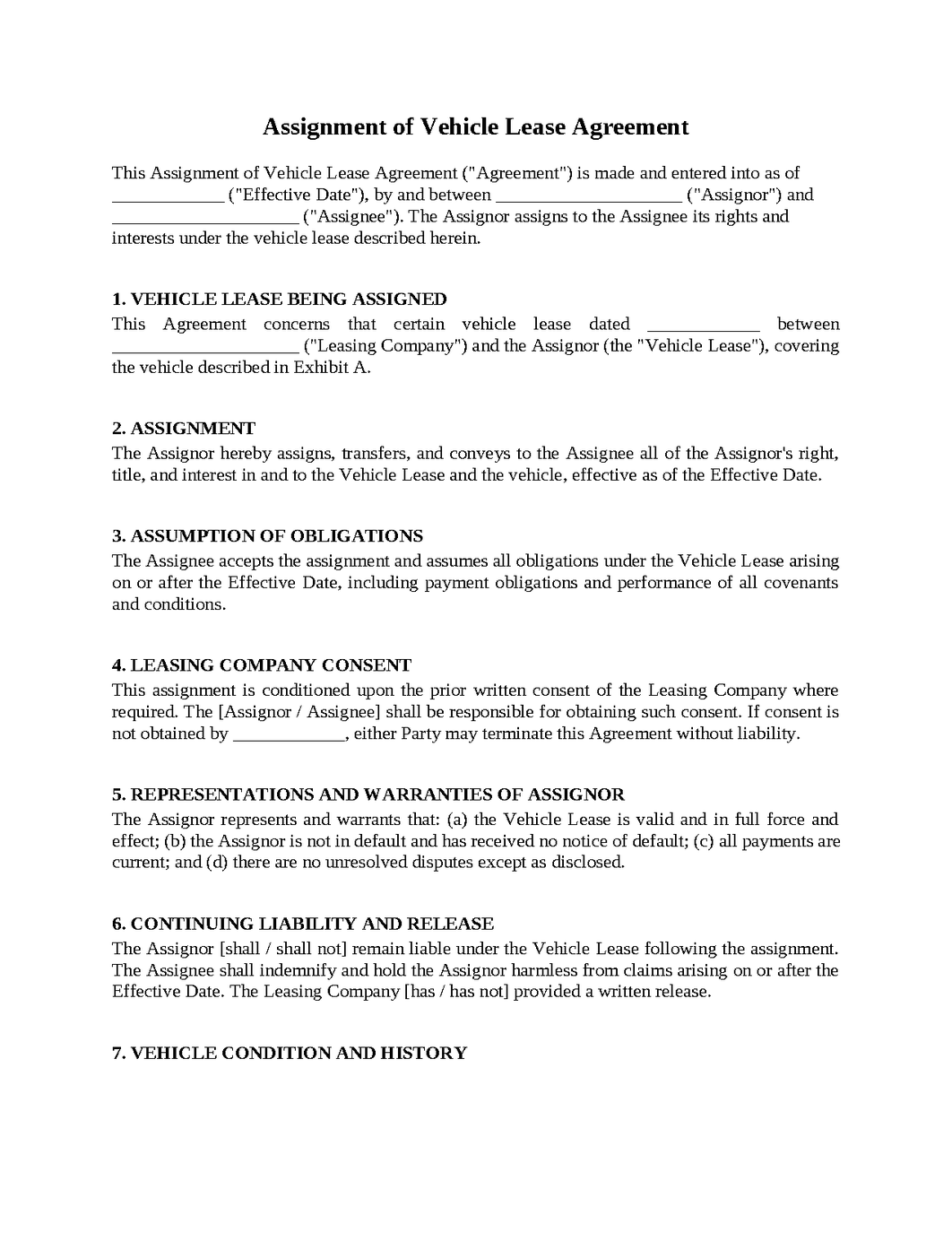
An Assignment of Vehicle Lease Agreement is a legal contract used when a lessee transfers its rights and obligations under a vehicle lease to another person or business. The party transferring the lease is known as the assignor, while the party assuming the lease is known as the assignee. Vehicle lease assignments commonly occur when individuals relocate, experience financial changes, no longer need a vehicle, or wish to exit a lease before the end of the term. Businesses may also assign vehicle leases as part of fleet reductions, mergers, acquisitions, or operational restructurings. Because vehicle leases often contain strict requirements regarding payments, mileage limits, maintenance obligations, insurance coverage, and end-of-term responsibilities, disputes can arise if the assignment is not documented carefully. An Assignment of Vehicle Lease Agreement helps establish who assumes responsibility for the leased vehicle and how future obligations will be allocated between the parties.
The Driver Transfers the Lease Without Lender Approval
A sales executive leases a luxury SUV with three years remaining on the lease term. After receiving an overseas work assignment, the executive decides the vehicle is no longer needed and begins searching for someone willing to take over the lease.
A local business owner expresses interest. The monthly payments are attractive, the vehicle is in excellent condition, and both parties are eager to complete the arrangement quickly.
The executive hands over the vehicle, transfers possession, and begins receiving reimbursement payments from the new driver. For several months, everything appears to work perfectly.
The situation changes when the leasing company conducts a routine account review. Insurance records, registration information, and service reports reveal that someone other than the approved lessee is operating the vehicle.
The leasing company reviews the lease and determines that the transfer violated provisions requiring prior written approval before any assignment may occur. The company immediately notifies the parties that the arrangement is unauthorized and may constitute a default under the lease.
What initially appeared to be a practical solution becomes a contractual dispute. The new driver risks losing access to the vehicle, while the original lessee faces potential penalties and liability exposure.
To help avoid this problem, an Assignment of Vehicle Lease Agreement should clearly identify all approval requirements contained in the lease and make lender or leasing company consent a condition of the transfer. The agreement should also establish which party is responsible for obtaining approval and what happens if the leasing company refuses to authorize the assignment.
The Assignee Inherits a Vehicle with Hidden Problems
A business professional agrees to assume a vehicle lease for a late-model pickup truck advertised as being in excellent condition.
The current lessee explains that the transfer is motivated by a job relocation and assures the incoming driver that the truck has been maintained properly.
The assignee reviews the vehicle, takes a short test drive, and feels comfortable proceeding. Because the truck appears clean and functional, little attention is given to maintenance records or prior repair history.
Several weeks after assuming the lease, problems begin emerging. Transmission issues surface, warning lights appear on the dashboard, and service technicians identify a history of recurring mechanical concerns.
Further investigation reveals that multiple warranty claims were filed previously and that certain repairs had only partially addressed underlying issues.
The assignee becomes frustrated. Instead of receiving a reliable vehicle, the assignee inherits significant repair disruptions and unexpected expenses.
The assignor argues that the vehicle was operational when possession transferred. The assignee believes material problems should have been disclosed before the assignment occurred.
To reduce these risks, an Assignment of Vehicle Lease Agreement should require disclosure of maintenance records, accident history, warranty claims, known defects, and pending repairs. The agreement should clearly allocate responsibility for pre-existing conditions and provide remedies if material information was withheld.
The Original Lessee Learns They Are Still Responsible
A family leases a minivan but later decides to downsize to a smaller vehicle after their children leave home. To avoid early termination penalties, they arrange for another family to assume the lease.
The assignment appears successful.
The new family takes possession of the vehicle, secures insurance coverage, and begins making monthly payments. The original lessees assume their obligations have ended permanently.
Nearly two years later, the new family experiences financial hardship and stops making lease payments.
The leasing company immediately begins collection efforts and contacts the original lessees regarding the default. The original lessees are stunned. They believed responsibility ended when the vehicle changed hands.
The leasing company points to lease provisions stating that the original lessee remains liable unless formally released. No such release was ever granted.
The original lessees now face collection demands, potential credit consequences, and legal expenses associated with a vehicle they have not used in years.
This situation is surprisingly common because many individuals assume that an approved assignment automatically eliminates future liability.
To avoid these problems, an Assignment of Vehicle Lease Agreement should clearly address continuing liability. The agreement should specify whether the assignor remains responsible after the transfer and require the assignee to indemnify the assignor for future losses. Whenever possible, the assignor should seek a written release from the leasing company.
The Parties Disagree About Excess Mileage Charges
A consultant assigns a vehicle lease with eighteen months remaining before expiration.
The vehicle has accumulated substantial mileage due to extensive travel, but neither party pays much attention to mileage calculations during the assignment process.
The assignee assumes the vehicle will remain within the lease mileage limits by the end of the term.
Several months before lease expiration, the assignee discovers the vehicle is already far above the allowable mileage threshold. The excess mileage penalties are projected to total several thousand dollars.
A dispute immediately develops.
The assignee argues that much of the excess mileage occurred before the assignment. The assignor responds that the assignee accepted the vehicle and should have reviewed mileage records more carefully.
Neither party can point to language clearly allocating responsibility.
The disagreement grows increasingly contentious because the financial consequences are substantial.
To prevent these disputes, an Assignment of Vehicle Lease Agreement should document the vehicle's mileage at the time of transfer and clearly allocate responsibility for existing and future excess mileage charges. The agreement should also identify any projected end-of-term fees that may affect the economics of the transaction.
An Accident Creates Confusion About Liability
A business owner assumes a vehicle lease for a commercial pickup truck used in day-to-day operations.
Several months after the assignment, the vehicle is involved in a serious accident that causes extensive property damage and personal injury claims.
Insurance companies begin investigating.
During the review process, questions emerge regarding ownership, approved drivers, insurance coverage, and lease responsibilities. The leasing company contacts both the assignee and the original lessee seeking information.
The original lessee becomes concerned because legal notices reference a vehicle lease that remains associated with their name.
The assignee argues that all operational responsibility transferred with the assignment. The leasing company focuses on the contractual obligations established under the original lease.
What began as a routine vehicle transfer now exposes multiple parties to significant legal and financial risks.
Accident-related disputes often reveal gaps in documentation that seemed unimportant when the assignment occurred.
To reduce these risks, an Assignment of Vehicle Lease Agreement should require proof of insurance, identify responsibility for claims arising after the transfer, allocate liability clearly between the parties, and establish indemnification obligations. These provisions can help prevent confusion if accidents or losses occur after the vehicle changes hands.
Vehicle leases are frequently assigned by individuals and businesses seeking flexibility without the costs associated with early lease termination. However, assigning a vehicle lease can create significant challenges involving lender approval, vehicle condition, continuing liability, mileage limits, insurance coverage, and accident-related risks. An Assignment of Vehicle Lease Agreement provides a structured framework for documenting these transfers and clarifying expectations regarding ownership, responsibility, and future obligations. When drafted carefully, it can help reduce disputes, protect both assignors and assignees, and ensure a smoother transition of vehicle lease rights and responsibilities.

Get started with Upsign today!
Easily send, sign and track your documents