

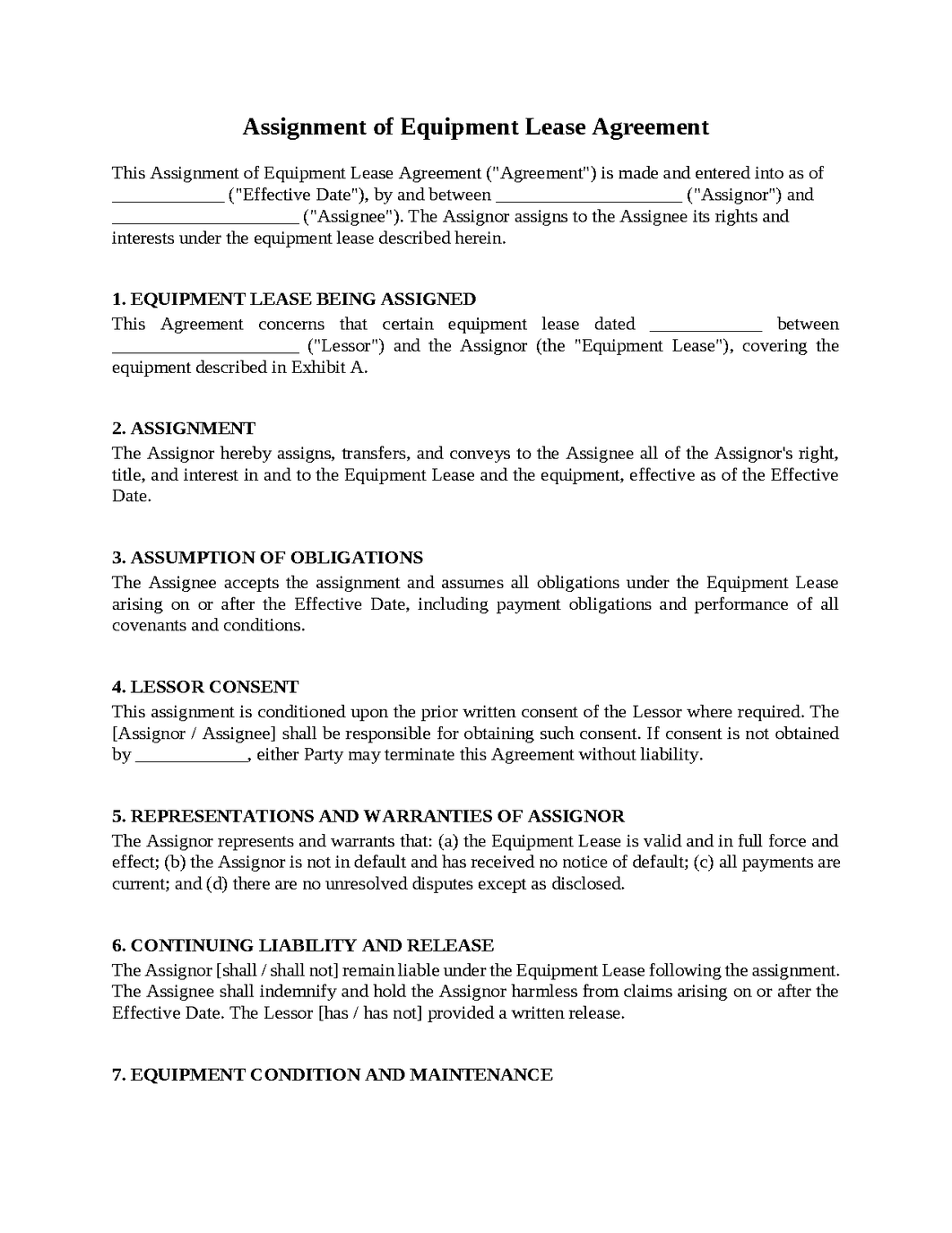
Assignment of Equipment Lease Agreement
An Assignment of Equipment Lease Agreement is a legal contract used when a lessee transfers its rights and obligations under an equipment lease to another person or business. The party transferring the lease is known as the assignor, while the party receiving the lease rights is known as the assignee. Equipment lease assignments commonly occur when businesses are sold, operations are relocated, equipment needs change, or companies seek to reduce expenses. Equipment subject to these agreements may include construction machinery, manufacturing equipment, medical devices, office equipment, technology systems, vehicles, agricultural equipment, and specialized industrial assets. Because equipment leases often involve long-term payment obligations, maintenance requirements, insurance obligations, and end-of-term purchase options, disputes can arise if the assignment is not documented carefully. An Assignment of Equipment Lease Agreement helps establish who assumes responsibility for the leased equipment and how future obligations will be allocated.
The Lessee Assigns the Lease Without the Leasing Company's Approval
A construction company leases several pieces of heavy equipment, including excavators, loaders, and grading machinery, under a long-term equipment lease. After completing a major project, the company realizes it no longer needs all of the equipment.
A smaller contractor expresses interest in taking over the lease. The arrangement appears beneficial to both parties. The original lessee can eliminate monthly lease payments, while the new contractor gains access to equipment without paying substantial upfront acquisition costs.
The parties quickly negotiate an assignment and transfer possession of the equipment.
Several months later, the leasing company conducts a routine audit and discovers that the equipment is being used by an entirely different business. Upon reviewing the lease, the leasing company identifies a provision requiring written approval before any assignment can occur.
No consent was requested.
The leasing company immediately declares the assignment unauthorized and notifies both businesses that the transfer violates the lease agreement. Questions arise regarding insurance coverage, maintenance compliance, and responsibility for future payments.
What seemed like a practical business solution becomes a contractual dispute involving repossession risks and potential default claims.
To help avoid this problem, an Assignment of Equipment Lease Agreement should identify all consent requirements contained in the lease and make lender or lessor approval a condition of the assignment. The agreement should also specify which party is responsible for obtaining approval and what happens if consent is denied.
The Assignee Inherits Equipment with Serious Problems
A medical practice acquires rights under an equipment lease covering diagnostic imaging equipment used in a specialty clinic.
The equipment appears modern and well-maintained. The seller emphasizes the value of the lease and highlights the favorable monthly payment terms.
Because the equipment remains operational during inspections, the buyer focuses primarily on pricing and financing considerations.
Several weeks after taking over the lease, significant problems begin emerging. Service records reveal recurring maintenance issues that were never disclosed. Certain components are nearing the end of their useful life. Expensive repairs become necessary to maintain compliance with industry standards.
The assignee is frustrated.
Instead of receiving reliable equipment, the buyer inherits substantial maintenance costs and operational disruptions. Patient scheduling becomes difficult, repair invoices accumulate, and revenue suffers.
The buyer argues that these issues should have been disclosed before the assignment occurred. The assignor responds that the equipment was functioning when possession transferred.
To reduce these risks, an Assignment of Equipment Lease Agreement should require disclosure of maintenance history, known defects, pending repairs, warranty claims, and service records. The agreement should also clearly allocate responsibility for pre-existing equipment issues discovered after the transfer.
The Original Lessee Learns It Is Still Responsible
A manufacturing company assigns an equipment lease covering specialized production machinery to another business after selling a product line.
Management assumes the assignment eliminates future obligations under the lease.
For several years, everything appears to proceed normally. The assignee makes payments on time and continues operating the equipment.
Eventually, however, market conditions deteriorate and the assignee experiences financial distress. Lease payments stop.
The leasing company immediately contacts the original lessee.
The assignor is surprised to learn that it remains liable under the lease despite no longer possessing or using the equipment. The leasing company points to lease provisions stating that the original lessee remains responsible unless expressly released.
The assignor now faces significant financial exposure for equipment it transferred years earlier.
Legal fees, collection efforts, and business disruptions follow as the parties dispute responsibility for unpaid obligations.
This issue is common because many businesses mistakenly assume an assignment automatically eliminates future liability.
To avoid these problems, an Assignment of Equipment Lease Agreement should clearly address continuing liability. The agreement should specify whether the assignor remains obligated after the transfer and require the assignee to indemnify the assignor against future lease-related claims. Whenever possible, the assignor should seek a written release from the leasing company.
The Parties Disagree About End-of-Lease Purchase Rights
A transportation company assigns a vehicle lease covering a fleet of delivery trucks to another logistics provider.
The assignee assumes the transaction includes all rights associated with the lease, including a favorable end-of-term purchase option allowing the vehicles to be acquired below market value.
Years later, as the lease approaches expiration, the assignee notifies the leasing company of its intention to exercise the purchase option.
A dispute quickly emerges.
The leasing company argues that the purchase option remained personal to the original lessee and was never transferred. The assignor believes the option transferred automatically. The assignee insists the option was a key factor in agreeing to assume the lease.
The disagreement becomes financially significant because the vehicles have appreciated in value.
What initially appeared to be a routine lease assignment now centers on ownership of a valuable contractual right.
To prevent these disputes, an Assignment of Equipment Lease Agreement should clearly identify which rights are being transferred, including purchase options, renewal rights, extension rights, upgrade privileges, and other economic benefits associated with the lease.
The Equipment Is Used Improperly After the Assignment
A company assigns a lease covering specialized manufacturing equipment to another business operating in a related industry.
The equipment is designed for a specific purpose and must be maintained according to strict manufacturer guidelines.
After taking possession, the assignee begins using the equipment in ways not contemplated by the lease or operating manuals. Maintenance schedules are ignored, unauthorized modifications are made, and performance standards decline.
Several months later, a major equipment failure occurs.
The leasing company investigates and determines that improper use contributed to the damage. Significant repair costs are incurred, and questions arise regarding responsibility for the losses.
The assignor becomes involved because the leasing company believes the original lessee may still bear liability under the lease.
What began as a completed assignment now exposes multiple parties to substantial financial risk.
To reduce these problems, an Assignment of Equipment Lease Agreement should clearly allocate maintenance responsibilities, require compliance with manufacturer specifications, establish inspection rights, and specify who bears responsibility for damage occurring after the transfer. These provisions can help prevent disputes when equipment condition becomes an issue.
Equipment leases often involve valuable assets that are essential to business operations. Whether the equipment consists of vehicles, machinery, medical devices, technology systems, or industrial tools, transferring lease rights requires careful planning and documentation. An Assignment of Equipment Lease Agreement provides a structured framework for transferring those rights and clarifying expectations regarding approvals, liability, maintenance, purchase options, and future obligations. When drafted carefully, it can help reduce disputes, protect valuable business assets, and provide confidence regarding the successful transfer of equipment lease rights and responsibilities.

Get started with Upsign today!
Easily send, sign and track your documents