

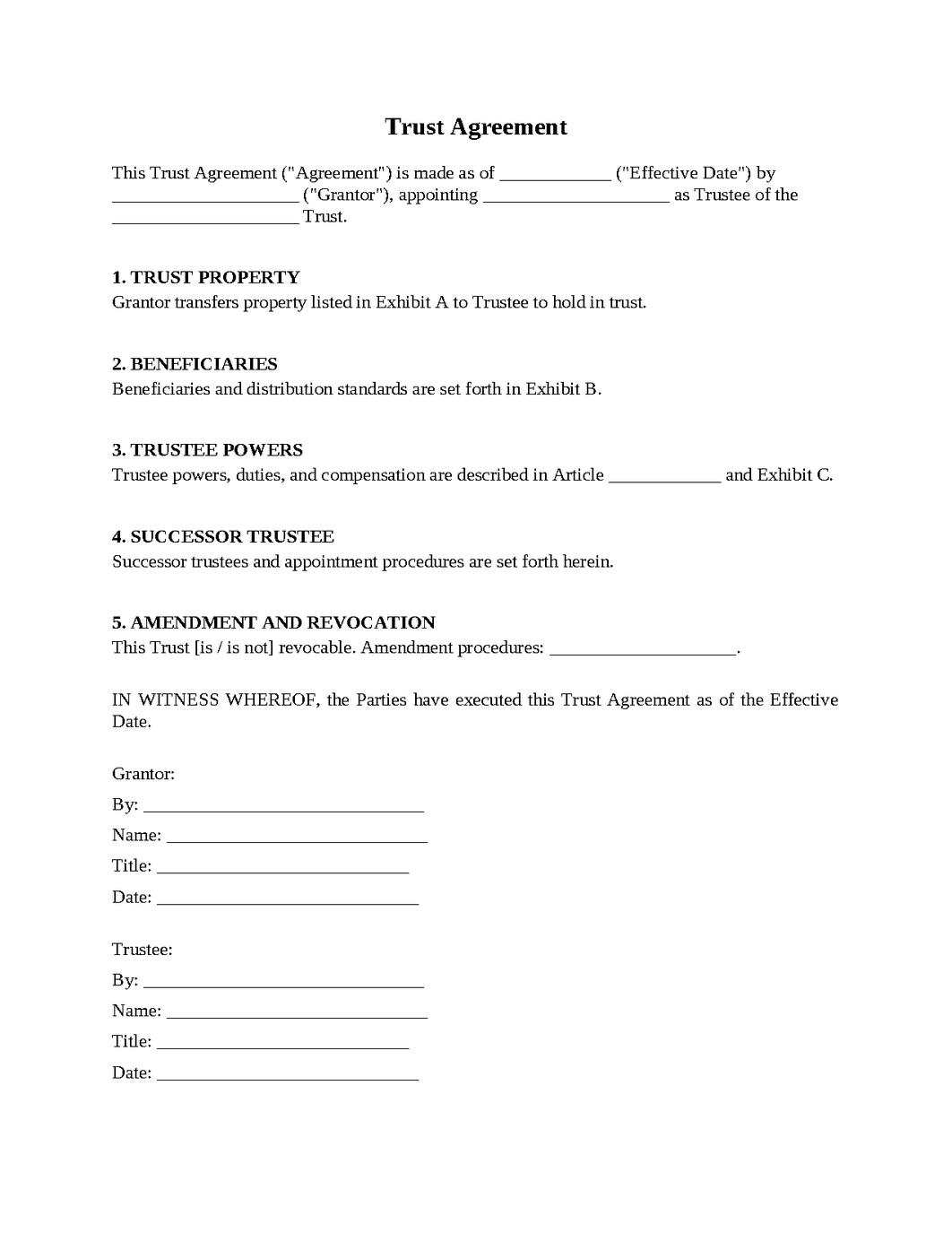
Trust Agreement
A Trust Agreement is a legal contract through which one party, known as the grantor or settlor, transfers assets into a trust to be managed by a trustee for the benefit of one or more beneficiaries. Trust Agreements are commonly used in estate planning, wealth preservation, charitable giving, special needs planning, business succession, asset management, and family financial planning. The agreement typically establishes how assets will be managed, distributed, invested, and protected both during the grantor's lifetime and after death. Because trusts often involve substantial assets, multiple beneficiaries, and long-term fiduciary responsibilities, disputes can arise when expectations are not documented clearly. A well-drafted Trust Agreement helps protect beneficiaries, trustees, and grantors while providing a structured framework for managing and distributing assets according to the grantor's intentions.
Beneficiaries Disagree About Distribution Decisions
A parent creates a trust to provide financial support for several children over an extended period of time.
The Trust Agreement gives the trustee discretion to make distributions for education, healthcare, housing, and other important needs. For several years, the arrangement works smoothly because the beneficiaries have relatively similar circumstances and expectations.
As time passes, however, one beneficiary experiences financial hardship and requests significant distributions from the trust. Another beneficiary believes the requests exceed what the grantor intended and argues that trust assets should be preserved for future needs.
The trustee finds itself in a difficult position. One beneficiary expects immediate assistance, while another believes unequal distributions undermine the fairness of the trust arrangement.
The disagreement begins affecting family relationships and creates tension among individuals who were originally expected to benefit from the same trust.
To help avoid this problem, a Trust Agreement should clearly define distribution standards, explain the trustee's discretionary authority, and provide guidance regarding how beneficiaries' needs should be evaluated over time.
The Trustee Is Accused of Mismanaging Trust Assets
A grantor establishes a trust containing investment accounts, real estate, and other valuable assets.
The trustee accepts responsibility for managing the trust and making decisions that are intended to benefit the beneficiaries. Initially, the trustee follows a conservative investment strategy and regularly communicates with the family regarding trust performance.
Several years later, market conditions change and some trust assets decline in value. Certain beneficiaries become concerned and begin questioning whether the trustee exercised appropriate judgment when managing investments and other trust property.
The trustee believes all decisions were made prudently and in good faith based on the information available at the time. The beneficiaries believe different decisions may have produced better results.
What began as ordinary investment fluctuations evolves into a dispute regarding fiduciary duties and asset management responsibilities.
To help prevent these issues, a Trust Agreement should clearly define trustee powers, establish investment authority, identify reporting obligations, and provide guidance regarding the standards governing fiduciary decision-making.
Family Circumstances Change Unexpectedly
A trust is created to benefit several family members over multiple decades.
At the time the trust is established, the grantor believes the beneficiaries' needs and circumstances are relatively predictable. Years later, however, unexpected events occur. One beneficiary develops significant medical needs, another becomes financially successful, and a third experiences personal challenges that require additional support.
The trustee must decide how to administer the trust in light of circumstances that were never specifically anticipated when the agreement was signed.
Some beneficiaries believe distributions should be adjusted to reflect changing needs. Others argue that the trust should be administered exactly as originally envisioned regardless of future developments.
The disagreement grows because the trust language provides only limited guidance regarding how unforeseen situations should be handled.
To help avoid this problem, a Trust Agreement should provide flexibility where appropriate, establish standards for addressing changing circumstances, and clearly express the grantor's priorities regarding beneficiary support.
A Successor Trustee Takes Over
A trust operates successfully for many years under the management of the original trustee.
Eventually, the trustee resigns, becomes incapacitated, or passes away. Responsibility for administering the trust transfers to a successor trustee who was named in the agreement years earlier.
The successor trustee inherits ongoing investment responsibilities, beneficiary relationships, tax obligations, and administrative duties. Beneficiaries become concerned because the new trustee approaches trust administration differently than the original trustee.
Although the successor trustee believes it is fulfilling its obligations properly, beneficiaries may question decisions that differ from prior practices.
The transition creates uncertainty because expectations developed under the prior trustee's leadership.
To help prevent these issues, a Trust Agreement should establish clear trustee succession procedures, define successor trustee powers, and provide sufficient guidance to promote consistency in trust administration over time.
Beneficiaries Challenge the Grantor's Intentions
A trust is established as part of a comprehensive estate plan intended to distribute family wealth according to the grantor's wishes.
Following the grantor's death, beneficiaries review the trust provisions and discover that distributions are not structured in the manner some family members expected. Certain beneficiaries believe the trust unfairly favors particular individuals or imposes restrictions that should not exist.
The trustee points to the language of the agreement and explains that its responsibility is to carry out the grantor's expressed intentions. Dissatisfied beneficiaries argue that the trust does not accurately reflect what the grantor truly wanted.
Family disagreements intensify as different interpretations emerge regarding conversations, promises, and expectations that occurred during the grantor's lifetime.
What was intended to create clarity and stability instead becomes a source of conflict among family members.
To help avoid these problems, a Trust Agreement should clearly express the grantor's intentions, address important family considerations, and provide unambiguous instructions regarding the administration and distribution of trust assets.
Trust Agreements are among the most powerful tools available for managing wealth, protecting beneficiaries, and carrying out long-term financial and family objectives. However, issues involving discretionary distributions, trustee performance, changing family circumstances, trustee succession, and beneficiary expectations can become significant sources of conflict when intentions are not documented clearly. A carefully drafted Trust Agreement provides a structured framework for administering assets and protecting the interests of all parties involved. When prepared thoughtfully, it can help preserve family harmony, reduce uncertainty, support responsible asset management, and ensure that the grantor's wishes are carried out for generations to come.

Get started with Upsign today!
Easily send, sign and track your documents