

Assignment of Storage Unit Agreement
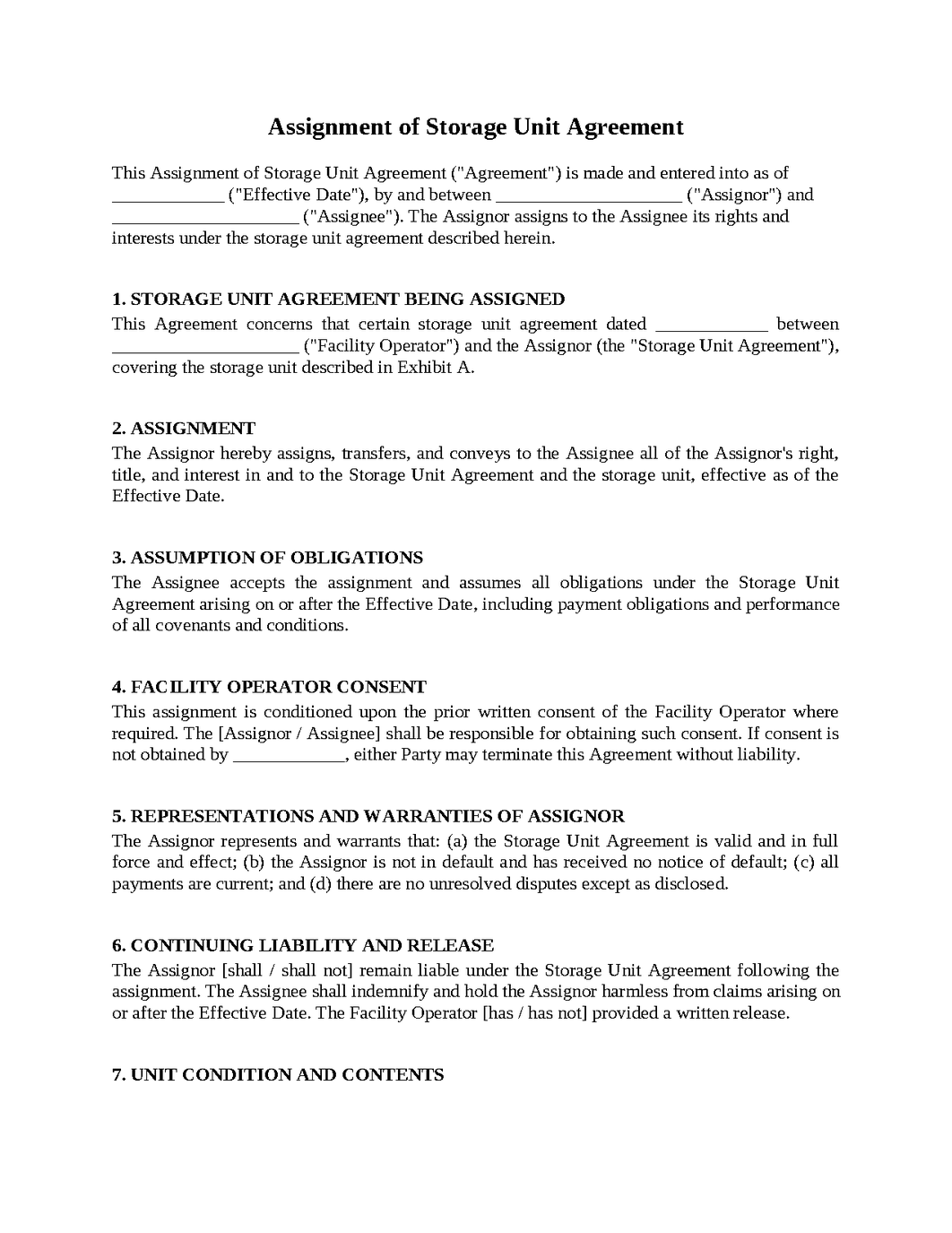
An Assignment of Storage Unit Agreement is a legal contract used when a renter transfers rights and obligations under a storage unit agreement to another person or business. The party transferring the storage rights is known as the assignor, while the party receiving those rights is known as the assignee. Storage unit assignments commonly occur when individuals relocate, businesses downsize, estates are administered, inventory is transferred, or ownership of stored property changes hands. Because storage facilities often impose strict rules regarding access, ownership, insurance, payment obligations, and prohibited items, disputes can arise when a storage agreement is transferred without proper documentation. An Assignment of Storage Unit Agreement helps establish who assumes responsibility for the storage unit and how future obligations will be allocated between the parties.
The Storage Unit Is Assigned Without Facility Approval
A small business leases a large storage unit to house excess inventory, equipment, and seasonal merchandise. After relocating to a larger warehouse, the business no longer needs the storage space but still has several months remaining under the rental agreement.
A neighboring business expresses interest in taking over the unit. The location is convenient, the rental rate is favorable, and both parties believe the arrangement will save time and money.
The businesses agree to transfer the unit and begin moving inventory. The new occupant starts using the space immediately and assumes the transaction is complete.
Several weeks later, facility management discovers that a different business is accessing the unit. A review of the rental agreement reveals that assignments require prior written approval from the storage company.
No approval was requested.
Facility management raises concerns regarding security procedures, insurance coverage, access rights, and compliance with facility rules. The storage company informs both parties that the transfer violates the rental agreement.
The assignee suddenly faces uncertainty regarding continued access to the stored inventory. The assignor risks default claims and may remain responsible for future obligations under the agreement.
To help avoid this problem, an Assignment of Storage Unit Agreement should clearly identify all facility approval requirements and make facility consent a condition of the assignment. The agreement should also establish which party is responsible for obtaining approval and what remedies are available if approval is denied.
The Assignee Discovers the Unit Contains Hidden Problems
A retailer assumes a storage unit agreement from another business that is closing operations.
The storage unit appears clean and functional during a brief inspection. The assignee is primarily interested in obtaining affordable storage space quickly and focuses little attention on the condition of the unit itself.
After taking possession, problems begin to emerge.
Evidence of prior water intrusion is discovered along one wall. Certain sections of the unit show signs of mold growth. Pest activity is identified in areas that had been hidden behind stored items.
The assignee becomes concerned because inventory placed in the unit may be exposed to damage.
Further investigation reveals that facility management had previously discussed moisture issues with the assignor. The assignee argues that these concerns should have been disclosed before the transfer occurred.
The assignor responds that the unit was accepted following an inspection and that no guarantees were made regarding the condition of the space.
The disagreement quickly escalates because protecting stored inventory is one of the primary reasons for leasing the unit.
To reduce these risks, an Assignment of Storage Unit Agreement should require disclosure of known defects, prior damage, environmental issues, pest concerns, and communications with facility management relating to the unit's condition.
The Original Renter Remains Responsible for Future Charges
A family assigns a storage unit agreement after moving across the country.
The assignee takes possession of the unit, updates access information, and begins making monthly payments. The assignor assumes all responsibilities ended when the transfer occurred.
Several years later, the assignee experiences financial difficulties and stops paying rent.
Late fees begin accumulating. The storage facility sends notices regarding unpaid charges and eventually initiates collection efforts.
The facility contacts the original renter.
The assignor is surprised to learn that the storage agreement still identifies the original renter as responsible unless formally released by the facility. No written release was ever obtained.
The assignor now faces collection demands and potential credit consequences despite having no access to or control over the storage unit.
The situation becomes increasingly frustrating because the assignor believed the assignment resolved all future obligations.
This issue occurs frequently because many renters assume an assignment automatically eliminates liability.
To avoid these problems, an Assignment of Storage Unit Agreement should address continuing liability directly. The agreement should require the assignee to indemnify the assignor against future claims and should identify whether the storage facility has released the assignor from ongoing obligations.
The Parties Disagree About What Property Was Included
A business assigns a storage unit agreement as part of a larger asset sale.
The buyer assumes that certain shelving systems, storage racks, security equipment, and packing materials located within the unit are included in the transfer.
The seller believes only the rental rights are being assigned.
Neither party addresses the issue clearly before closing.
After possession changes hands, disagreements arise regarding ownership of various items left inside the unit. Some property appears permanently installed, while other items could reasonably belong to either party.
The buyer refuses to return certain equipment. The seller claims valuable assets were never intended to be part of the transaction.
The dispute quickly becomes contentious because the combined value of the property is significant.
What should have been a simple assignment becomes a disagreement over ownership and possession of physical assets.
To help prevent these issues, an Assignment of Storage Unit Agreement should clearly identify whether any personal property, fixtures, equipment, shelving, inventory, or other items are included in the transfer. Detailed inventories can eliminate substantial confusion later.
A Security Breach Creates Unexpected Liability
An entrepreneur assumes a storage unit agreement that has been used to store business records, inventory, and equipment.
Several months after the assignment, a security incident occurs at the facility. Unauthorized individuals gain access to multiple units, including the assigned space.
As investigations begin, questions emerge regarding prior access credentials, gate codes, lock changes, and security procedures used before the assignment occurred.
The assignee argues that access controls were never updated properly after the transfer. The assignor insists that all necessary information was provided and that responsibility shifted to the assignee upon assignment.
The storage facility becomes involved because customers begin questioning its security practices.
Insurance companies, attorneys, and investigators all seek to determine whether the breach resulted from actions occurring before or after the transfer.
The resulting claims involve lost property, business interruption, and disputes regarding responsibility for the security failure.
To reduce these risks, an Assignment of Storage Unit Agreement should establish procedures for transferring access rights, changing security credentials, updating authorized users, and documenting possession of keys, access cards, gate codes, and other security mechanisms. The agreement should also allocate responsibility for security-related issues arising before and after the transfer.
Storage unit agreements are frequently transferred in both personal and business settings, particularly when property, inventory, or operational needs change. However, assigning a storage unit agreement can create significant challenges involving facility approvals, hidden defects, continuing liability, ownership of stored property, and security-related risks. An Assignment of Storage Unit Agreement provides a structured framework for documenting these transfers and clarifying expectations regarding future rights and obligations. When drafted carefully, it can help reduce disputes, protect stored property, and provide confidence regarding the successful transfer of storage unit rights and responsibilities.

Get started with Upsign today!
Easily send, sign and track your documents