

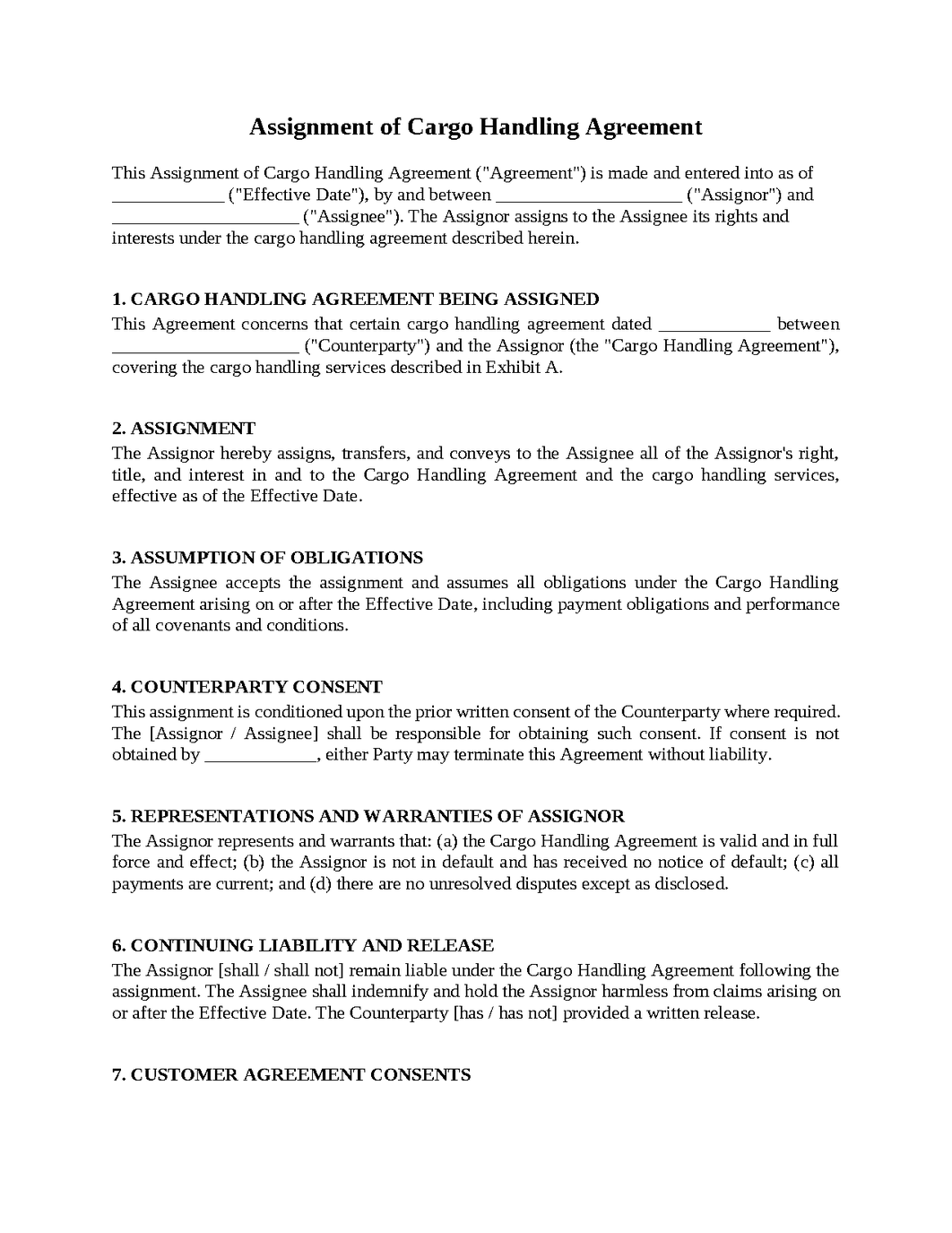
Assignment of Cargo Handling Agreement
An Assignment of Cargo Handling Agreement is a legal contract used when a party transfers its rights and obligations under a cargo handling agreement to another person or business. The party transferring the rights is known as the assignor, while the party receiving the rights is known as the assignee. Cargo handling agreements are commonly used by ports, terminal operators, stevedoring companies, shipping lines, freight forwarders, logistics providers, and warehouse operators. These agreements often govern the loading, unloading, storage, movement, inspection, and processing of cargo moving through transportation networks. Because cargo handling operations involve valuable goods, strict service requirements, safety regulations, customer commitments, and substantial liability exposure, disputes can arise when rights are transferred without careful planning. An Assignment of Cargo Handling Agreement helps establish who assumes responsibility for cargo handling operations and how future obligations will be allocated between the parties.
The Assignment Violates Customer Approval Requirements
A cargo handling company operates under a long-term agreement with several major importers and exporters at a busy port facility. The company decides to sell a division of its business and assign the cargo handling agreement to another operator.
The assignee has experience in logistics and appears capable of performing the required services. Both parties focus heavily on staffing transitions, equipment transfers, and operational continuity.
Shortly after the assignment closes, several customers object.
Their contracts contain provisions requiring approval before cargo handling responsibilities may be transferred to another company. Some customers selected the original operator because of its safety record, specialized equipment, and long-standing relationships with port personnel.
The customers argue that they never agreed to have their cargo handled by a different company.
Several large customers terminate their agreements and move their business elsewhere. Cargo volume declines sharply, revenue projections collapse, and the economics of the transaction change dramatically.
The assignee suddenly finds itself operating with far less business than expected.
To help avoid this problem, an Assignment of Cargo Handling Agreement should identify all customer agreements requiring consent and establish procedures for obtaining approvals before closing. The agreement should also address how customer relationships will be maintained and allocate responsibility if approvals cannot be secured.
The Assignee Inherits Unsafe Equipment
A logistics company assumes rights under a cargo handling agreement serving a regional shipping terminal.
The operation appears attractive because it includes cranes, forklifts, conveyors, and other equipment necessary to handle large cargo volumes. During site visits, the equipment appears functional and capable of supporting operations.
Several months after the assignment, safety issues begin emerging.
Equipment failures occur more frequently than expected. Maintenance records reveal a history of deferred repairs. Certain cranes require major upgrades to comply with safety standards, and several forklifts are approaching the end of their useful lives.
The assignee becomes concerned because equipment reliability directly affects operational performance and worker safety.
Unexpected repair costs begin accumulating. Cargo movement slows, employee productivity declines, and customer complaints increase as delays become more common.
The assignor argues that all equipment was available for inspection before the assignment. The assignee believes the extent of the maintenance problems should have been disclosed more clearly.
To reduce these risks, an Assignment of Cargo Handling Agreement should require disclosure of maintenance records, inspection reports, equipment deficiencies, pending repairs, and safety concerns. The agreement should also allocate responsibility for material equipment problems that existed before the transfer.
The Original Operator Remains Liable for Future Claims
A stevedoring company assigns a cargo handling agreement after exiting a particular port market.
The assignee successfully takes over operations and continues servicing customers without interruption. The assignor assumes that all obligations ended when the assignment became effective.
Several years later, a major cargo loss occurs.
Customers allege that cargo was mishandled, resulting in substantial financial damages. Multiple claims are filed against parties involved in the handling process.
To the assignor's surprise, attorneys begin pursuing claims against the original operator as well.
Certain contractual documents were never amended to release the assignor from future obligations. Some customers argue that the original operator remains responsible because it originally contracted to perform the services.
The assignor now faces legal expenses and potential liability for operations it has not controlled for years.
Management becomes frustrated because it believed the assignment fully transferred all responsibilities.
To avoid these problems, an Assignment of Cargo Handling Agreement should address continuing liability directly. The agreement should require the assignee to indemnify the assignor against future claims and should identify all contracts requiring amendments, releases, or customer acknowledgments before the assignment becomes effective.
Service Requirements Make the Business Unprofitable
A terminal services company acquires rights under a cargo handling agreement because historical financial statements suggest the operation generates attractive profits.
The assignee focuses primarily on revenue, labor costs, and cargo volumes. The transaction appears highly favorable based on available financial information.
After taking over operations, however, management discovers that the agreement contains demanding service obligations.
Cargo must be unloaded within strict timeframes. Certain vessels receive priority treatment. Delays trigger contractual penalties. Staffing levels must remain available around the clock to satisfy customer commitments.
The prior operator maintained these service levels by investing heavily in labor, equipment redundancy, and overtime resources.
The assignee quickly realizes that meeting contractual requirements is significantly more expensive than expected.
Profit margins shrink as additional employees are hired, maintenance budgets increase, and operational investments become necessary.
What initially appeared to be a highly profitable business produces far lower returns than anticipated.
To help prevent these problems, an Assignment of Cargo Handling Agreement should require disclosure of service standards, performance guarantees, penalty provisions, staffing requirements, and operational commitments. Understanding these obligations before closing can dramatically affect the value of the transaction.
Cargo Damage Claims Create a Major Dispute
A cargo services provider assumes operation of a handling facility that processes thousands of shipments each month.
The transition occurs rapidly because all parties want to avoid disruptions to shipping schedules. Cargo already moving through the facility remains in process while operational control changes hands.
Several months after the assignment, customers begin reporting damaged cargo.
Some shipments arrive with visible damage. Others contain shortages or discrepancies. Investigations reveal inconsistencies in handling records and cargo inspection reports.
The assignee argues that certain problems originated before the assignment occurred and that damaged cargo was already in the system when operational control changed hands.
The assignor insists that cargo conditions were documented accurately before the transfer and that any new damage occurred afterward.
The dispute escalates as customers file claims seeking reimbursement for losses. Insurance carriers become involved, and attorneys begin reviewing operational records, inspection reports, and transition documentation.
The financial exposure becomes substantial because the value of the damaged cargo is significant.
To reduce these risks, an Assignment of Cargo Handling Agreement should establish detailed cargo verification procedures before closing, require documentation of cargo condition during the transition, allocate responsibility for cargo already in process, and provide clear rules governing claims discovered after the transfer. These provisions can significantly reduce uncertainty when cargo damage disputes arise.
Cargo handling operations play a critical role in global transportation and supply chains by ensuring goods move efficiently between ships, terminals, warehouses, trucks, and rail systems. Because these operations involve valuable cargo, strict service obligations, safety requirements, regulatory compliance, and substantial liability exposure, assigning rights under a cargo handling agreement can create significant risks. An Assignment of Cargo Handling Agreement provides a structured framework for documenting these transfers and clarifying expectations regarding future rights and obligations. When drafted carefully, it can help reduce disputes, protect customer relationships, maintain operational continuity, and support a successful transition of cargo handling responsibilities.

Get started with Upsign today!
Easily send, sign and track your documents