

Assignment of Distribution Center Agreement
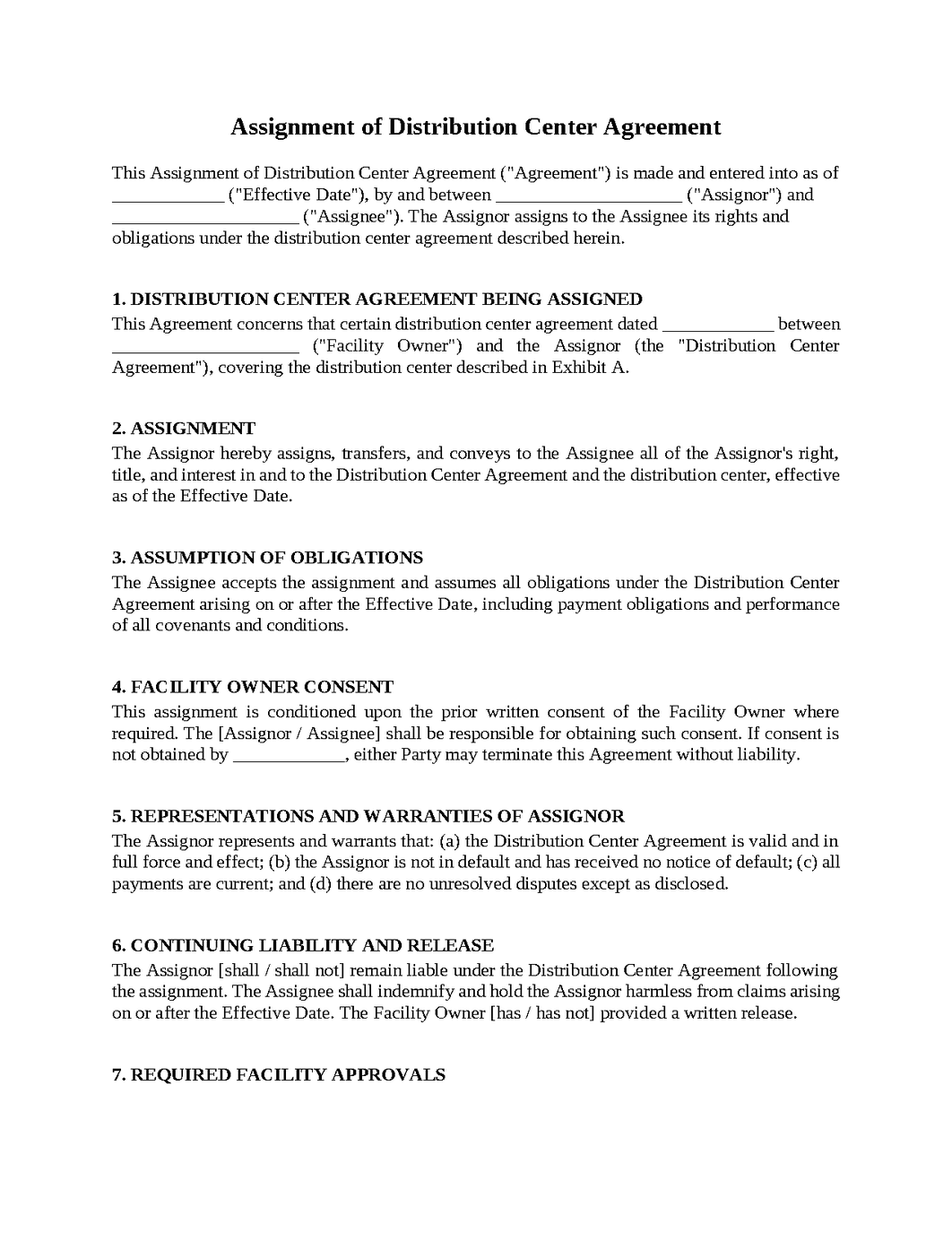
An Assignment of Distribution Center Agreement is a legal contract used when a party transfers its rights and obligations under a distribution center agreement to another person or business. The party transferring the rights is known as the assignor, while the party receiving the rights is known as the assignee. Distribution center assignments commonly occur during mergers, acquisitions, supply chain reorganizations, logistics outsourcing arrangements, business sales, and operational restructurings. Because distribution centers often serve as critical hubs for inventory management, order fulfillment, transportation coordination, and customer delivery operations, transferring rights associated with a distribution center can involve substantial operational and financial risks. Disputes frequently arise regarding landlord approvals, service commitments, infrastructure capabilities, inventory handling obligations, and ongoing liability. An Assignment of Distribution Center Agreement helps establish who assumes responsibility for the facility and what rights and obligations transfer as part of the assignment.
The Assignment Occurs Without Required Facility Approval
A national retailer leases a large distribution center that supports regional fulfillment operations. The facility is strategically located near major transportation routes and serves thousands of customers each week.
After implementing a new logistics strategy, the retailer decides to consolidate operations into fewer facilities. Rather than terminate the agreement, the company identifies another business interested in assuming the distribution center rights.
The parties negotiate quickly because both view the arrangement as beneficial. The assignor can reduce operating expenses, while the assignee gains immediate access to a fully operational logistics facility.
Inventory begins arriving shortly after the transfer. Employees are hired, shipping schedules are established, and the assignee starts processing orders.
Several weeks later, the property owner discovers the operational change. Upon reviewing the governing agreements, the owner identifies provisions requiring prior written approval before any assignment may occur.
No approval was obtained.
The owner raises concerns regarding the assignee's financial stability, operational capabilities, insurance coverage, and compliance history. Questions arise regarding whether the assignee meets the qualifications originally required for occupancy.
The assignee suddenly faces uncertainty regarding continued access to a facility that has already become central to daily operations.
To help avoid this problem, an Assignment of Distribution Center Agreement should clearly identify all required approvals and make those approvals a condition of the assignment. The agreement should also establish responsibility for obtaining approvals and specify what happens if consent cannot be secured.
The Assignee Inherits Infrastructure Problems
An e-commerce company assumes rights under a distribution center agreement because the facility appears ideal for expanding fulfillment operations.
The building contains loading docks, storage systems, conveyor equipment, and warehouse management infrastructure. During initial walkthroughs, everything appears functional and suitable for immediate use.
Shortly after operations begin, significant problems emerge.
Conveyor systems experience repeated failures. Loading dock equipment requires major repairs. Portions of the warehouse management technology are outdated and incompatible with the assignee's systems.
As technicians investigate, they discover that many of these issues existed before the assignment occurred. Internal maintenance records reveal a history of deferred repairs and recurring equipment failures.
The assignee becomes frustrated.
Customer shipments are delayed, labor costs increase, and operational efficiency declines. Instead of accelerating growth, the company spends significant resources addressing inherited infrastructure problems.
The assignor argues that the facility was available for inspection and that no guarantees were made regarding future performance.
To reduce these risks, an Assignment of Distribution Center Agreement should require disclosure of maintenance records, equipment condition reports, technology limitations, deferred repairs, and known operational deficiencies. The agreement should also allocate responsibility for pre-existing infrastructure issues discovered after the transfer.
The Original Operator Remains Liable for Future Obligations
A third-party logistics provider assigns its distribution center agreement after losing a major customer and restructuring operations.
The assignee takes over the facility and successfully operates from the location for several years. The assignor assumes the transaction eliminated all future obligations.
Eventually, however, the assignee experiences financial difficulties and defaults on rent, service fees, and maintenance obligations.
The facility owner immediately contacts the original operator.
Management is surprised.
Although the assignor has not used the facility for years, the underlying agreement provides that the original party remains responsible unless formally released. No release was obtained during the assignment process.
The assignor now faces substantial exposure involving unpaid rent, repair obligations, common area charges, and legal expenses.
The financial impact is significant because distribution centers often involve large facilities and long-term contractual commitments.
The assignor becomes frustrated because it no longer controls the facility yet remains exposed to liabilities created by another business.
To avoid these problems, an Assignment of Distribution Center Agreement should clearly address continuing liability. The agreement should require the assignee to indemnify the assignor against future claims and should identify whether the facility owner has released the assignor from ongoing obligations.
Service-Level Commitments Create Unexpected Problems
A fulfillment company assumes rights under a distribution center agreement that supports multiple large retail customers.
The assignee focuses primarily on facility costs, location advantages, and available warehouse capacity. Little attention is given to the service commitments associated with the operation.
After taking over the facility, the assignee discovers that the existing agreements require strict performance standards. Orders must be processed within specific timeframes. Inventory accuracy targets must be maintained. Delivery performance metrics are subject to contractual penalties.
The assignee quickly realizes that achieving these standards will require significantly more staffing and technology investment than anticipated.
Several customer contracts begin generating penalty charges because service levels are missed during the transition period.
The economics of the transaction change dramatically.
What initially appeared to be an attractive opportunity becomes much more expensive due to operational obligations that were not fully understood.
To help prevent these disputes, an Assignment of Distribution Center Agreement should require disclosure of service-level commitments, customer performance standards, operational benchmarks, penalty provisions, and other obligations that may materially affect future operations.
Inventory Losses Lead to a Major Dispute
A distribution company assumes operation of a large fulfillment facility that contains significant customer inventory.
The transition occurs quickly because both parties want to avoid disruptions in customer service.
Shortly after taking control, inventory discrepancies begin appearing. Certain products cannot be located. Inventory counts do not match system records. Several customers report missing shipments.
An investigation is launched.
The assignee argues that inventory problems originated before the assignment occurred and that inaccurate records were inherited from the assignor. The assignor insists that inventory was transferred accurately and that losses occurred after possession changed hands.
The dispute grows increasingly serious because customer relationships are affected and the value of the missing inventory is substantial.
Auditors, attorneys, insurers, and customers all become involved.
What began as a routine operational transition evolves into a costly disagreement regarding accountability for inventory losses.
To reduce these risks, an Assignment of Distribution Center Agreement should establish detailed inventory verification procedures, require joint audits before closing, document inventory levels carefully, and allocate responsibility for discrepancies discovered after the transfer.
Distribution centers play a critical role in modern supply chains and often serve as essential infrastructure for inventory management, fulfillment, and customer service operations. However, assigning rights associated with a distribution center can create significant challenges involving approvals, facility condition, service commitments, inventory accountability, and continuing liability. An Assignment of Distribution Center Agreement provides a structured framework for documenting these transfers and clarifying expectations regarding future rights and obligations. When drafted carefully, it can help reduce disputes, protect operational continuity, and provide confidence regarding the successful transfer of distribution center responsibilities and benefits.

Get started with Upsign today!
Easily send, sign and track your documents