

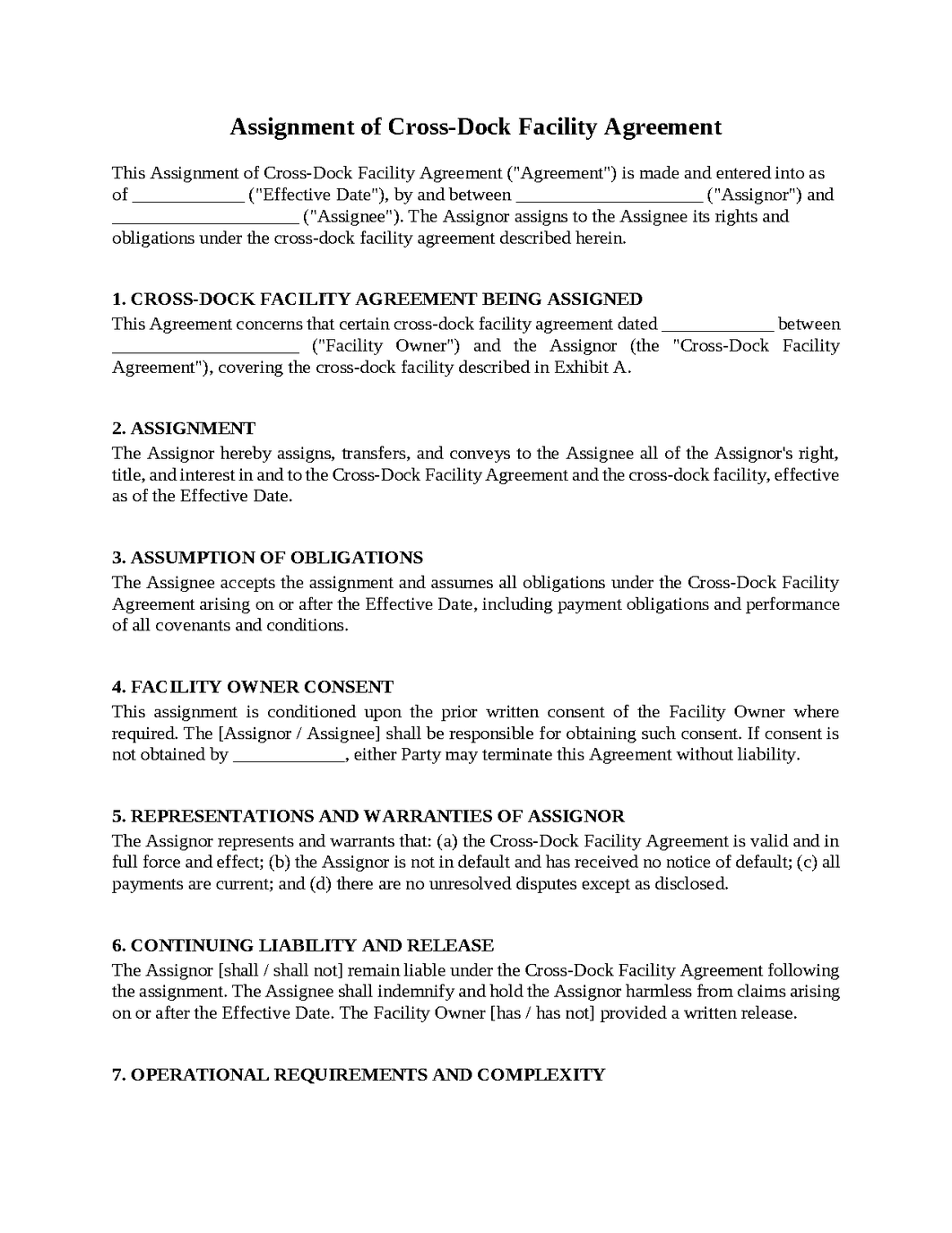
Assignment of Cross-Dock Facility Agreement
An Assignment of Cross-Dock Facility Agreement is a legal contract used when a party transfers its rights and obligations under a cross-dock facility agreement to another person or business. The party transferring the rights is known as the assignor, while the party receiving those rights is known as the assignee. Cross-dock facility assignments commonly occur during logistics acquisitions, transportation restructurings, supply chain consolidations, third-party logistics transitions, and business sales. Unlike traditional warehousing operations, cross-dock facilities are designed to move goods rapidly from inbound transportation to outbound transportation with minimal storage time. Because these facilities depend on precise scheduling, transportation coordination, labor availability, technology integration, and customer service commitments, assigning rights under a cross-dock facility agreement can create substantial operational and financial risks. An Assignment of Cross-Dock Facility Agreement helps establish who assumes responsibility for the facility and how future obligations will be allocated between the parties.
The Assignee Underestimates the Operational Complexity
A regional transportation company decides to acquire rights under a cross-dock facility agreement from another logistics provider that is exiting a particular market.
The facility appears attractive because it generates substantial revenue and serves several large customers. Management believes the operation is similar to a traditional warehouse and expects the transition to be relatively straightforward.
After taking over the facility, however, the assignee quickly discovers that cross-dock operations require an entirely different level of coordination. Inbound trucks must arrive within narrow delivery windows. Outbound shipments depend on precise timing. Labor resources must be available exactly when freight arrives.
Small disruptions create immediate consequences.
A delayed inbound truck can cause multiple outbound loads to miss departure schedules. Customer deliveries begin arriving late, transportation costs increase, and service failures multiply. The facility that appeared highly profitable now requires significantly more operational expertise than anticipated.
The assignor argues that operational information was available during due diligence. The assignee responds that the complexity of the operation was never fully explained.
To help avoid these problems, an Assignment of Cross-Dock Facility Agreement should require disclosure of operational requirements, scheduling dependencies, staffing models, service expectations, customer commitments, and historical performance metrics. The agreement should also include detailed transition assistance provisions to help the assignee assume operations successfully.
The Assignee Inherits Technology Systems That Cannot Support Operations
A logistics company assumes rights under a cross-dock facility agreement serving several national retailers.
The facility relies heavily on transportation management software, barcode scanning systems, shipment tracking technology, and customer reporting platforms. During negotiations, the systems appear functional and capable of supporting daily operations.
Shortly after the assignment closes, significant problems begin emerging.
Key software integrations fail repeatedly. Shipment visibility becomes unreliable. Customer reports contain inaccurate information. Several technology platforms depend on legacy systems maintained by vendors whose contracts are nearing expiration.
The assignee learns that major software upgrades are required immediately.
Implementation costs exceed initial expectations, and disruptions affect customer service. Shipment errors increase, operational efficiency declines, and customer confidence begins to erode.
The economics of the transaction change dramatically because technology investments that were not anticipated become unavoidable.
To reduce these risks, an Assignment of Cross-Dock Facility Agreement should require disclosure of technology infrastructure, software dependencies, support agreements, cybersecurity concerns, integration requirements, and anticipated upgrade costs. The agreement should also address responsibility for known system deficiencies that exist before the assignment occurs.
The Original Operator Remains Responsible for Customer Claims
A national logistics provider assigns a cross-dock facility agreement after restructuring its transportation network.
The assignee takes over operations successfully and begins serving the same customers. The assignor assumes that all obligations associated with the facility ended when the transfer was completed.
Several years later, significant customer disputes arise involving lost freight, damaged shipments, and service failures.
Customers begin reviewing historical agreements and determining who may be responsible for the losses. To the assignor's surprise, several claims are directed toward the original operator as well.
Certain customer agreements were never amended properly. Some contracts continue identifying the assignor as a responsible party for services performed through the facility.
The assignor now faces legal expenses and potential liability for operations it no longer controls.
Management becomes frustrated because the facility was transferred years earlier, yet contractual exposure continues to exist.
To avoid these problems, an Assignment of Cross-Dock Facility Agreement should clearly address continuing liability. The agreement should require the assignee to indemnify the assignor against future claims and should identify all customer agreements that require amendment, consent, or release before the assignment becomes effective.
Hidden Service-Level Requirements Destroy Profitability
A transportation company acquires rights under a cross-dock facility agreement because the operation appears highly profitable based on historical financial statements.
The assignee focuses on revenue, facility costs, and transportation volumes. The transaction appears to offer substantial growth opportunities.
After assuming operations, management discovers that several major customers operate under strict service-level agreements.
Freight must be processed within specific timeframes. Certain shipments require guaranteed transfer windows measured in hours rather than days. Failure to meet performance metrics results in financial penalties and customer chargebacks.
The prior operator invested heavily in staffing, automation, and transportation capacity to maintain these standards.
The assignee quickly realizes that meeting customer expectations is far more expensive than anticipated. Additional labor must be hired, transportation schedules must be expanded, and technology investments become necessary.
Margins shrink significantly.
What initially appeared to be a highly profitable operation now produces far lower returns because the true cost of meeting customer requirements was underestimated.
To help prevent these issues, an Assignment of Cross-Dock Facility Agreement should require disclosure of customer service-level commitments, penalty provisions, performance guarantees, operational benchmarks, and staffing requirements. Understanding these obligations before closing can dramatically affect the value of the transaction.
Freight Accountability Problems Lead to Major Losses
A third-party logistics company assumes operation of a cross-dock facility handling freight for numerous customers.
The transition occurs quickly because both parties want to avoid interruptions in transportation services.
Several months after the assignment, freight discrepancies begin appearing. Shipments cannot be located. Delivery records contain inconsistencies. Customers report missing inventory and delayed deliveries.
An investigation is launched.
The assignee argues that inventory control problems and tracking inaccuracies existed before the assignment occurred. The assignor insists that freight records were accurate at the time of transfer and that any losses occurred afterward.
The dispute grows increasingly serious because customers are affected directly. Lost freight claims begin accumulating, insurance carriers become involved, and customer relationships deteriorate.
The financial consequences quickly become substantial.
What began as a routine assignment evolves into a major dispute involving freight accountability, customer claims, insurance coverage, and operational failures.
To reduce these risks, an Assignment of Cross-Dock Facility Agreement should require detailed shipment audits before closing, establish reconciliation procedures for freight in transit, document customer inventory carefully, and allocate responsibility for discrepancies discovered after the transfer. Clear accountability procedures can significantly reduce disputes when freight losses occur.
Cross-dock facilities play a critical role in modern transportation networks by enabling the rapid movement of goods between suppliers, carriers, and customers. Because these operations depend on precise coordination, advanced technology, strict service standards, and accurate freight management, assigning rights under a cross-dock facility agreement can create substantial operational and legal risks. An Assignment of Cross-Dock Facility Agreement provides a structured framework for documenting these transfers and clarifying expectations regarding future rights and obligations. When drafted carefully, it can help reduce disputes, protect customer relationships, maintain operational continuity, and support a successful transition of cross-dock facility operations.

Get started with Upsign today!
Easily send, sign and track your documents