

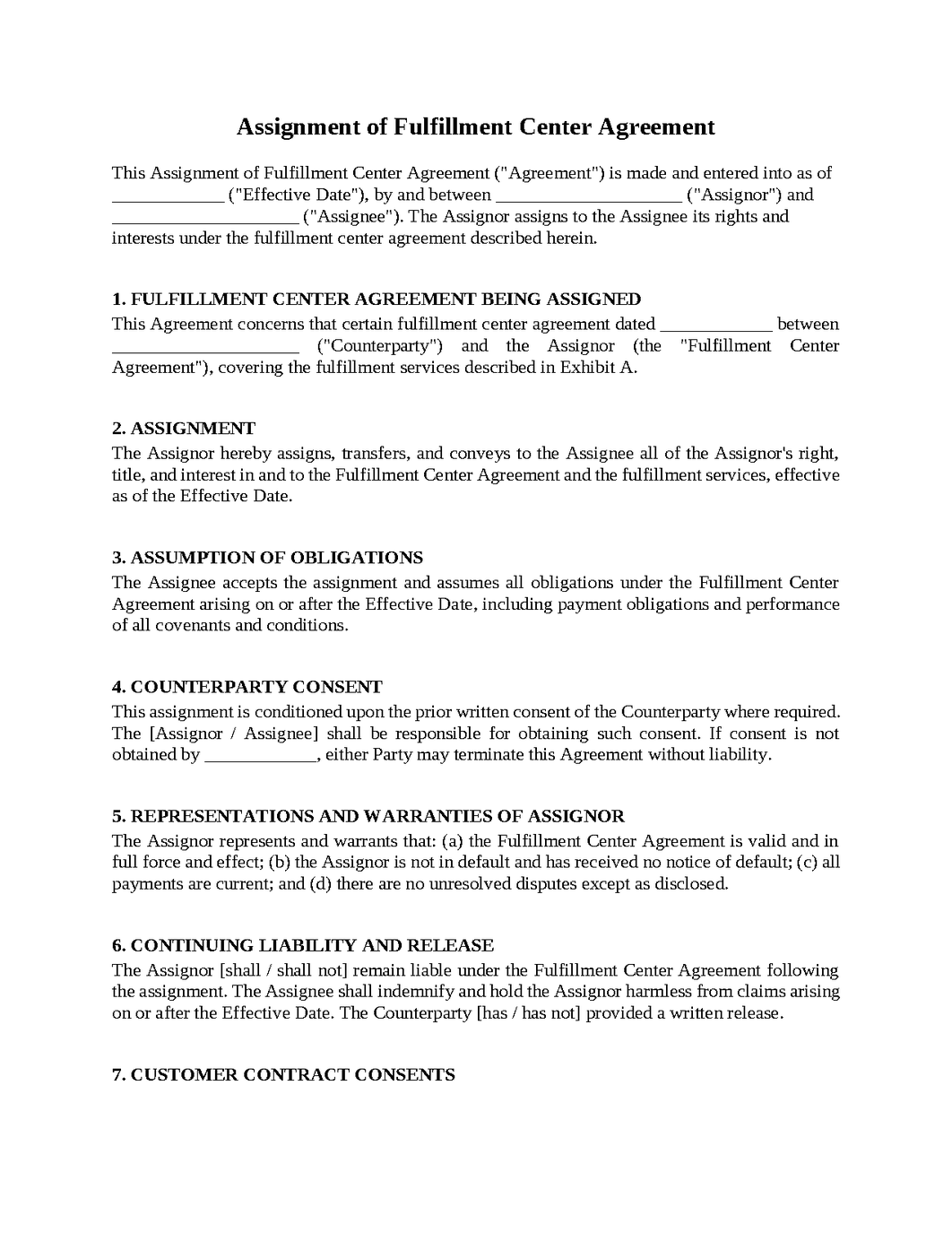
Assignment of Fulfillment Center Agreement
An Assignment of Fulfillment Center Agreement is a legal contract used when a party transfers its rights and obligations under a fulfillment center agreement to another person or business. The party transferring the rights is known as the assignor, while the party receiving those rights is known as the assignee. Fulfillment center assignments commonly occur during business acquisitions, e-commerce platform sales, logistics outsourcing transactions, supply chain restructurings, and corporate reorganizations. Because fulfillment centers serve as the operational backbone for inventory storage, order processing, packaging, shipping, returns management, and customer service commitments, transferring fulfillment center rights can involve significant operational and financial risks. Disputes frequently arise regarding service obligations, inventory accuracy, technology systems, customer commitments, facility approvals, and ongoing liability. An Assignment of Fulfillment Center Agreement helps establish who assumes responsibility for the fulfillment operation and what rights and obligations transfer as part of the assignment.
The Assignment Happens Without Customer Approval
An e-commerce company operates a fulfillment center that handles order processing and shipping for dozens of online brands. The company decides to exit the logistics business and transfer the fulfillment operation to another provider.
The assignee has experience managing warehouses and appears capable of handling the operational workload. Both parties focus heavily on inventory transfers, staffing plans, and technology integration.
After the assignment closes, customers begin receiving notices that a new company is operating the fulfillment center.
Several major clients immediately object.
Their service agreements contain provisions requiring prior approval before fulfillment responsibilities can be transferred to another provider. Some customers selected the original company because of its reputation, technology platform, and operational capabilities.
The clients argue that they never agreed to have a different provider handle their inventory and customer orders.
Several customers terminate their contracts and move their business elsewhere. Revenue projections collapse, and the assignee loses a significant portion of the customer base that justified the transaction.
What appeared to be a valuable operational acquisition suddenly becomes a struggling business.
To help avoid this problem, an Assignment of Fulfillment Center Agreement should identify customer contracts that require consent, establish procedures for obtaining approvals, and clearly allocate responsibility if customers refuse to authorize the transfer. The agreement should also address communication strategies to maintain customer confidence during the transition.
The Assignee Inherits Broken Fulfillment Technology
A growing third-party logistics provider assumes operation of a fulfillment center serving several rapidly expanding online retailers.
The facility appears modern and efficient. Automated packing stations, barcode systems, shipping integrations, and warehouse management software are already in place.
Because the technology appears functional during demonstrations, the assignee focuses more attention on facility economics than on system architecture.
Within weeks of taking over operations, major issues emerge.
Inventory synchronization problems begin affecting order accuracy. Shipping integrations fail intermittently. Customer portals generate incorrect inventory counts. Returns processing becomes increasingly unreliable.
Technology consultants discover that many systems rely on custom software developed years earlier by contractors who are no longer available. Documentation is incomplete, support contracts have expired, and critical infrastructure is nearing obsolescence.
The assignee now faces substantial technology replacement costs that were never included in the acquisition model.
Order delays increase, customer complaints grow, and profitability declines.
To reduce these risks, an Assignment of Fulfillment Center Agreement should require disclosure of software architecture, technology dependencies, support agreements, known system limitations, cybersecurity concerns, and upcoming replacement requirements. The agreement should also provide remedies if material technology issues were not disclosed before closing.
The Original Operator Remains Responsible for Future Claims
A fulfillment provider assigns its fulfillment center agreement after selling a business division.
The assignee takes over operations successfully and continues serving customers from the facility. The assignor assumes that all responsibilities ended when the transfer occurred.
Several years later, the assignee experiences financial difficulties and begins missing service commitments. Inventory losses increase, customer complaints multiply, and contract disputes emerge.
Several customers file claims relating to missing products and shipping errors.
To the assignor's surprise, attorneys begin contacting the original operator as well.
Certain customer agreements and facility contracts were never amended to release the assignor from future liability. Some customers continue arguing that the original provider remains responsible because it originally contracted for the services.
The assignor now faces legal expenses and potential exposure arising from operations it no longer controls.
Management becomes frustrated because the business division was sold years earlier, yet legal risk continues to follow the company.
To avoid these problems, an Assignment of Fulfillment Center Agreement should address continuing liability explicitly. The agreement should require the assignee to indemnify the assignor for future claims and should identify any customer contracts, facility agreements, or vendor relationships that require amendments or releases before the transfer becomes effective.
Service-Level Guarantees Become a Financial Burden
A logistics company acquires rights under a fulfillment center agreement that serves several high-volume e-commerce brands.
Management focuses primarily on facility size, customer count, and revenue opportunities. The transaction appears highly attractive based on historical financial performance.
After closing, however, the assignee learns that the fulfillment center operates under strict service-level commitments.
Orders must ship within specified timeframes. Inventory accuracy rates must exceed demanding thresholds. Returns must be processed within narrow windows. Failure to meet these standards triggers financial penalties.
The previous operator invested heavily in labor, automation, and quality control systems to achieve these results.
The assignee quickly realizes that maintaining the required service levels is significantly more expensive than expected.
Margins shrink as additional staffing is hired, technology upgrades are implemented, and operational controls are expanded.
The fulfillment center remains busy but far less profitable than anticipated.
To help prevent these issues, an Assignment of Fulfillment Center Agreement should require disclosure of service-level agreements, customer performance guarantees, penalty provisions, operational benchmarks, and staffing requirements. Understanding these obligations before closing can dramatically improve decision-making.
Inventory Losses Trigger Customer Lawsuits
A national fulfillment provider assumes operation of a fulfillment center containing inventory owned by numerous customers.
The transition occurs rapidly because all parties want to avoid disrupting order fulfillment during peak sales season.
Several months after the assignment, inventory discrepancies begin appearing.
Customer records indicate thousands of units should be available, but physical counts reveal significant shortages. Certain products cannot be located. Others appear to have been misclassified or shipped incorrectly.
Large customers begin demanding answers.
The assignee argues that inaccurate inventory records existed before the transfer and that shortages originated during the assignor's management period. The assignor insists that inventory counts were accurate when possession changed hands.
Independent auditors are retained.
Customers threaten litigation because inventory losses affect their ability to fulfill orders and generate revenue.
The financial exposure becomes substantial as inventory values, customer claims, and legal expenses continue growing.
To reduce these risks, an Assignment of Fulfillment Center Agreement should require comprehensive inventory audits before closing, establish detailed reconciliation procedures, document inventory ownership carefully, and allocate responsibility for discrepancies discovered after the transfer. These provisions can significantly reduce uncertainty when inventory-related disputes arise.
Fulfillment centers are among the most operationally complex facilities in modern commerce. They often combine inventory management, technology systems, customer service commitments, transportation coordination, and supply chain execution within a single operation. As a result, assigning rights under a fulfillment center agreement can create significant challenges involving customer approvals, technology infrastructure, service-level obligations, inventory accountability, and continuing liability. An Assignment of Fulfillment Center Agreement provides a structured framework for documenting these transfers and clarifying expectations regarding future rights and responsibilities. When drafted carefully, it can help reduce disputes, preserve customer relationships, protect operational continuity, and support a successful transition of fulfillment center operations.

Get started with Upsign today!
Easily send, sign and track your documents