

Assignment of Rail Yard Agreement
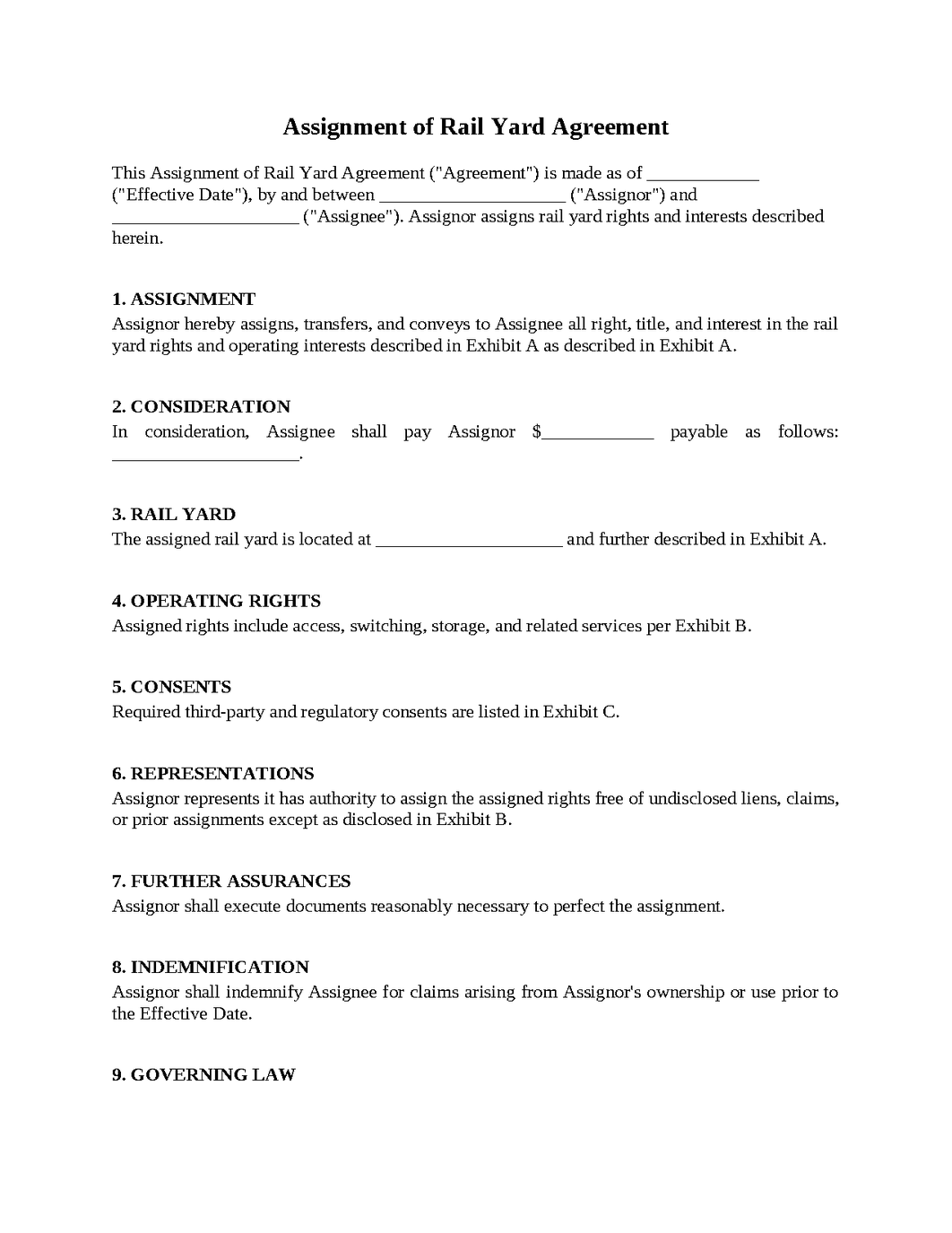
An Assignment of Rail Yard Agreement is a legal contract used when a party transfers its rights and obligations under a rail yard agreement to another person or business. The party transferring the rights is known as the assignor, while the party receiving the rights is known as the assignee. Rail yard agreements are commonly used by rail carriers, freight operators, logistics companies, intermodal providers, industrial facilities, and transportation infrastructure operators. Rail yards serve as critical hubs where railcars are assembled, disassembled, stored, inspected, repaired, loaded, unloaded, and routed throughout transportation networks. Because rail yard operations involve substantial infrastructure, regulatory oversight, safety obligations, carrier relationships, and operational commitments, transferring rights under a rail yard agreement can create significant legal and financial risks. An Assignment of Rail Yard Agreement helps establish who assumes responsibility for the rail yard and how future obligations will be allocated among the parties.
The Assignment Disrupts Critical Railroad Relationships
A regional transportation company operates a rail yard under a long-term operating agreement with several rail carriers. The yard serves as a key interchange point where freight is transferred between rail networks and local customers.
As part of a corporate restructuring, the company decides to assign its rail yard agreement to another logistics provider. The assignee has experience in transportation operations and believes the yard will provide a valuable opportunity for growth.
The parties devote considerable attention to staffing, equipment transfers, and operational continuity. Management assumes that once the agreement is assigned, existing rail traffic will continue flowing through the facility without interruption.
Shortly after the assignment closes, however, several rail carriers raise objections. Existing operating arrangements require carrier approval before another operator may assume control of yard activities. Some carriers have long-standing relationships with the original operator and are reluctant to transition critical operations to an unfamiliar company.
As concerns grow, carriers begin routing certain traffic through alternative facilities. Planned rail movements are delayed, and freight volumes decline significantly.
The assignee quickly realizes that the rail yard's value depends not only on physical infrastructure but also on the relationships and operating rights that support daily operations. Without those relationships, the economics of the transaction deteriorate rapidly.
To help avoid this problem, an Assignment of Rail Yard Agreement should identify all carrier agreements, interchange rights, access permissions, and operational approvals that may affect continued use of the facility. The agreement should establish procedures for obtaining required consents and allocate responsibility if key railroad relationships cannot be transferred successfully.
The Assignee Discovers the Yard Requires Massive Capital Improvements
A logistics company assumes rights under a rail yard agreement because the facility appears strategically located and capable of supporting future growth.
During preliminary inspections, rail tracks appear functional, switching equipment is operational, and daily yard activities continue without major disruption. The assignee views the facility as a cost-effective way to expand transportation services.
Several months after assuming control, engineering reviews reveal significant problems.
Sections of track require replacement. Drainage systems have deteriorated. Switching equipment is nearing the end of its useful life. Lighting systems, communications infrastructure, and safety barriers require substantial upgrades.
Further investigation uncovers internal reports documenting these issues years earlier. Capital improvement projects had been deferred repeatedly because of budget constraints.
The assignee becomes frustrated because the anticipated growth investment now must compete with millions of dollars in infrastructure repairs.
Expansion plans are delayed while management evaluates how to fund necessary improvements. Customers experience service disruptions, and operating costs increase as temporary solutions are implemented.
What initially appeared to be a valuable transportation asset now requires far greater investment than anticipated.
To reduce these risks, an Assignment of Rail Yard Agreement should require disclosure of engineering studies, maintenance records, capital improvement plans, deferred repair projects, and infrastructure assessments. These disclosures can help ensure the assignee understands the facility's true condition before completing the assignment.
The Original Operator Remains Liable for Future Yard Obligations
A freight transportation company assigns a rail yard agreement after exiting a geographic market.
The assignee takes over operations successfully and manages the facility for several years. Rail traffic continues moving through the yard, customer relationships remain stable, and the assignor assumes all responsibilities ended when the assignment became effective.
Eventually, however, the assignee encounters financial difficulties and begins falling behind on obligations. Maintenance projects are delayed, contractual commitments are missed, and disputes arise with facility owners and transportation partners.
Several parties begin reviewing the underlying agreements.
To the assignor's surprise, certain contractual provisions still identify the original operator as a responsible party. Required releases were never obtained, and some counterparties never formally consented to the transfer.
The assignor now faces potential liability for obligations created years after the assignment occurred.
Management becomes frustrated because the company no longer controls the rail yard and has no practical ability to influence operations.
The legal expenses associated with resolving ownership and liability questions become substantial.
To avoid these problems, an Assignment of Rail Yard Agreement should address continuing liability explicitly. The agreement should require the assignee to indemnify the assignor against future claims and identify all parties whose releases or acknowledgments are necessary to eliminate ongoing exposure.
Safety and Regulatory Problems Surface After the Transfer
A transportation operator assumes control of a rail yard that handles significant freight traffic each day.
The facility appears active and productive, and management focuses primarily on customer demand, rail volumes, and operational opportunities. Regulatory compliance receives less attention during the transaction process.
Several months after the assignment, regulators conduct a routine inspection.
The inspection identifies deficiencies involving track inspections, employee training documentation, switching procedures, and equipment maintenance records. Some issues appear to have existed before the assignment occurred.
Regulators begin requesting historical information and reviewing prior operating practices.
The assignee becomes concerned because rail yard compliance issues can lead to fines, operational restrictions, and reputational damage. Customers begin asking questions about safety practices, and management must devote substantial resources to corrective actions.
The assignor argues that no active enforcement action existed when the transfer occurred. The assignee believes the compliance concerns should have been disclosed before closing.
To reduce these risks, an Assignment of Rail Yard Agreement should require disclosure of regulatory inspections, safety audits, compliance concerns, enforcement actions, accident histories, and operational deficiencies. The agreement should also allocate responsibility for violations originating before the transfer date.
A Rail Accident Leads to Years of Litigation
A logistics company assumes operation of a busy rail yard that serves multiple industries and transportation partners.
For many months, operations proceed normally. Freight volumes remain strong, railcars move efficiently through the facility, and the assignment appears successful.
Then a serious accident occurs.
A switching incident causes multiple railcars to derail within the yard. Property damage is extensive, operations are disrupted, and several customers suffer shipment delays. Investigators immediately begin examining the cause of the accident.
As the investigation unfolds, questions arise regarding track conditions, maintenance records, employee training programs, and prior safety concerns. Evidence suggests that some infrastructure issues may have existed before the assignment occurred.
The assignee argues that hidden maintenance deficiencies contributed to the derailment. The assignor insists that the facility met applicable requirements when operational control changed hands.
Regulators, insurers, rail carriers, customers, and attorneys all become involved.
The resulting litigation continues for years as the parties attempt to determine responsibility for damages, operational interruptions, and regulatory penalties.
To help avoid these situations, an Assignment of Rail Yard Agreement should require disclosure of maintenance histories, safety concerns, accident records, engineering evaluations, and known infrastructure issues. The agreement should also clearly allocate liability for conditions existing before and after the transfer and establish indemnification procedures for future claims.
Rail yards are essential components of freight transportation networks and often represent significant operational, financial, and strategic assets. Because these facilities involve complex infrastructure, carrier relationships, safety obligations, regulatory oversight, and substantial capital investment, assigning rights under a rail yard agreement can create significant challenges. An Assignment of Rail Yard Agreement provides a structured framework for documenting these transfers and clarifying expectations regarding future rights and responsibilities. When drafted carefully, it can help reduce disputes, preserve transportation relationships, maintain operational continuity, and support a successful transition of rail yard operations.

Get started with Upsign today!
Easily send, sign and track your documents