

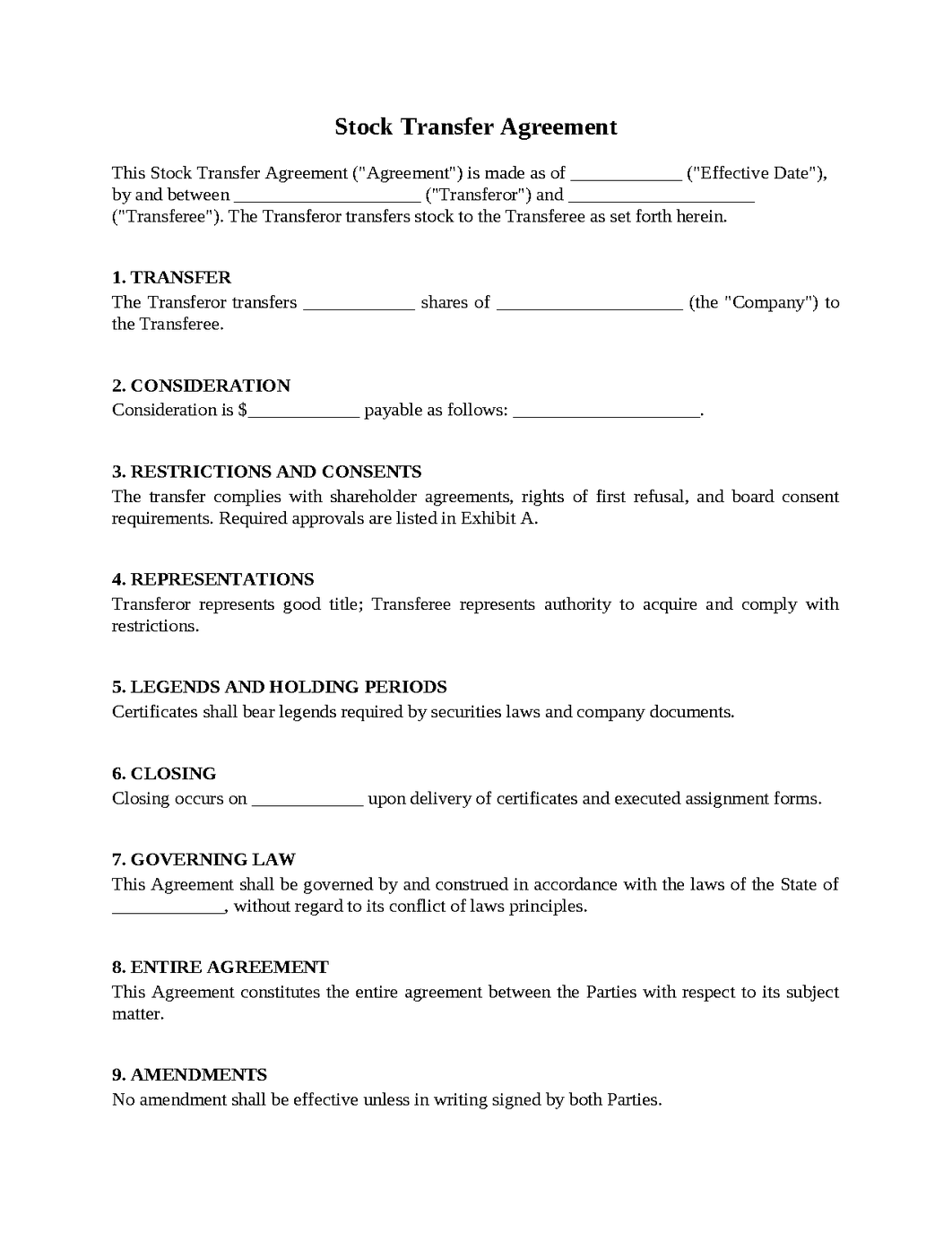
Stock Transfer Agreement
A Stock Transfer Agreement is a legal contract that governs the transfer of stock ownership from one shareholder to another. Unlike a Stock Purchase Agreement, which often focuses on the sale of stock as part of a larger investment or acquisition transaction, a Stock Transfer Agreement is commonly used for individual share transfers between existing shareholders, family members, business partners, trusts, employees, or third-party purchasers. These agreements are frequently utilized in closely held corporations, succession planning arrangements, estate planning strategies, internal ownership restructurings, and private stock transactions. Because stock ownership affects voting rights, economic interests, and corporate control, disputes can arise when transfer terms are not documented clearly. A well-drafted Stock Transfer Agreement helps protect all parties involved while ensuring a smooth ownership transition.
The Parties Disagree About Whether the Transfer Was Completed
A shareholder agrees to transfer stock to another individual and both parties believe they have reached a final agreement.
The buyer provides payment, and the seller intends to relinquish ownership. However, questions later arise regarding whether stock certificates were properly endorsed, whether corporate records were updated, and whether all required approvals were obtained.
The buyer believes ownership transferred immediately upon payment. The seller argues that additional administrative steps were necessary before the transfer became effective.
The corporation becomes uncertain regarding who is entitled to vote the shares and receive future distributions.
What appeared to be a completed transaction becomes a dispute over ownership rights.
To help avoid this problem, a Stock Transfer Agreement should clearly identify the conditions required for transfer, establish closing procedures, and define when ownership rights officially pass from the transferor to the transferee.
Transfer Restrictions Prevent the Intended Transaction
A shareholder decides to transfer stock to an outside investor.
The shareholder negotiates terms and reaches an agreement with the proposed buyer. During the transfer process, however, the shareholder discovers that corporate governing documents contain restrictions limiting transfers without approval from the company or other shareholders.
The seller believes ownership should be freely transferable. The corporation and remaining shareholders believe the restrictions are essential to maintaining control over who may become an owner.
The proposed buyer becomes frustrated after investing significant time and resources into the transaction.
The disagreement centers on whether the transfer may proceed at all.
To reduce these risks, a Stock Transfer Agreement should acknowledge applicable transfer restrictions, identify required approvals, and establish procedures for satisfying corporate governance requirements before the transfer is completed.
Family Members Disagree About a Stock Transfer
A business owner transfers shares to one child as part of a succession planning strategy.
The transfer is intended to reward involvement in the business and facilitate future leadership transitions. Other family members later question the transaction and argue that the transfer created an imbalance in ownership or inheritance expectations.
The recipient believes the transfer reflects years of contribution and commitment to the company. Other family members believe the transaction should have been structured differently.
The disagreement extends beyond the stock itself and begins affecting family relationships.
What started as a business planning decision becomes a source of personal conflict.
To help prevent these issues, a Stock Transfer Agreement should clearly document the purpose of the transfer, identify the shares being transferred, and coordinate with broader succession and estate planning objectives.
The Buyer Learns of Problems After Acquiring the Shares
An investor purchases stock in a privately held corporation from an existing shareholder.
The investor believes the company is financially stable and that the shares represent a valuable opportunity. After the transfer is completed, however, the investor discovers operational problems, financial challenges, or pending liabilities that were not fully understood before the transaction.
The investor believes important information should have been disclosed before the transfer. The seller argues that the shares were transferred on an as-is basis and that the buyer assumed the risks associated with ownership.
The disagreement becomes increasingly significant as the company's performance declines.
Both parties have different views regarding what information should have been shared before closing.
To help avoid these problems, a Stock Transfer Agreement should address representations and warranties, establish disclosure expectations, and define the parties' rights if material information proves inaccurate.
A Shareholder Dies Before the Transfer Is Completed
A shareholder agrees to transfer stock as part of a planned transaction.
Before all closing requirements are completed, the shareholder unexpectedly passes away. Questions immediately arise regarding whether the transfer remains enforceable, whether the estate must complete the transaction, and who now controls the shares.
The intended buyer believes the agreement should proceed according to its original terms. Family members and estate representatives may have different views regarding the shareholder's obligations.
The corporation becomes uncertain regarding ownership and voting rights.
What should have been a routine transfer becomes a complicated legal matter.
To reduce these risks, a Stock Transfer Agreement should clearly address closing procedures, establish obligations that survive death or incapacity, and identify how the transaction will be handled if unforeseen circumstances arise before completion.
Stock Transfer Agreements play a critical role in facilitating ownership changes while protecting shareholders and corporations alike. However, issues involving transfer completion, ownership restrictions, family succession, disclosure obligations, and unexpected events can become significant sources of conflict when expectations are not documented clearly. A carefully drafted Stock Transfer Agreement provides a structured framework for managing these transactions and protecting all parties involved. When prepared thoughtfully, it can help reduce uncertainty, facilitate orderly ownership transfers, preserve corporate stability, and support long-term business continuity.

Get started with Upsign today!
Easily send, sign and track your documents