

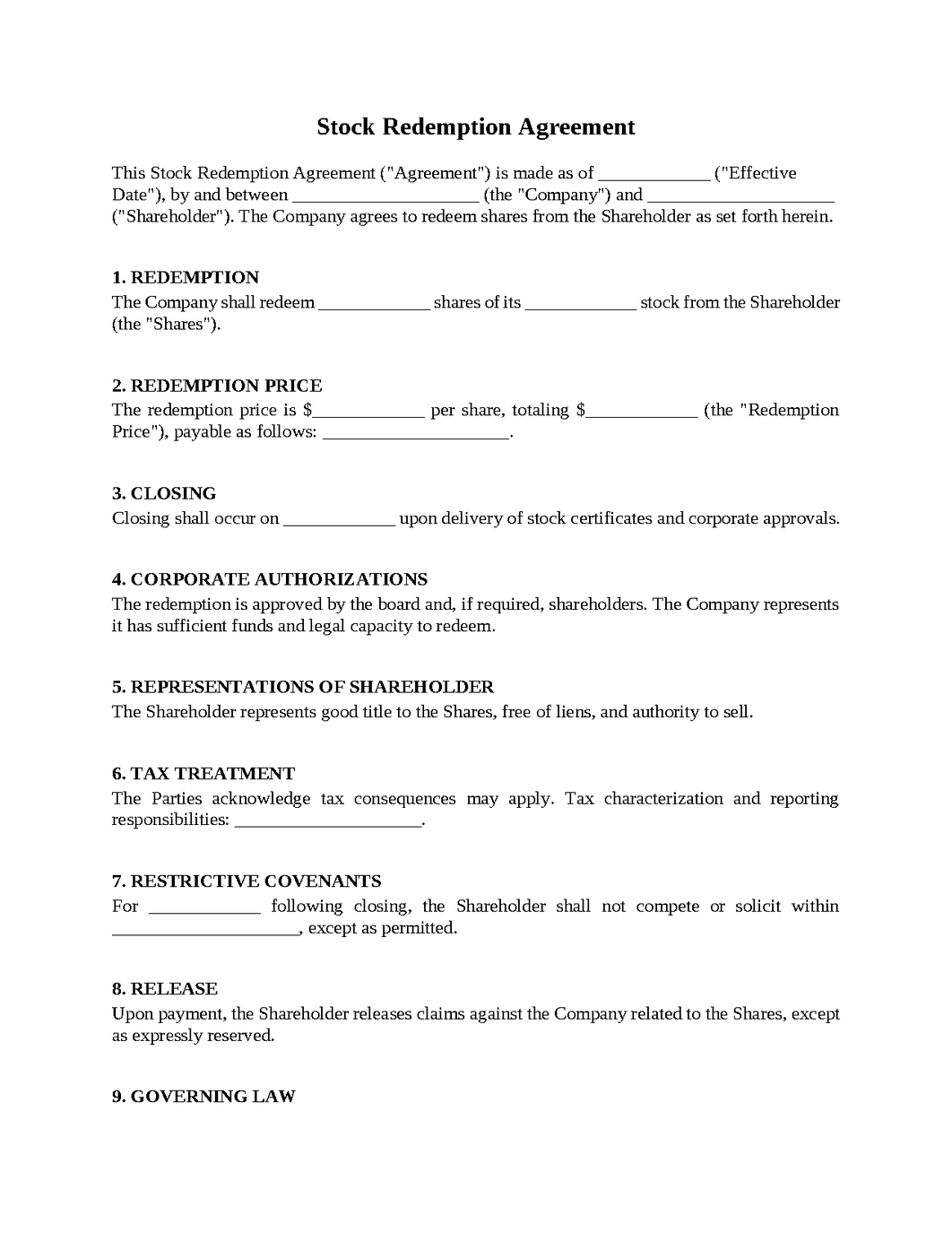
Stock Redemption Agreement
A Stock Redemption Agreement is a legal contract through which a corporation agrees to repurchase shares of its own stock from one or more shareholders. These agreements are commonly used in closely held corporations, family businesses, professional practices, succession planning arrangements, founder exits, shareholder disputes, retirement transitions, and ownership restructuring transactions. A Stock Redemption Agreement typically addresses the number of shares being redeemed, purchase price, payment terms, closing conditions, tax considerations, and the rights and obligations of both the corporation and the departing shareholder. Because stock redemptions directly affect ownership percentages, corporate control, and company finances, disputes can arise when expectations are not documented clearly. A well-drafted Stock Redemption Agreement helps protect the corporation and its shareholders while facilitating smooth ownership transitions.
The Parties Disagree About the Value of the Shares
A shareholder decides to exit a privately held corporation after many years of ownership.
The corporation agrees in principle to redeem the shares so that ownership can remain concentrated among the remaining shareholders. The departing shareholder believes the business has grown substantially and that the shares are worth a significant amount.
The corporation views the company's prospects more conservatively and believes a lower valuation is appropriate. Each side relies on different assumptions regarding profitability, growth potential, and market conditions.
As negotiations continue, the valuation gap becomes the primary obstacle to completing the redemption.
Neither party disputes the shareholder's ownership rights, but both disagree regarding the fair value of those rights.
To help avoid this problem, a Stock Redemption Agreement should establish valuation methodologies, identify appraisal procedures when necessary, and define how disagreements regarding share value will be resolved.
The Corporation Struggles to Make Redemption Payments
A company agrees to redeem a substantial block of stock from a retiring shareholder.
Because the redemption amount is significant, the parties structure the transaction through installment payments over several years. Initially, both parties expect the arrangement to work smoothly.
As business conditions change, however, the corporation experiences reduced cash flow and financial pressure. Management becomes concerned about its ability to continue making redemption payments according to schedule.
The former shareholder relies on those payments for retirement planning and expects the corporation to honor its obligations.
The disagreement creates tension because both parties face legitimate financial concerns.
To reduce these risks, a Stock Redemption Agreement should clearly establish payment schedules, identify security arrangements when appropriate, define default remedies, and address the consequences of missed payments.
Remaining Shareholders Gain More Control Than Expected
A corporation redeems shares from one of several shareholders.
After the redemption is completed, ownership percentages among the remaining shareholders increase automatically. Certain shareholders gain greater voting power and influence over company decisions than they previously possessed.
Over time, disputes arise regarding governance, board control, and decision-making authority. Some shareholders believe the redemption altered the balance of power in ways that were not fully anticipated.
The corporation completed the redemption successfully, but ownership dynamics changed significantly.
What appeared to be a straightforward transaction now affects long-term corporate governance.
To help prevent these issues, a Stock Redemption Agreement should address the impact of the redemption on ownership percentages and coordinate with any shareholder agreements governing voting rights and corporate control.
Tax Consequences Differ From Expectations
A shareholder and corporation negotiate a redemption transaction believing it will provide favorable financial results.
After the transaction closes, however, questions arise regarding the tax treatment of the redemption proceeds. The shareholder expected one result, while tax authorities or advisors interpret the transaction differently.
The corporation may also encounter unexpected reporting obligations or financial consequences associated with the redemption.
Neither party intended to create adverse tax outcomes, but the complexity of redemption transactions can produce unexpected results.
The disagreement becomes more significant when financial liabilities arise that neither side anticipated.
To help avoid these problems, a Stock Redemption Agreement should clearly describe the transaction structure and encourage appropriate tax review before the redemption is completed.
A Dispute Exists Before the Redemption Occurs
A shareholder and corporation become involved in disagreements regarding management decisions, compensation, governance, or business strategy.
Rather than continuing the conflict indefinitely, the parties decide that redeeming the shareholder's stock may be the best solution. Although both sides agree in principle, disagreements remain regarding releases of claims, future obligations, confidentiality, and non-disparagement provisions.
The shareholder wants a clean break and fair compensation. The corporation wants certainty that the dispute will not continue after the redemption is completed.
The redemption transaction becomes intertwined with broader legal and business concerns.
What began as an ownership transaction evolves into a comprehensive separation arrangement.
To reduce these risks, a Stock Redemption Agreement should clearly address any related disputes, define released claims, establish ongoing obligations where appropriate, and document the parties' intentions regarding future interactions.
Stock Redemption Agreements are valuable tools for managing ownership transitions while allowing corporations to maintain control over their shareholder base. However, issues involving valuation, payment obligations, ownership changes, tax consequences, and preexisting disputes can become significant sources of conflict when expectations are not documented clearly. A carefully drafted Stock Redemption Agreement provides a structured framework for managing these transactions and protecting all parties involved. When prepared thoughtfully, it can help facilitate orderly ownership transitions, reduce disputes, preserve corporate stability, and support the long-term success of the business.

Get started with Upsign today!
Easily send, sign and track your documents