

Share Purchase Agreement
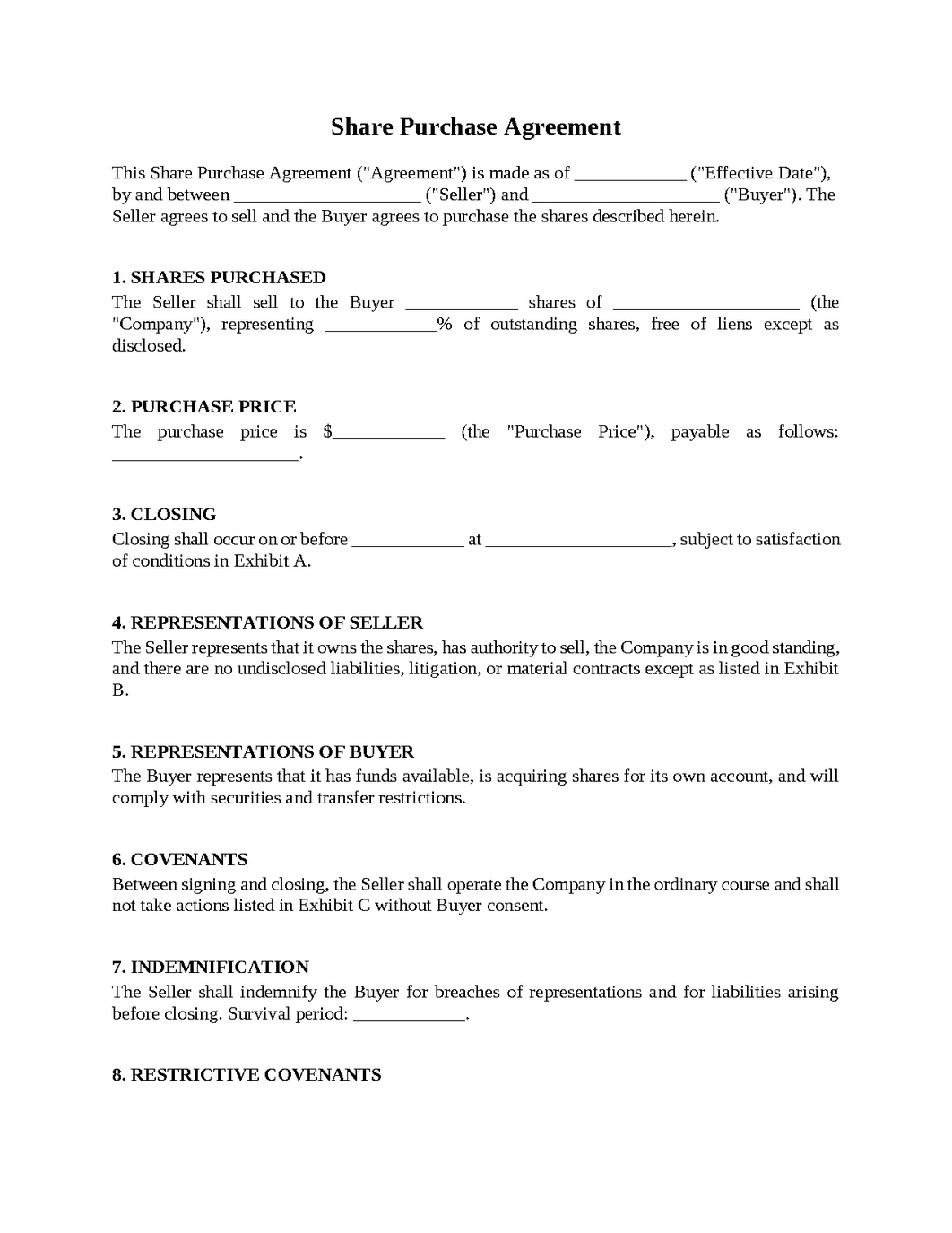
A Share Purchase Agreement is a legal contract that governs the sale and purchase of ownership interests in a corporation. Unlike an asset purchase transaction, where specific business assets are transferred, a Share Purchase Agreement transfers ownership of the company itself through the sale of shares. These agreements are commonly used in business acquisitions, private equity transactions, founder exits, succession planning, investor buyouts, and mergers. A Share Purchase Agreement typically addresses the purchase price, representations and warranties, closing conditions, indemnification obligations, post-closing responsibilities, and ownership transfer procedures. Because the transaction often involves the acquisition of an entire business and substantial financial commitments, disputes can arise when expectations are not documented clearly. A well-drafted Share Purchase Agreement helps protect both buyers and sellers while reducing transactional risk.
The Buyer Discovers Problems After Closing
A successful business is sold through a share purchase transaction after months of negotiations and due diligence.
The buyer reviews financial statements, customer contracts, employee information, and operational records before completing the acquisition. Based on the information provided, the buyer believes the company is financially healthy and positioned for future growth.
Several months after closing, however, previously undisclosed liabilities begin to emerge. Regulatory issues, customer disputes, tax obligations, or contractual problems create unexpected expenses for the business.
The buyer believes these issues should have been disclosed before the sale. The seller argues that all material information was provided and that business risks are inherent in any acquisition.
The disagreement becomes significant because the financial impact may be substantial.
To help avoid this problem, a Share Purchase Agreement should include detailed representations and warranties, establish disclosure requirements, and define remedies available if material information proves inaccurate or incomplete.
The Parties Disagree About the Company's Value
A shareholder decides to sell ownership interests in a privately held company.
Both parties agree that the business has significant value, but determining the appropriate purchase price proves challenging. The seller focuses on future growth opportunities, customer relationships, and market potential. The buyer focuses on operational risks, competitive pressures, and future uncertainty.
After extensive negotiations, a purchase price is agreed upon. Later, however, disputes arise regarding working capital adjustments, earnout provisions, or financial calculations that affect the final amount paid.
Each party believes the transaction economics should favor its position.
The disagreement becomes more complicated because the value of a private company is often subject to interpretation.
To reduce these risks, a Share Purchase Agreement should clearly define valuation methodologies, establish adjustment formulas, identify accounting standards, and create procedures for resolving financial disputes.
Key Employees Leave Shortly After the Acquisition
A buyer acquires a company largely because of its experienced management team and specialized workforce.
At closing, the buyer assumes that key employees will remain with the business and continue contributing to its success. Shortly after the acquisition is completed, however, several important employees resign or pursue other opportunities.
The buyer becomes concerned because the company's value was closely tied to those individuals. The seller argues that employment decisions remain personal choices outside the seller's control.
Questions arise regarding whether employee retention expectations were discussed adequately during negotiations.
The issue affects both operational performance and the perceived value of the acquisition.
To help prevent these problems, a Share Purchase Agreement should address key employee matters when appropriate, coordinate with employment and retention arrangements, and clearly define any obligations relating to management continuity.
An Earnout Becomes a Source of Conflict
A portion of the purchase price is structured as an earnout tied to the company's future performance.
The seller accepts the arrangement because it creates the opportunity to receive additional compensation if the business performs well after closing. The buyer appreciates the structure because it aligns payment obligations with future results.
As the earnout period progresses, disagreements arise regarding revenue recognition, expense allocation, management decisions, and performance measurements.
The seller believes business decisions are reducing earnout payments unfairly. The buyer believes operations are being managed appropriately and consistently with business needs.
The disagreement becomes increasingly contentious because future compensation depends on the outcome.
To help avoid these issues, a Share Purchase Agreement should define earnout calculations carefully, establish performance metrics, identify operational restrictions when appropriate, and provide dispute-resolution procedures.
A Seller Starts Competing With the Business
A founder sells ownership interests in a successful company and receives substantial compensation for the transaction.
The buyer expects the acquired business to retain its customers, goodwill, and market position. Several months after closing, the seller launches a new venture serving many of the same customers and operating within the same industry.
The buyer believes the seller is undermining the value of the acquired company. The seller argues that participation in the industry was never restricted adequately.
What initially appeared to be a successful acquisition becomes a dispute regarding competitive activities.
The financial consequences become more significant as customer relationships are affected.
To reduce these risks, a Share Purchase Agreement should address non-compete obligations, non-solicitation restrictions, confidentiality requirements, and post-closing conduct expectations when appropriate.
Share Purchase Agreements are among the most important documents used in business acquisition transactions because they govern the transfer of ownership and allocation of risk between buyers and sellers. However, issues involving undisclosed liabilities, valuation disputes, employee retention, earnout calculations, and post-closing competition can become significant sources of conflict when expectations are not documented clearly. A carefully drafted Share Purchase Agreement provides a structured framework for managing these transactions and protecting all parties involved. When prepared thoughtfully, it can help reduce uncertainty, facilitate successful ownership transfers, preserve business value, and support long-term transactional success.

Get started with Upsign today!
Easily send, sign and track your documents