

Release of Promissory Note
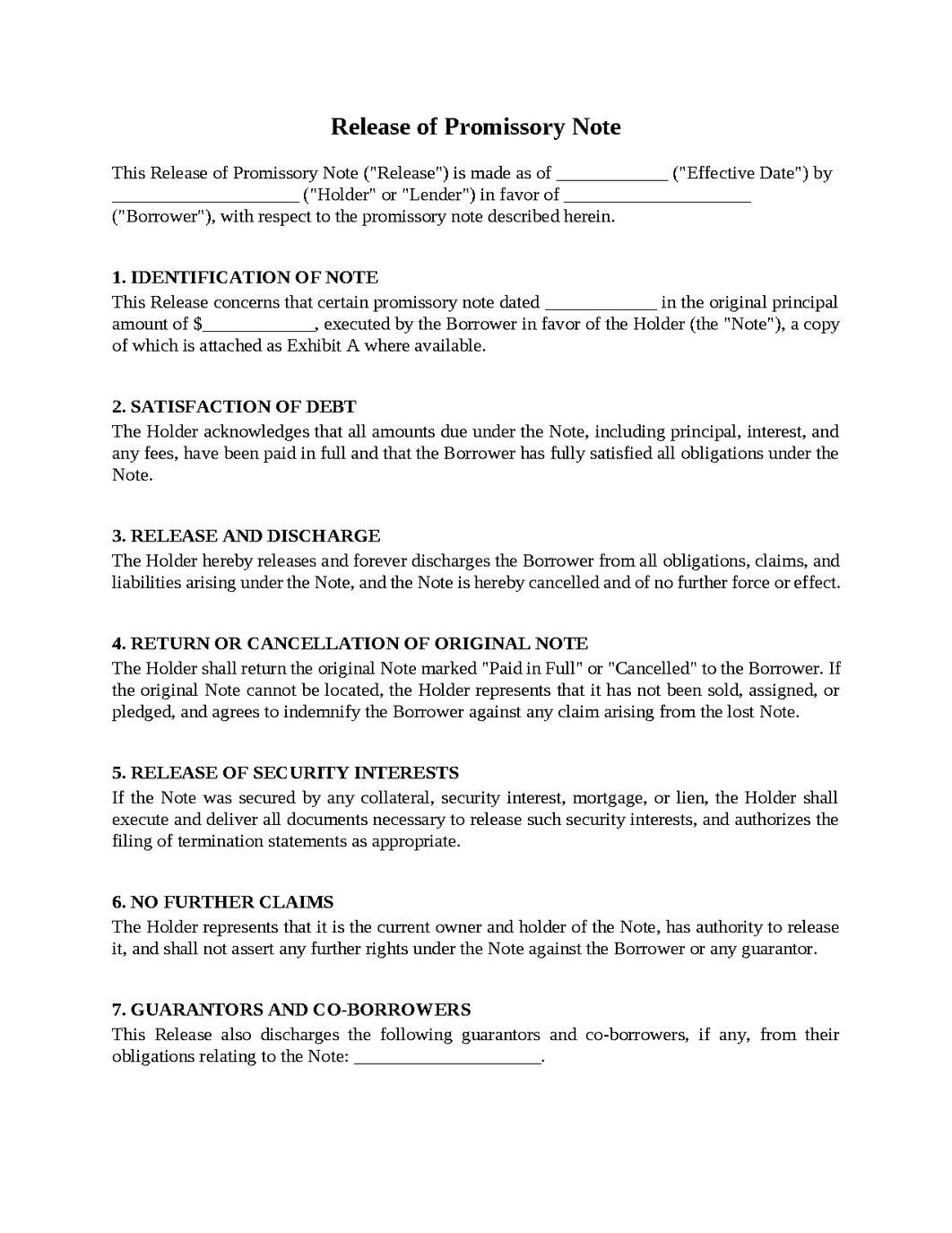
A Release of Promissory Note is a legal document used to formally acknowledge that a promissory note has been paid in full, satisfied, forgiven, settled, canceled, or otherwise discharged. The release serves as written evidence that the borrower no longer owes obligations under the note and that the lender relinquishes any further claims arising from the debt. Release of Promissory Notes are commonly used in private lending arrangements, business loans, seller-financed transactions, family loans, commercial financing, and real estate transactions. Because promissory notes often remain in effect for years and may involve significant amounts of money, disputes can arise when satisfaction of the obligation is not documented clearly. A well-prepared Release of Promissory Note helps provide certainty and protect both borrowers and lenders from future disagreements.
The Borrower Believes the Note Was Paid Off
A business owner borrows money from a private lender and signs a promissory note requiring monthly payments over several years.
The borrower makes payments consistently and eventually believes the obligation has been satisfied in full. The lender, however, maintains records indicating that additional interest, late charges, or fees remain outstanding.
The borrower requests written confirmation that the note has been paid. The lender refuses until all disputed amounts are resolved.
What should have been a straightforward conclusion to the lending relationship becomes a disagreement regarding the final balance owed.
Neither party expected conflict after years of successful payments, yet both interpret the loan records differently.
To help avoid this problem, a Release of Promissory Note should be executed promptly once all obligations have been satisfied and should clearly confirm that no additional amounts remain due under the note.
The Original Note Cannot Be Located
A borrower pays off a promissory note that was executed many years earlier.
At the time of repayment, both parties are pleased that the debt has been resolved. When the borrower later seeks financing from another lender, questions arise regarding whether the original note remains outstanding.
The borrower requests documentation proving that the obligation was satisfied. Unfortunately, the original note cannot be located, and records maintained by the parties are incomplete.
The new lender becomes concerned because there is no clear evidence showing that the prior debt was released properly.
A matter that should have been simple becomes complicated because important documentation is missing.
To reduce these risks, a Release of Promissory Note should be prepared and retained whenever a note is satisfied. Clear written records help eliminate uncertainty years after repayment occurs.
A Family Loan Creates Estate Disputes
A parent lends money to an adult child through a formal promissory note.
Over time, the child repays a substantial portion of the debt. Eventually, the parent decides to forgive the remaining balance and tells the child that no further payments are necessary.
The family treats the matter as resolved and moves forward. Years later, during administration of the parent's estate, other family members question whether the debt was truly forgiven.
The child believes the note was released. Other heirs argue that the remaining balance should be treated as an asset of the estate.
Without written evidence of the release, family members disagree regarding the parent's intentions.
To help prevent these issues, a Release of Promissory Note should be executed whenever a lender forgives or cancels a debt. Written documentation helps preserve family relationships and avoid future misunderstandings.
A Business Sale Reveals Outstanding Loan Questions
A company is sold after years of successful operation.
During the due diligence process, the buyer discovers a promissory note listed in historical company records. Management explains that the obligation was paid off long ago and is no longer relevant.
The buyer requests documentation confirming that the note was satisfied and released. The seller struggles to locate evidence proving that the lender formally relinquished rights under the note.
Although everyone believes the debt was repaid, uncertainty remains because no formal release can be produced.
The issue delays the transaction and creates concerns about potential future claims.
To help avoid these problems, a Release of Promissory Note should be maintained with company records and provided during future due diligence reviews. Proper documentation helps facilitate business transactions.
The Lender Continues Asserting Rights Under the Note
A borrower and lender negotiate a settlement that resolves a promissory note before the original maturity date.
The borrower makes the agreed payment and assumes the matter is complete. The lender later claims that the settlement addressed only part of the obligation and attempts to enforce additional rights under the note.
The borrower argues that the settlement was intended to end all obligations. The lender points to ambiguities in the settlement discussions and supporting documents.
The disagreement escalates because neither party documented the release clearly.
A conflict that could have been avoided easily now requires significant time and expense to resolve.
To reduce these risks, a Release of Promissory Note should clearly identify the note being released, confirm the satisfaction of all obligations, and expressly state that the lender waives future claims arising from the note.
Promissory notes are among the most common tools used to document loans and repayment obligations. However, issues involving disputed balances, missing records, family loans, business transactions, and settlement agreements can become significant sources of conflict when satisfaction of a note is not documented clearly. A carefully prepared Release of Promissory Note provides a structured framework for confirming that the obligation has been resolved and protecting both lenders and borrowers from future disputes. When prepared thoughtfully, it can help preserve important records, reduce uncertainty, facilitate future transactions, and provide confidence that the debt relationship has ended completely.

Get started with Upsign today!
Easily send, sign and track your documents