

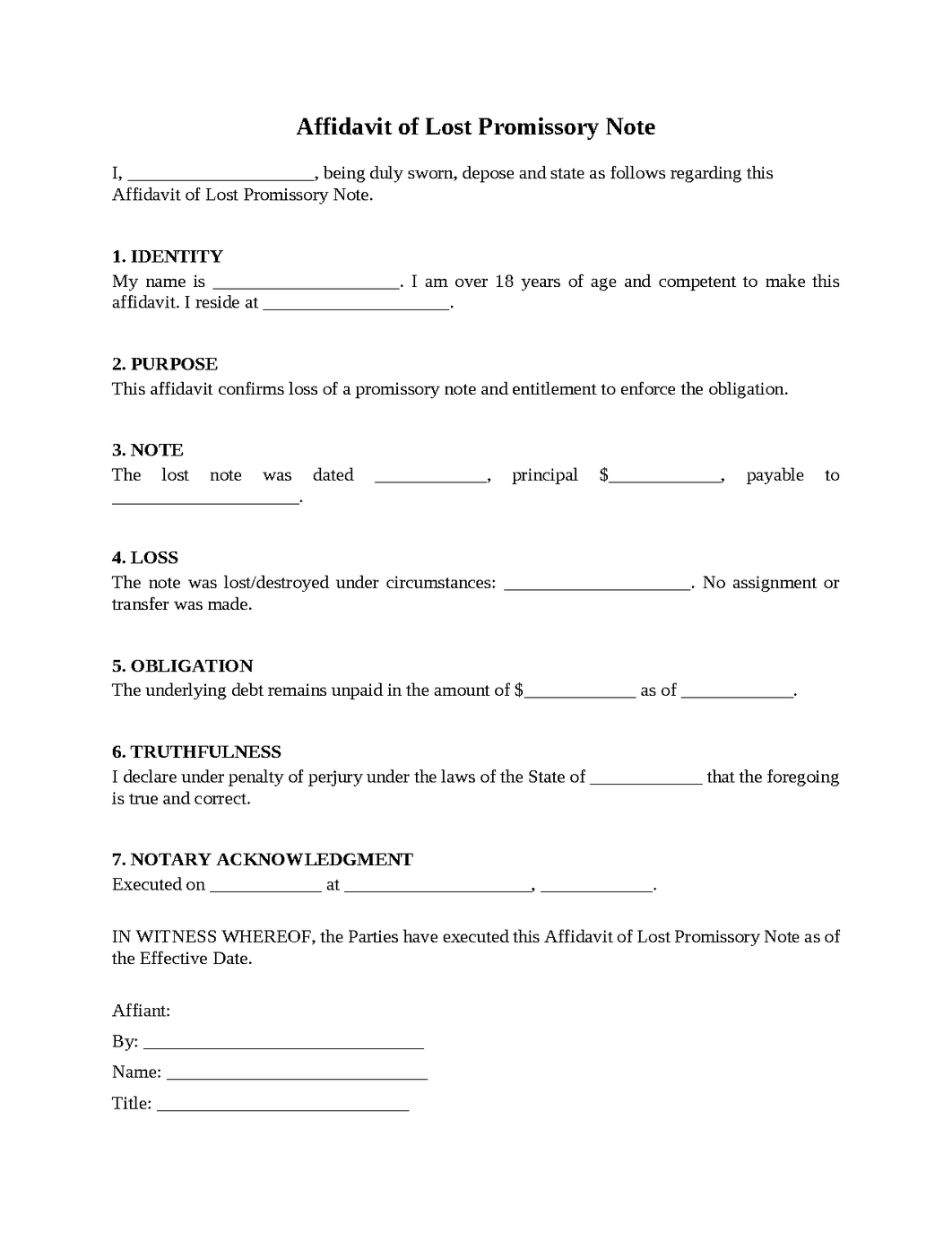
Affidavit of Lost Promissory Note
An Affidavit of Lost Promissory Note is a sworn statement used when the original promissory note evidencing a debt cannot be located. Promissory notes are commonly used in real estate transactions, business loans, private lending arrangements, and other financial agreements where one party promises to repay money to another. Because the original note often serves as evidence of the debt and the lender's right to collect payment, losing the document can create complications. An Affidavit of Lost Promissory Note helps establish the existence of the note, explain the circumstances surrounding its loss, and confirm the lender's continuing rights despite the missing original. Lenders, borrowers, title companies, attorneys, courts, financial institutions, and investors frequently rely on these affidavits when resolving issues involving missing loan documentation.
A Borrower Questions Whether the Debt Still Exists
A business owner borrows $250,000 from a private investor to expand operations. The parties execute a promissory note outlining repayment terms, interest rates, and default provisions. Several years later, the lender attempts to collect the remaining balance but discovers that the original promissory note cannot be located.
The borrower immediately raises concerns. Without the original document, they question whether the lender can prove the debt still exists and whether the repayment terms being referenced are accurate.
Situations like this create uncertainty for both parties. The lender knows the loan was made and may have supporting records showing payments were received over time. The borrower may acknowledge receiving funds but disagree regarding the amount still owed or the terms governing repayment.
The missing note becomes a focal point of the dispute. Questions arise regarding whether the note was lost, destroyed, transferred to another party, or satisfied previously.
Without proper documentation, collection efforts may become more difficult. Courts, attorneys, and financial institutions often require evidence supporting the lender's claims before enforcing repayment obligations.
An Affidavit of Lost Promissory Note helps address these concerns by documenting the existence of the note, describing the circumstances surrounding its loss, and confirming that the lender continues to claim ownership of the debt. While the affidavit does not replace all supporting evidence, it provides an important record explaining why the original document is unavailable.
A Property Sale Is Delayed Because Loan Documents Are Missing
A homeowner is preparing to sell a property that was financed years earlier through seller financing. The loan has been fully repaid, but during the closing process, the title company requests documentation confirming that the debt has been satisfied.
The lender intends to release the lien but discovers that the original promissory note cannot be found. Although everyone agrees the loan existed and was repaid, the missing note creates concerns regarding documentation requirements.
The title company wants assurance that no competing claims exist and that the party releasing the lien has authority to do so. Buyers and lenders involved in the transaction also want confidence that ownership rights will not be challenged later.
What should have been a routine closing suddenly becomes more complicated. Additional records must be reviewed, old payment histories may need to be located, and attorneys may become involved.
Missing promissory notes frequently create issues during real estate transactions because title companies rely heavily on documentation. Even when the parties agree regarding the underlying facts, closing requirements still must be satisfied.
An Affidavit of Lost Promissory Note helps explain why the original note cannot be produced and provides supporting information regarding the debt. By creating a sworn record of the circumstances, the affidavit often helps title companies evaluate the situation and move transactions toward completion.
A Loan Is Sold but the Original Note Cannot Be Located
A private lender originates dozens of loans each year and later sells many of them to investors. During the transfer of one particular loan, the lender discovers that the original promissory note is missing from its records.
The investor purchasing the loan becomes concerned. The note serves as important evidence of the borrower's repayment obligation, and the investor wants assurance that the debt can still be enforced.
Questions immediately arise. Was the note misplaced during a prior file transfer? Was it accidentally destroyed? Was it delivered to another party years earlier? No one can determine exactly what happened.
The inability to produce the original note creates risk for the purchaser. Investors frequently rely on original loan documents when evaluating acquisitions, particularly for larger loans involving significant balances.
Without clear documentation, negotiations may stall. The purchase price may be reduced to reflect additional risk. In some cases, investors may decline the transaction entirely.
An Affidavit of Lost Promissory Note helps document the history of the loan and explain the circumstances surrounding the missing note. While purchasers may still request additional evidence, the affidavit provides a formal record supporting the lender's position and helps facilitate discussions regarding the transfer.
Multiple Parties Claim Rights to the Same Debt
A private lender makes a loan to a real estate investor and retains the original promissory note for several years. After the lender's death, family members discover incomplete records and are unable to locate the original note.
As the estate is being administered, two separate parties claim ownership of the debt. One individual argues that the lender assigned the note before death. Another claims the debt remains part of the lender's estate.
Without the original note, determining ownership becomes more complicated. Attorneys reviewing the matter must reconstruct the history of the transaction using available records, correspondence, payment histories, and witness testimony.
Ownership disputes involving financial instruments can create significant challenges. Borrowers may not know who should receive payments. Estate representatives may struggle to administer assets properly. Potential purchasers may hesitate to become involved until ownership questions are resolved.
These disputes often require substantial time and expense to resolve. Missing documentation increases uncertainty and creates opportunities for competing interpretations of past events.
An Affidavit of Lost Promissory Note helps establish a formal record regarding the lender's ownership of the note before it was lost. Although the affidavit may not eliminate every dispute, it provides evidence that can assist courts, attorneys, and other decision-makers when evaluating competing claims.
A Court Requires Evidence Before Enforcing the Loan
A borrower stops making payments on a substantial loan. The lender initiates legal action seeking repayment but discovers that the original promissory note cannot be located.
The court requires evidence establishing the existence of the debt and the lender's right to enforce it. Simply claiming that a note once existed is generally not enough. Supporting documentation and sworn testimony may be necessary.
The lender gathers payment records, correspondence, account statements, and other materials demonstrating the history of the loan. However, the missing note remains an important issue because it was the primary document establishing repayment obligations.
Courts often encounter situations involving lost financial instruments. While legal procedures may allow enforcement under certain circumstances, judges typically want clear evidence regarding the note's existence, ownership, and loss.
Without sufficient documentation, enforcement efforts may be delayed or unsuccessful. The lender must demonstrate that the note existed, that they have rights under the note, and that the note was lost rather than transferred or satisfied.
An Affidavit of Lost Promissory Note helps provide this information in a sworn format. By explaining the circumstances surrounding the loss and confirming the lender's continuing claim to the debt, the affidavit often becomes an important piece of evidence in legal proceedings.
Promissory notes serve as important evidence of financial obligations, and losing the original document can create significant challenges for lenders, borrowers, investors, title companies, and courts. Questions regarding repayment rights, ownership, loan transfers, property transactions, and debt enforcement frequently arise when original notes cannot be located. An Affidavit of Lost Promissory Note provides a practical tool for documenting the existence of the note, explaining its loss, and supporting the lender's continuing rights. When prepared accurately and supported by appropriate records, the affidavit can help reduce uncertainty, facilitate transactions, and provide decision-makers with greater confidence when evaluating claims involving missing loan documents.
:::

Get started with Upsign today!
Easily send, sign and track your documents