

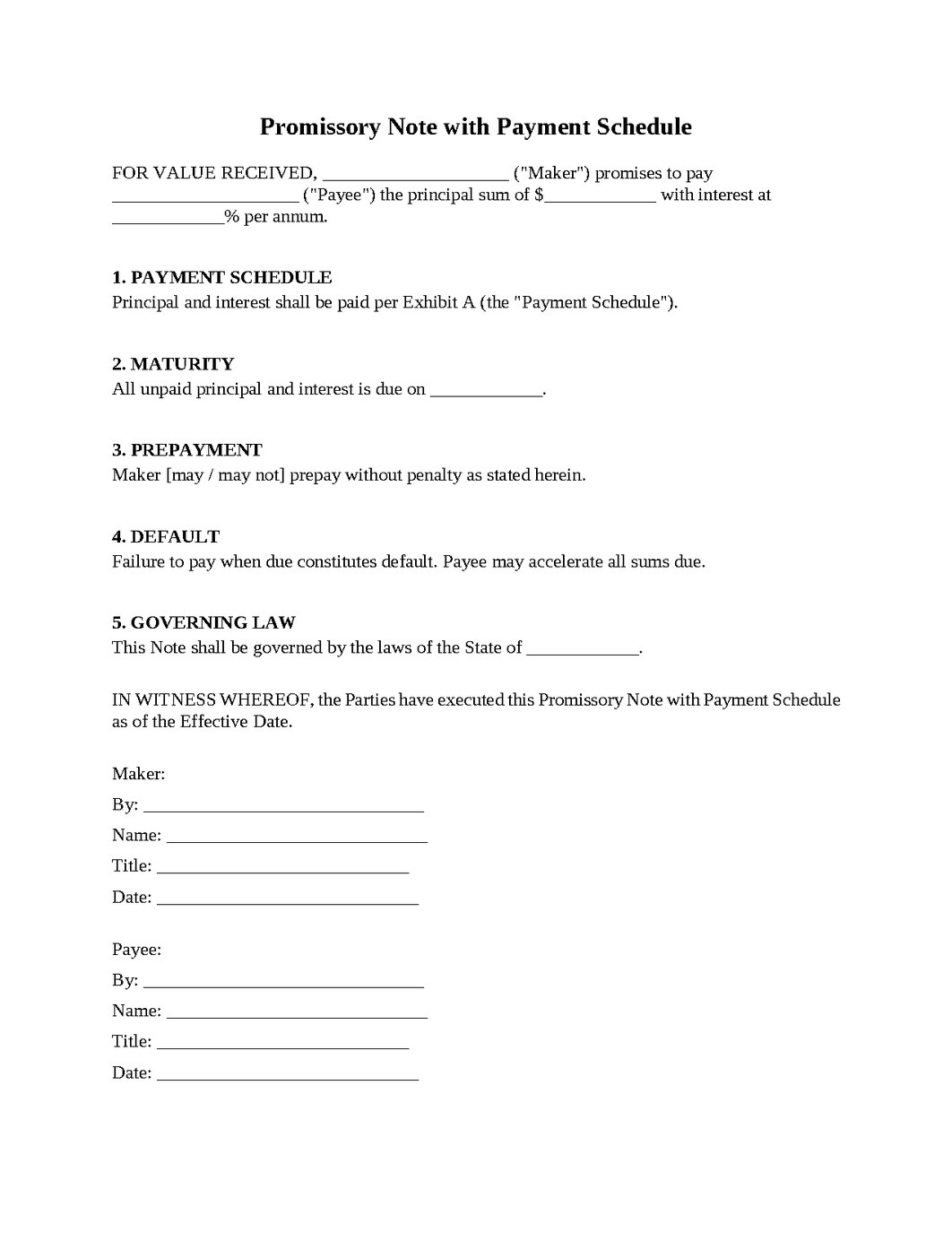
Promissory Note with Payment Schedule
A Promissory Note with Payment Schedule is a legal contract in which one party promises to repay borrowed money to another party according to a defined repayment plan. Unlike a simple promissory note that may require repayment on demand or in a lump sum, a Promissory Note with Payment Schedule establishes specific payment amounts, due dates, interest obligations, maturity dates, and default provisions. These agreements are commonly used for business loans, family loans, seller financing transactions, private lending arrangements, startup financing, and real estate transactions. Because money, timing, and repayment expectations are involved, disputes frequently arise when obligations are not documented clearly. A well-drafted Promissory Note with Payment Schedule helps protect both the lender and borrower while reducing uncertainty throughout the repayment period.
The Parties Disagree About How Payments Should Be Applied
A business owner borrows money from a private investor to fund company expansion. The parties agree on a repayment schedule consisting of monthly payments over several years.
For the first year, payments are made consistently and the relationship remains positive. As the loan balance declines, however, questions arise regarding how payments are being applied. The borrower believes additional payments should reduce principal immediately. The lender believes certain amounts should first be applied to accrued interest and fees.
Because neither party focused heavily on payment allocation provisions when the note was signed, different interpretations emerge regarding the remaining balance.
The disagreement becomes increasingly important because the allocation method directly affects the amount owed and the length of the repayment period.
To help avoid this problem, a Promissory Note with Payment Schedule should clearly define how payments are applied among principal, interest, late fees, costs, and other obligations. Detailed payment allocation provisions help eliminate uncertainty.
A Temporary Financial Setback Leads to Default Questions
A borrower obtains financing to purchase equipment needed for a growing business. The payment schedule appears manageable based on current revenue projections.
Several years into the repayment period, the business experiences an unexpected downturn. Revenue declines temporarily, and the borrower misses one scheduled payment while attempting to stabilize operations.
The lender becomes concerned because the note provides remedies following a default. The borrower believes the missed payment should be treated as a temporary setback rather than a major contractual violation.
As discussions continue, questions arise regarding grace periods, notice requirements, cure rights, and acceleration of the remaining balance.
Neither party necessarily wants litigation, but both need clarity regarding their contractual rights.
To reduce these risks, a Promissory Note with Payment Schedule should clearly define events of default, establish notice requirements, provide cure opportunities when appropriate, and explain the consequences of missed payments.
Early Payoff Creates Unexpected Disagreements
A borrower receives additional funds through a business sale and decides to pay off a promissory note years ahead of schedule.
The borrower assumes early repayment will be welcomed because the lender receives money sooner than expected. The lender is pleased to receive payment but points out that anticipated interest income will be reduced significantly.
Questions arise regarding whether the borrower may prepay without penalty and whether additional amounts are owed to compensate for lost interest.
The borrower believes early payment should reduce overall borrowing costs. The lender argues that the repayment schedule was negotiated with a specific return in mind.
The disagreement highlights how even successful repayment can generate conflict if expectations are unclear.
To help prevent these issues, a Promissory Note with Payment Schedule should clearly address prepayment rights, identify any penalties or fees, and explain how early repayment affects interest obligations.
Family Members Interpret the Agreement Differently
A parent lends money to an adult child to help purchase a home. Both parties want to document the transaction properly while maintaining a positive family relationship.
Initially, everyone understands the repayment schedule and intends to follow the agreement. As time passes, however, family circumstances evolve. Additional financial assistance is provided, occasional payments are delayed, and informal conversations begin replacing formal documentation.
Years later, family members disagree regarding how much remains outstanding and whether certain payments were intended as gifts or loan repayments.
Because records were not maintained consistently, memories differ regarding important details.
A relationship built on trust becomes strained due to uncertainty surrounding the loan.
To help avoid these problems, a Promissory Note with Payment Schedule should clearly document payment obligations, require accurate records, and establish procedures for modifying repayment terms if circumstances change.
The Borrower Sells Assets Securing the Loan
A lender provides financing secured by valuable business assets. The repayment schedule extends over several years, and both parties expect the collateral to remain available until the debt is satisfied.
As business operations evolve, the borrower sells certain assets as part of a restructuring effort. The lender becomes concerned because the collateral supporting the loan may no longer provide the same level of protection.
The borrower argues that the asset sale was necessary and beneficial to the business. The lender worries that repayment risk has increased significantly.
What began as a routine business transaction becomes a dispute regarding collateral protection and lender rights.
To reduce these risks, a Promissory Note with Payment Schedule should address collateral requirements, establish restrictions on asset transfers when appropriate, and identify lender remedies if collateral value is impaired.
Promissory Notes with Payment Schedules are widely used to document loans and create clear repayment expectations. However, issues involving payment allocation, defaults, prepayments, family lending arrangements, and collateral protection can become significant sources of conflict when obligations are not documented clearly. A carefully drafted Promissory Note with Payment Schedule provides a structured framework for managing these relationships and protecting both lenders and borrowers. When prepared thoughtfully, it can help reduce misunderstandings, improve repayment certainty, preserve business and personal relationships, and support successful financing arrangements.

Get started with Upsign today!
Easily send, sign and track your documents