

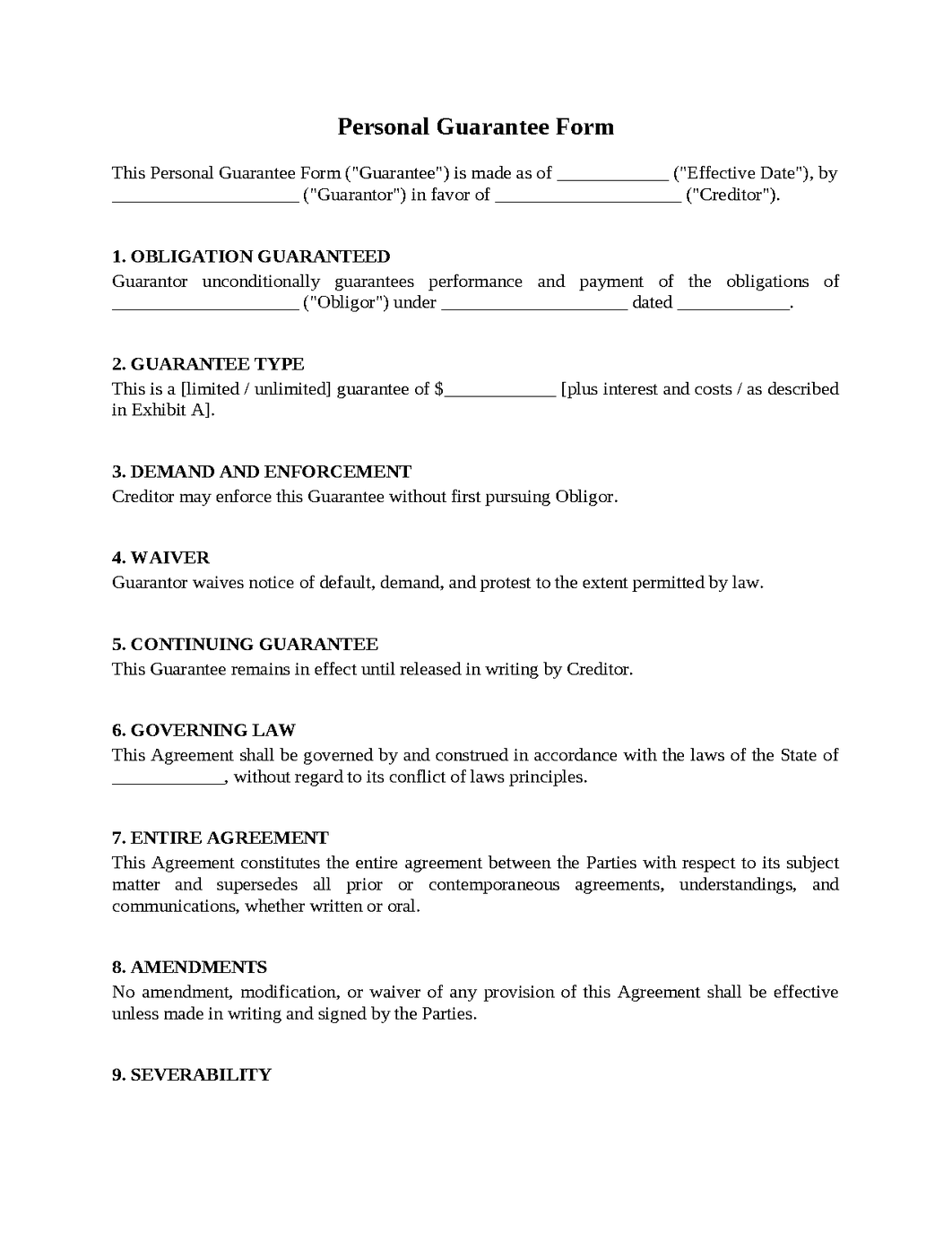
Personal Guarantee Form
A Personal Guarantee Form is a legal document in which an individual agrees to become personally responsible for the obligations of another party if that party fails to perform. Personal guarantees are commonly used in commercial leases, business loans, vendor agreements, equipment financing transactions, franchise arrangements, lines of credit, and other business relationships where one party wants additional security beyond the assets of a company. Lenders, landlords, suppliers, and service providers often require personal guarantees when dealing with newly formed businesses, companies with limited operating histories, or organizations that may not have sufficient assets to satisfy future obligations. While a personal guarantee can help a business obtain financing or secure a valuable opportunity, it can also expose the guarantor's personal assets to significant risk. A well-drafted Personal Guarantee Form helps clarify the scope of liability and reduce disputes regarding the guarantor's obligations.
The Guarantor Does Not Understand Unlimited Liability
An entrepreneur launches a new business and seeks a commercial lease for retail space.
The landlord is willing to lease the property but requires a personal guarantee because the company has limited operating history and minimal assets.
Eager to secure the location, the entrepreneur signs the guarantee without paying close attention to its terms.
Several years later, the business experiences financial difficulties and closes unexpectedly. Rent obligations remain outstanding, and the landlord seeks payment.
The entrepreneur assumes liability will be limited to a portion of the remaining lease term.
The landlord points to the guarantee and explains that it covers all obligations under the lease, including rent, damages, legal expenses, and other amounts owed.
The entrepreneur is shocked to discover that personal assets may now be exposed.
What originally appeared to be a routine lease requirement becomes a significant personal financial problem.
To help avoid this situation, a Personal Guarantee Form should clearly define the scope of liability, identify whether the guarantee is limited or unlimited, and explain precisely which obligations are covered. The guarantor should understand the full extent of potential exposure before signing.
The Business Changes Ownership but the Guarantee Remains
A business owner personally guarantees a line of credit used to support company operations.
Several years later, the owner sells the business to another entrepreneur. The sale closes successfully, management changes, and the former owner assumes all obligations associated with the company have ended.
The new owner continues using the line of credit after the acquisition.
Eventually, the business defaults.
The lender contacts the original owner and demands payment under the personal guarantee.
The former owner is surprised.
Although ownership of the business changed, the guarantee was never released or terminated. The lender explains that the guarantee remains effective unless the lender formally agrees otherwise.
The former owner now faces liability for debts incurred after selling the business.
What should have been a clean exit becomes an unexpected financial obligation.
To reduce these risks, a Personal Guarantee Form should address assignment, ownership changes, and termination procedures. Individuals selling a business should ensure that guarantees are formally released rather than assuming liability ends automatically.
The Creditor Pursues the Guarantor Immediately
A supplier extends significant trade credit to a growing company.
As a condition of the arrangement, one of the owners signs a personal guarantee.
The owner assumes the supplier will first pursue the business if payment problems arise.
Months later, the company experiences cash flow difficulties and misses several payments.
The supplier immediately seeks recovery from the guarantor without first exhausting collection efforts against the company.
The guarantor objects.
The owner argues that the supplier should pursue company assets before seeking payment personally.
The supplier responds that the guarantee allows direct collection from the guarantor.
The disagreement becomes increasingly contentious because expectations were never aligned regarding collection procedures.
To help avoid these disputes, a Personal Guarantee Form should clearly identify whether the guarantee is primary or secondary, explain when collection efforts may be directed toward the guarantor, and specify any prerequisites to enforcement.
Future Debt Is Added Without the Guarantor's Knowledge
A business obtains financing from a lender, and one of the owners signs a personal guarantee.
The owner believes the guarantee applies only to the specific loan being issued.
Over time, the business enters into additional borrowing arrangements with the same lender. Credit limits increase, loan balances grow, and new obligations are added.
When the business eventually defaults, the lender seeks recovery for all outstanding debt.
The guarantor is surprised to learn that the guarantee applies not only to the original loan but also to future obligations.
The lender points to language extending the guarantee to current and future indebtedness.
The guarantor insists that such exposure was never anticipated.
The dispute centers on the scope of the guarantee and whether future obligations were covered properly.
To reduce these risks, a Personal Guarantee Form should clearly identify whether it applies only to specific obligations or to future indebtedness as well. The agreement should eliminate ambiguity regarding the debts covered by the guarantee.
The Guarantor's Estate Becomes Involved
A successful business owner signs a personal guarantee in support of a long-term commercial obligation.
Years later, the guarantor passes away unexpectedly.
The business continues operating for a period of time but eventually defaults.
The creditor seeks payment and contacts the guarantor's estate.
Family members are surprised to learn that obligations signed years earlier may still affect estate assets.
Questions arise regarding whether the guarantee survived the guarantor's death, whether notice requirements were satisfied, and which assets may be available to satisfy the obligation.
The resulting dispute creates additional stress during an already difficult period.
What initially appeared to be a business matter now affects heirs and estate administration.
To help prevent these issues, a Personal Guarantee Form should clearly address survival provisions, estate liability, termination rights, notice requirements, and circumstances under which the guarantee may end. These provisions can help reduce uncertainty for both creditors and guarantors.
Personal guarantees are often essential tools for obtaining financing, securing leases, establishing vendor relationships, and supporting business growth. However, they also create significant personal financial exposure that many guarantors underestimate. Disputes frequently arise regarding the scope of liability, ownership changes, collection procedures, future obligations, and estate issues. A well-drafted Personal Guarantee Form provides a structured framework for defining these responsibilities and establishing clear expectations for all parties involved. When prepared carefully, it can help reduce misunderstandings, allocate risk appropriately, and provide greater certainty regarding the guarantor's obligations.

Get started with Upsign today!
Easily send, sign and track your documents