

Sales Agency Agreement
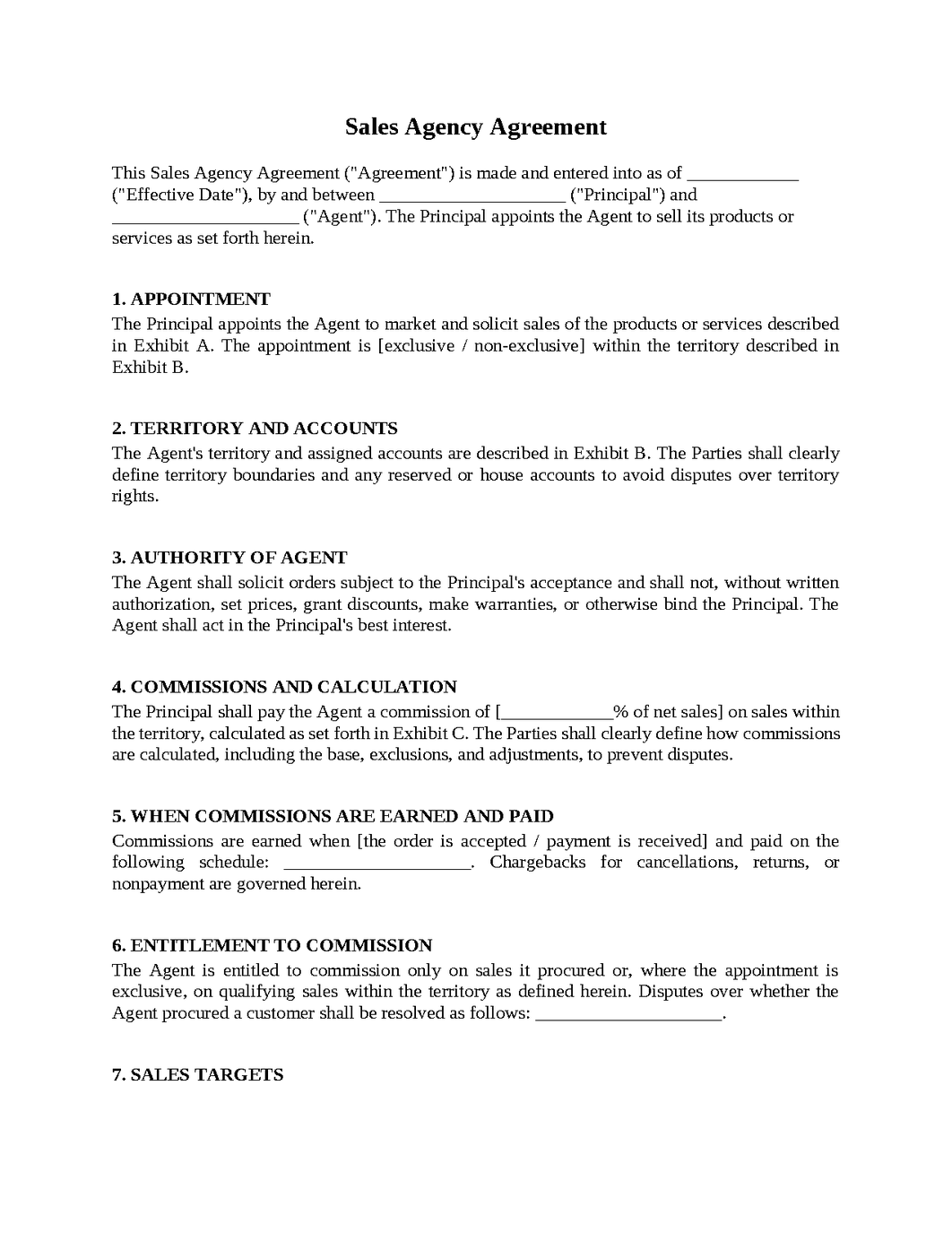
A Sales Agency Agreement is a legal contract that establishes the terms under which a sales agent, sales representative, or sales agency markets, promotes, solicits, and helps sell products or services on behalf of a company. These agreements are commonly used in manufacturing, software, industrial products, consumer goods, healthcare, technology, and international distribution relationships. A Sales Agency Agreement typically addresses territory rights, commission structures, sales targets, customer ownership, exclusivity provisions, reporting obligations, and termination rights. Because compensation is often tied directly to sales performance and customer relationships, disputes can arise when expectations are not documented clearly. A well-drafted Sales Agency Agreement helps align incentives and protect both the principal and the sales agency.
The Agent Claims Commission on a Customer It Did Not Close
A manufacturer hires a sales agency to develop new business within a specific territory.
The agency spends months meeting with prospects, attending trade shows, and introducing the company's products to potential customers. One prospect expresses interest but does not make a purchase immediately.
Several months later, the manufacturer closes a deal directly with the customer through its internal sales team. The sales agency claims that its efforts created the opportunity and that a commission is owed.
The manufacturer argues that its own employees completed the negotiations and secured the order. The agency believes the transaction would never have occurred without the original introduction.
The disagreement becomes significant because the customer represents substantial recurring revenue.
To help avoid this problem, a Sales Agency Agreement should clearly define customer ownership rules, establish commission eligibility requirements, and identify when commissions are earned on opportunities introduced by the agency.
Territory Rights Become Controversial
A company appoints a sales agency to represent its products within a defined geographic territory.
Initially, both parties understand the arrangement and begin building customer relationships. As demand grows, however, the company starts receiving inquiries from customers located near territory boundaries.
The company believes it should be free to pursue certain opportunities directly. The agency argues that all prospects within the territory belong exclusively to the agency.
The disagreement intensifies when multiple sales opportunities involve customers operating in several regions simultaneously.
Neither side intended confusion, but the territory provisions do not address these situations clearly.
To reduce these risks, a Sales Agency Agreement should precisely define territory boundaries, establish rules for multi-region customers, and identify circumstances under which the company may pursue opportunities independently.
Commission Calculations Lead to Disputes
A sales agency is compensated through commissions based on sales generated within its assigned territory.
For several years, the arrangement functions successfully. Eventually, however, questions arise regarding discounts, rebates, returns, shipping charges, and promotional pricing.
The agency believes commissions should be calculated based on the full value of customer orders. The company believes certain deductions should be applied before commissions are determined.
As sales volume increases, the financial impact of the disagreement becomes substantial.
Neither party believes it is acting unfairly, yet both arrive at very different commission amounts.
To help prevent these issues, a Sales Agency Agreement should clearly define commission calculations, identify allowable deductions, establish reporting requirements, and explain how adjustments will be handled.
The Company Terminates the Agency After Major Accounts Are Developed
A sales agency spends years building relationships with customers and expanding market share for a manufacturer's products.
The agency invests significant resources into developing key accounts and generating consistent sales growth. Once the customer base becomes well established, the company decides to terminate the agency relationship and transition the accounts to internal sales personnel.
The agency believes it should continue receiving commissions on customers it developed. The company believes commissions should end when the relationship terminates.
The disagreement centers on the long-term value of the customer relationships created by the agency.
What began as a successful partnership becomes a dispute over post-termination compensation.
To help avoid these problems, a Sales Agency Agreement should address post-termination commissions, establish customer protection periods, and clearly define ongoing compensation rights after the relationship ends.
Sales Targets Are Never Clearly Defined
A company hires a sales agency with the expectation that revenue will increase significantly.
The agency works diligently to market the products and generate new opportunities. After several years, however, the company becomes dissatisfied with sales growth and questions whether the agency is performing adequately.
The agency argues that market conditions, competition, pricing decisions, and product availability all affect sales performance. The company believes greater effort and better execution should have produced stronger results.
The disagreement grows because neither party established measurable expectations at the beginning of the relationship.
Both sides are disappointed, yet neither can point to objective performance standards.
To reduce these risks, a Sales Agency Agreement should establish sales goals, define performance metrics, identify reporting obligations, and create procedures for addressing underperformance before termination becomes necessary.
Sales Agency Agreements are valuable tools for expanding market reach and generating new business opportunities. However, issues involving customer ownership, territory rights, commission calculations, post-termination compensation, and performance expectations can become significant sources of conflict when responsibilities are not documented clearly. A carefully drafted Sales Agency Agreement provides a structured framework for managing these relationships and protecting both parties involved. When prepared thoughtfully, it can help reduce misunderstandings, strengthen business partnerships, improve accountability, and support long-term sales growth.

Get started with Upsign today!
Easily send, sign and track your documents