

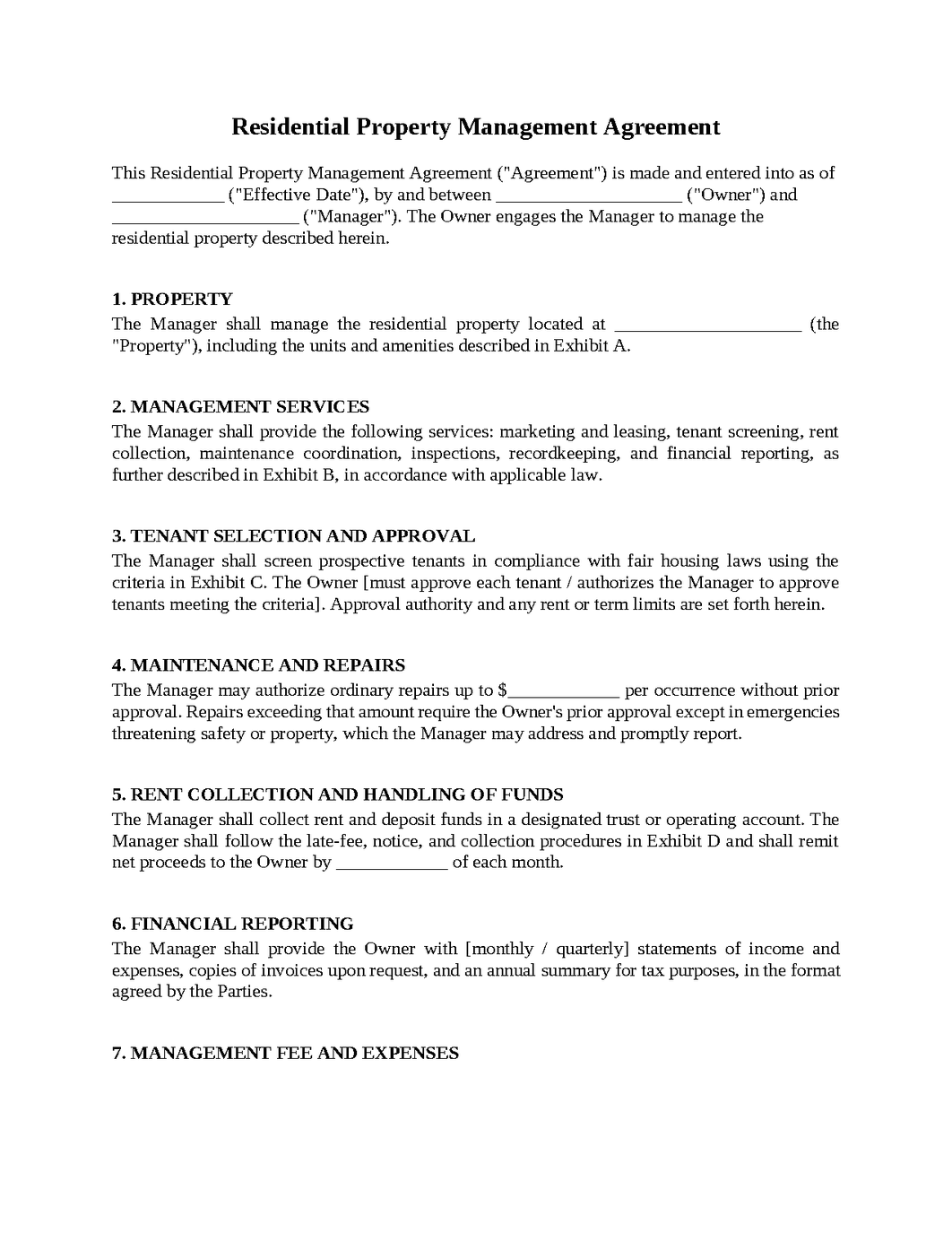
Residential Property Management Agreement
A Residential Property Management Agreement is a legal contract that establishes the terms under which a property manager or property management company operates and manages residential rental properties on behalf of a property owner. These agreements are commonly used for single-family homes, duplexes, apartment buildings, condominiums, townhomes, and residential investment portfolios. A Residential Property Management Agreement typically addresses leasing authority, tenant screening, rent collection, maintenance coordination, financial reporting, property inspections, vendor management, compensation, and termination rights. Because the manager is entrusted with significant responsibility over valuable real estate assets and tenant relationships, disputes can arise when expectations are not documented clearly. A well-drafted Residential Property Management Agreement helps protect both owners and managers while promoting efficient property operations.
The Manager Approves a Tenant the Owner Would Have Rejected
A property owner hires a management company to oversee several rental homes and handle all tenant placement activities.
The owner wants the properties occupied quickly and trusts the management company to evaluate applicants professionally. After a new tenant moves in, problems begin developing almost immediately. Rent payments are inconsistent, lease violations occur, and neighbors begin filing complaints.
The owner becomes frustrated and argues that the tenant should never have been approved. The management company responds that the applicant met the established screening criteria and appeared qualified at the time of approval.
The disagreement centers on whether the manager exercised reasonable judgment during the screening process.
Neither party intended a poor outcome, but both have different views regarding tenant-selection standards.
To help avoid this problem, a Residential Property Management Agreement should clearly establish tenant-screening criteria, define approval authority, identify owner participation rights, and document the standards that will be used when evaluating applicants.
Emergency Repairs Lead to Unexpected Expenses
A rental property experiences a major plumbing failure during a holiday weekend.
The property manager receives an urgent call from the tenant reporting water damage and potential flooding. To prevent further damage, the manager authorizes emergency repairs immediately without first contacting the owner.
The repairs successfully protect the property, but the resulting invoice is substantially larger than the owner expected. The owner believes approval should have been obtained before incurring such a significant expense.
The manager argues that waiting could have resulted in far greater damage and liability.
The disagreement arises because neither party clearly understood the limits of emergency spending authority.
To reduce these risks, a Residential Property Management Agreement should establish spending limits, define emergency situations, identify approval requirements, and clarify when managers may act without prior owner authorization.
Rent Collection Procedures Become a Source of Conflict
A management company is responsible for collecting rent from tenants and remitting net proceeds to the property owner each month.
For several years, the process functions smoothly. Eventually, however, several tenants begin making late payments. The manager works with tenants to preserve occupancy and avoid vacancies.
The owner becomes concerned after noticing declining cash flow and increasing accounts receivable balances. The owner believes stronger collection efforts should be pursued. The manager believes flexibility helps maintain tenant relationships and reduces turnover costs.
Both parties want the property to remain profitable, but they disagree regarding the best collection strategy.
The issue creates tension because expectations regarding enforcement were never discussed in detail.
To help prevent these problems, a Residential Property Management Agreement should clearly define rent-collection procedures, establish authority regarding payment plans, identify collection remedies, and specify when owner approval is required.
Financial Reporting Fails to Meet the Owner's Expectations
A property owner relies on a management company to handle bookkeeping, vendor payments, rent deposits, and operational reporting.
The manager provides periodic financial statements that summarize property performance. Over time, the owner begins requesting additional details regarding repairs, reserve balances, maintenance expenses, and vendor invoices.
The manager believes the reports satisfy contractual obligations. The owner believes greater transparency is necessary to evaluate the property's performance properly.
Neither side accuses the other of wrongdoing, but trust begins eroding because reporting expectations differ.
What started as a simple reporting issue becomes a broader disagreement regarding accountability.
To help avoid these issues, a Residential Property Management Agreement should establish reporting requirements, identify financial information that must be provided, define record-access rights, and specify reporting frequency.
The Owner Terminates the Relationship During Tenant Occupancy
After several years, a property owner decides to replace the management company and transition operations to a new manager.
At the time of termination, tenants remain under active leases, maintenance requests are pending, security deposits are being held, and vendor contracts are in place.
Questions quickly arise regarding transfer of tenant records, lease documentation, accounting information, maintenance histories, keys, and security deposits.
The outgoing manager wants adequate time to complete the transition properly. The owner wants immediate access to all information necessary to continue managing the properties.
What should have been a routine management change becomes an operational challenge affecting both tenants and owners.
To reduce these risks, a Residential Property Management Agreement should establish termination procedures, define record-transfer obligations, identify ownership of tenant files, and require cooperation during management transitions.
Residential Property Management Agreements are essential tools for defining responsibilities between property owners and management professionals. However, issues involving tenant screening, emergency repairs, rent collection, financial reporting, and management transitions can become significant sources of conflict when expectations are not documented clearly. A carefully drafted Residential Property Management Agreement provides a structured framework for managing these relationships and protecting all parties involved. When prepared thoughtfully, it can help improve property performance, strengthen accountability, reduce misunderstandings, and support successful long-term rental operations.

Get started with Upsign today!
Easily send, sign and track your documents