

Real Estate Development Agreement
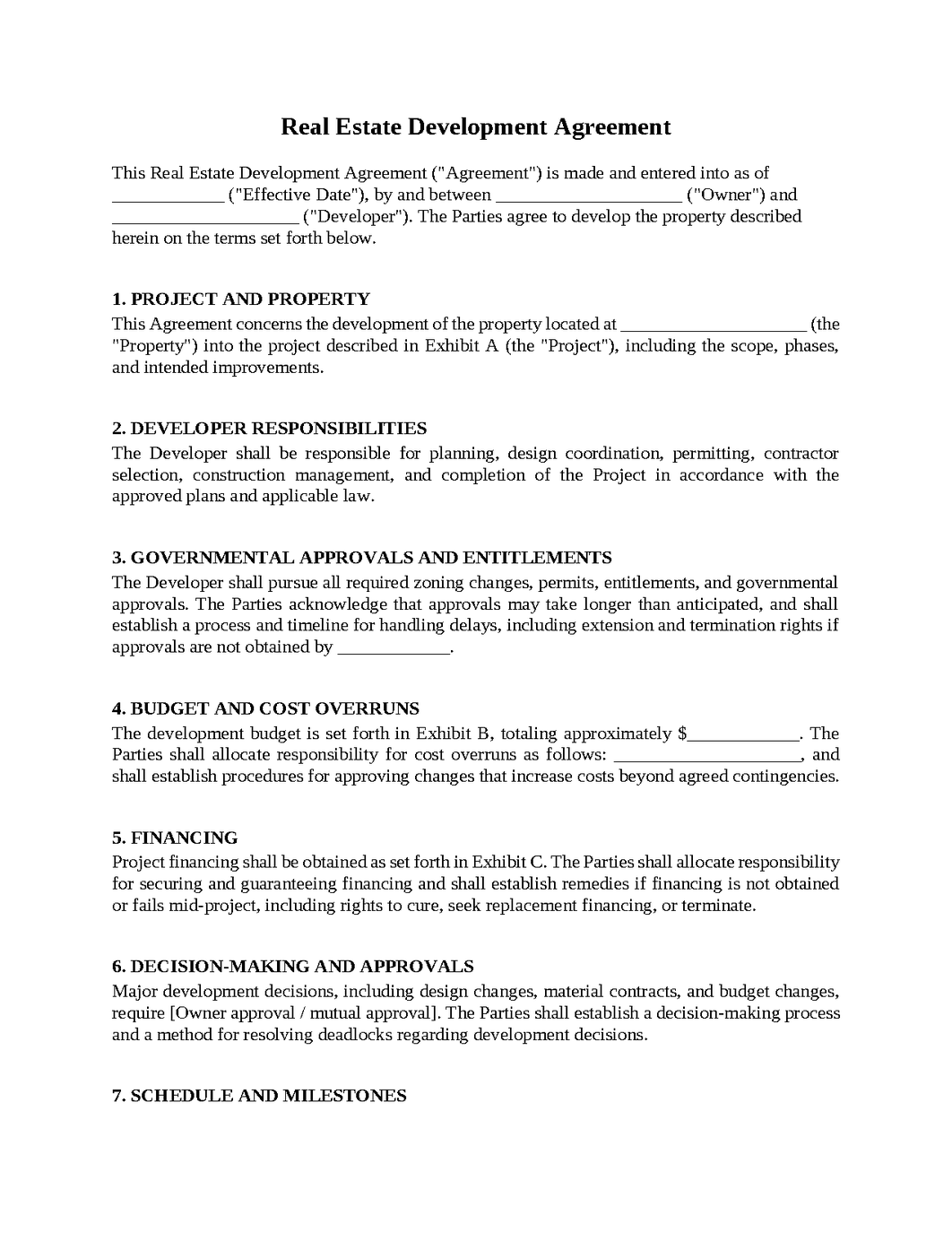
A Real Estate Development Agreement is a legal contract that establishes the terms under which one or more parties collaborate to develop real property. These agreements are commonly used for residential subdivisions, commercial developments, mixed-use projects, industrial parks, apartment complexes, hospitality projects, and large-scale land development initiatives. A Real Estate Development Agreement typically addresses land ownership, development responsibilities, project approvals, financing obligations, construction requirements, profit allocation, timelines, and risk management. Because development projects often involve substantial investments, regulatory approvals, and multiple stakeholders, disputes can arise when expectations are not documented clearly. A well-drafted Real Estate Development Agreement helps align interests and reduce uncertainty throughout the development process.
Government Approvals Take Longer Than Expected
A landowner and a developer enter into an agreement to transform vacant land into a residential community.
At the beginning of the project, both parties believe zoning approvals, permits, and governmental reviews can be obtained within a reasonable timeframe. Based on those assumptions, financing plans, construction schedules, and marketing efforts are developed.
As the project progresses, however, regulatory approvals take much longer than anticipated. Public hearings are delayed, environmental reviews require additional studies, and local agencies request modifications to development plans.
The developer becomes frustrated because carrying costs continue increasing while progress remains limited. The landowner worries that the value of the property may be affected if delays continue indefinitely.
Neither party caused the delays, yet both experience significant financial consequences.
To help avoid this problem, a Real Estate Development Agreement should clearly allocate responsibility for obtaining approvals, establish realistic timelines, identify extension rights, and address the consequences of regulatory delays.
Development Costs Exceed Original Budgets
A developer begins construction on a mixed-use project based on detailed financial projections prepared during the planning phase.
Initially, the project appears financially viable and attracts support from investors and lenders. As construction advances, however, material costs rise, labor becomes more expensive, and unforeseen site conditions require additional work.
The project's budget begins exceeding original estimates significantly. The developer believes the increased costs are unavoidable. Investors and landowners become concerned about additional capital requirements and reduced profitability.
Questions arise regarding who must contribute additional funds and whether the project should proceed as originally planned.
The disagreement becomes increasingly important because project success depends on continued financial support.
To reduce these risks, a Real Estate Development Agreement should establish budgeting procedures, define capital contribution obligations, address cost overruns, and provide mechanisms for approving significant changes to project expenditures.
The Parties Disagree About Development Decisions
A landowner contributes property to a development project while a developer contributes expertise, personnel, and project management services.
At first, both parties collaborate effectively and share a common vision for the project. As development progresses, however, disagreements emerge regarding design features, construction quality, amenities, and project timing.
The developer wants flexibility to make operational decisions efficiently. The landowner believes certain decisions may affect long-term property value and should require approval.
What began as a partnership becomes strained because authority over key decisions was never defined clearly.
Both parties want the project to succeed but disagree about who should control important aspects of development.
To help avoid these problems, a Real Estate Development Agreement should clearly allocate decision-making authority, establish approval rights, define reserved powers, and create procedures for resolving disagreements.
Financing Falls Apart Mid-Project
A developer secures financing commitments and begins work on a major commercial development.
Several phases of the project are completed successfully, and substantial resources have already been invested. During a period of economic uncertainty, however, lenders tighten underwriting standards and financing commitments become more difficult to obtain.
The developer struggles to secure additional funding necessary to complete the remaining phases of construction. Investors and landowners become concerned that the project may remain unfinished.
Questions arise regarding responsibility for obtaining replacement financing, contributing additional capital, or modifying development plans.
The uncertainty threatens the viability of the entire project.
To help prevent these issues, a Real Estate Development Agreement should address financing obligations, establish contingency plans, define default remedies, and identify procedures for responding to funding shortfalls.
The Project Is Sold Before Completion
A development project progresses successfully and attracts interest from a larger real estate company seeking to acquire the project before completion.
The acquisition offer presents an opportunity to generate significant returns for the parties involved. At the same time, questions emerge regarding how sale proceeds should be distributed and whether all participants agree that selling is the best course of action.
Some parties prefer to complete the development and maximize long-term value. Others believe selling immediately reduces risk and provides a favorable return.
The disagreement becomes increasingly significant as negotiations continue.
What began as a development project evolves into a debate regarding exit strategy and profit realization.
To reduce these risks, a Real Estate Development Agreement should establish procedures for project sales, define approval requirements, identify distribution priorities, and address how profits will be allocated if the project is sold before completion.
Real Estate Development Agreements provide the framework for some of the most complex and capital-intensive projects in the real estate industry. However, issues involving governmental approvals, cost overruns, decision-making authority, financing challenges, and project exits can become significant sources of conflict when expectations are not documented clearly. A carefully drafted Real Estate Development Agreement provides a structured framework for managing these relationships and protecting all parties involved. When prepared thoughtfully, it can help reduce uncertainty, align incentives, improve project execution, and support successful development outcomes.

Get started with Upsign today!
Easily send, sign and track your documents