

Quitclaim Deed
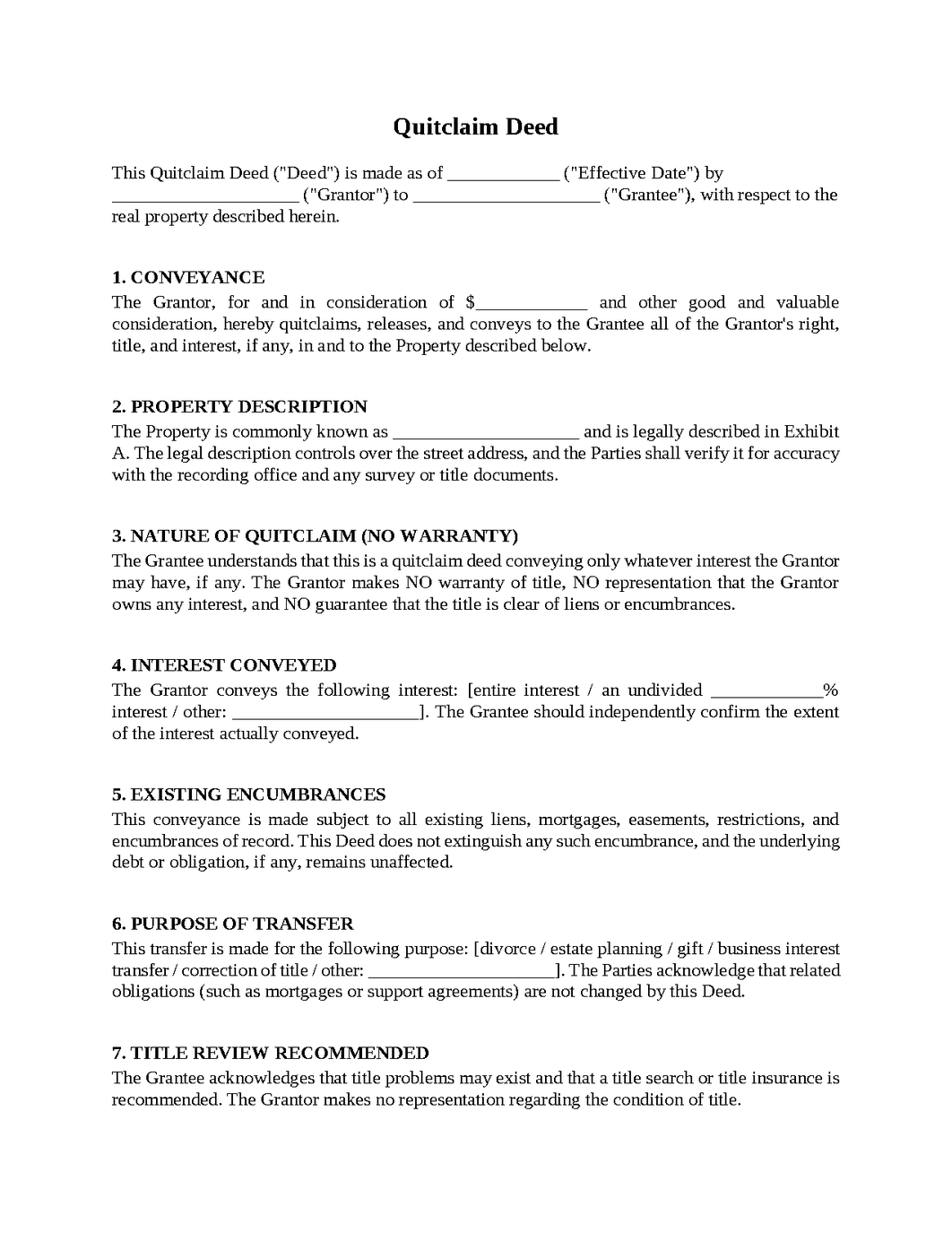
A Quitclaim Deed is a legal document used to transfer whatever ownership interest a person may have in real property to another party without providing warranties or guarantees regarding title. Unlike a warranty deed, a Quitclaim Deed does not promise that the grantor actually owns the property or that the title is free from defects. Quitclaim Deeds are commonly used between family members, spouses, former spouses, business partners, trusts, and related parties where the parties know each other and are not relying on extensive title protections. Because a Quitclaim Deed transfers only the interest the grantor possesses, disputes can arise when parties misunderstand the legal effect of the transfer. A well-prepared Quitclaim Deed helps clarify ownership intentions and reduce future title disputes.
The Recipient Assumes Full Ownership Is Being Transferred
A father decides to transfer property interests to an adult child using a Quitclaim Deed. The family believes the transfer is simple because everyone trusts one another and no sale is involved.
After the deed is recorded, the child assumes complete ownership of the property has been transferred. Years later, questions arise regarding prior ownership interests, liens, and other claims affecting title.
The child discovers that a Quitclaim Deed transfers only whatever interest the father actually possessed at the time of the transfer. If ownership was shared or subject to limitations, those issues may remain.
The misunderstanding creates frustration because the recipient believed the transfer provided greater assurances than it actually did.
Neither party intended confusion, but both misunderstood the legal effect of the document.
To help avoid this problem, a Quitclaim Deed should be accompanied by a clear explanation of the interest being transferred and the limitations associated with quitclaim transfers. Understanding the nature of the conveyance helps prevent future surprises.
Divorce Proceedings Leave Ownership Questions Unresolved
A married couple owns a home together. During divorce proceedings, one spouse agrees to transfer ownership rights to the other spouse through a Quitclaim Deed.
The deed is signed and recorded, and both parties assume the matter is resolved. Several years later, the spouse who retained the property attempts to refinance or sell the home.
Questions arise regarding mortgage obligations that remained in both spouses' names even though ownership interests changed. The former spouse who signed the Quitclaim Deed believed all responsibilities ended with the transfer.
The spouse retaining the property discovers that ownership and loan obligations are separate legal matters.
The misunderstanding creates financial complications long after the divorce has concluded.
To reduce these risks, parties using a Quitclaim Deed during a divorce should address both ownership transfers and related financial obligations. A Quitclaim Deed changes title ownership but does not automatically remove someone from existing loan agreements.
A Business Partner Transfers an Interest Without Understanding the Consequences
Several individuals jointly own investment property through a business arrangement.
One partner decides to exit the investment and signs a Quitclaim Deed transferring any ownership interest to the remaining partners. At the time, everyone believes the transaction is straightforward.
Years later, the property's value increases dramatically. The former partner begins questioning whether the transfer accurately reflected the intended agreement and whether compensation was appropriate.
The remaining owners believe the transfer permanently resolved ownership issues. The former partner argues that expectations regarding value and future appreciation were never discussed adequately.
The disagreement becomes especially significant because substantial property value is now involved.
To help avoid these issues, a Quitclaim Deed should be supported by clear documentation explaining the purpose of the transfer, any consideration being paid, and the parties' understanding regarding future ownership rights.
Hidden Title Problems Surface After the Transfer
A family member receives property through a Quitclaim Deed and assumes ownership has been transferred successfully.
After deciding to sell the property, the new owner discovers title issues involving prior deeds, unresolved ownership claims, liens, or recording errors. Because a Quitclaim Deed provides no warranties regarding title quality, the recipient has limited recourse against the grantor.
The new owner becomes frustrated because the problems were unknown when the transfer occurred. The grantor insists that no promises were made regarding title condition.
The dispute centers on expectations rather than misconduct.
The recipient assumed the transfer carried protections that were never actually provided.
To help prevent these problems, parties receiving property through a Quitclaim Deed should consider conducting title reviews and obtaining professional advice regarding ownership status before relying on the transfer.
Estate Planning Transfers Create Family Disputes
A property owner uses a Quitclaim Deed to transfer real estate into a trust or to add family members to title as part of an estate planning strategy.
The owner believes the transfer will simplify future administration and avoid probate complications. Other family members later question the purpose of the transfer and whether it reflects the owner's true intentions.
After the owner's death, disagreements arise regarding ownership rights, inheritance expectations, and the effect of the Quitclaim Deed on the overall estate plan.
Family members interpret the transfer differently and rely on conflicting understandings of what the owner intended.
A document intended to simplify matters instead becomes a source of confusion.
To reduce these risks, a Quitclaim Deed used in estate planning should be coordinated carefully with wills, trusts, beneficiary designations, and other planning documents. Clear communication regarding the purpose of the transfer can help prevent future disputes.
Quitclaim Deeds are useful tools for transferring ownership interests between parties who know and trust one another, particularly in family, business, and estate planning contexts. However, issues involving ownership expectations, divorce settlements, business interests, title defects, and estate planning objectives can become significant sources of conflict when the legal effect of the deed is misunderstood. A carefully prepared Quitclaim Deed, supported by appropriate legal and title review, helps ensure that ownership transfers occur as intended. When used thoughtfully, it can simplify property transfers, reduce administrative burdens, and support long-term planning goals.

Get started with Upsign today!
Easily send, sign and track your documents