

Waiver and Release Agreement
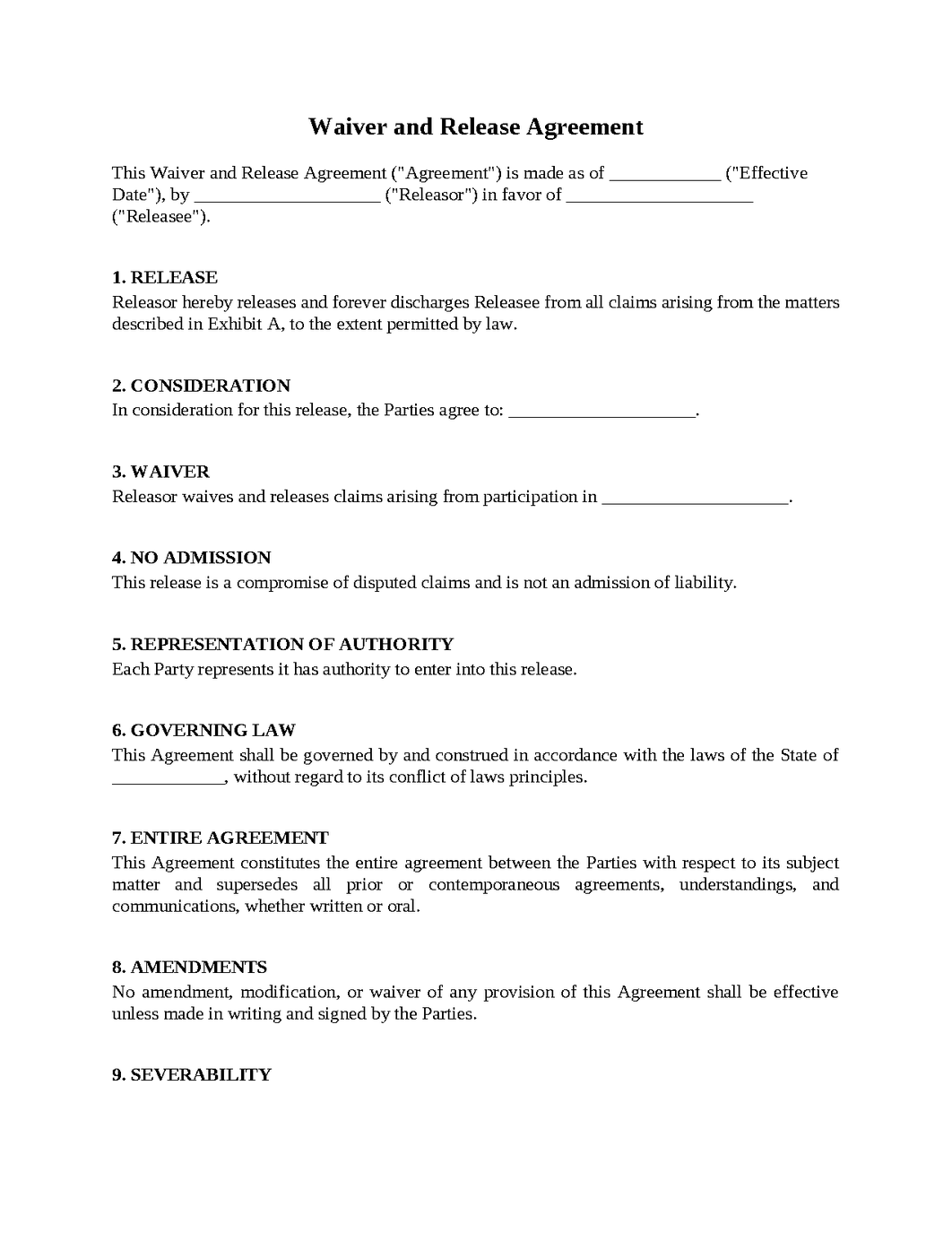
A Waiver and Release Agreement is a legal contract through which one party voluntarily agrees to waive certain legal rights and release another party from liability arising from a specific activity, event, service, relationship, or transaction. These agreements are commonly used in recreational activities, sporting events, educational programs, fitness facilities, volunteer opportunities, travel experiences, construction projects, and various business activities involving known risks. While a Liability Release Agreement typically focuses on releasing liability for injuries or damages, a Waiver and Release Agreement often combines both the assumption of risk and the release of potential claims into a single document. Because participants may later experience losses, injuries, or unexpected outcomes, disputes frequently arise when the parties disagree about the risks that were assumed or the rights that were waived. A carefully drafted Waiver and Release Agreement helps establish clear expectations while reducing uncertainty regarding future claims.
A Participant Is Injured During a Voluntary Activity
An organization hosts an outdoor adventure program that includes physically demanding activities and varying environmental conditions.
Before participating, each attendee signs a Waiver and Release Agreement acknowledging the risks associated with the program. Most participants review the document, understand the nature of the activity, and proceed without concern.
During one event, a participant suffers a significant injury and requires medical treatment. The participant later incurs medical expenses, loses time from work, and faces a lengthy recovery process.
The participant argues that the organization failed to provide adequate supervision and therefore should remain responsible for the resulting damages. The organization believes the participant knowingly accepted the risks and voluntarily signed the waiver before taking part.
The disagreement centers on whether the injury resulted from risks that were assumed or from conduct that falls outside the scope of the waiver.
To help avoid this problem, a Waiver and Release Agreement should clearly identify the risks associated with the activity and explain the claims and liabilities being waived.
The Participant Claims the Waiver Was Never Understood
A fitness company launches a new program involving specialized equipment and high-intensity training sessions.
As part of the enrollment process, participants are required to sign a Waiver and Release Agreement. The company believes the document adequately explains the risks and provides participants with an opportunity to review the terms before participating.
Several months later, a participant experiences an injury and challenges the agreement. The participant acknowledges signing the document but argues that the legal language was difficult to understand and that the consequences of the waiver were never explained clearly.
The company maintains that participation was voluntary and that the participant had sufficient time to ask questions or seek advice before signing.
The disagreement becomes focused on whether the waiver was entered into knowingly and voluntarily.
To help prevent these issues, a Waiver and Release Agreement should be written in clear language, presented in a conspicuous manner, and provide participants with a reasonable opportunity to understand its contents before signing.
A Parent Signs on Behalf of a Minor
A youth sports organization requires parents to complete a Waiver and Release Agreement before children may participate in league activities.
The organization explains the physical nature of the sport and outlines the risks that participants may encounter during practices and competitions. Parents sign the required documents so their children may join the program.
During a tournament, a child suffers an injury that requires medical attention and ongoing treatment. The parents later question whether the waiver should apply under the circumstances and whether the organization fulfilled its responsibilities regarding supervision and safety.
The organization points to the signed waiver and the known risks of athletic participation. The parents believe the injury resulted from conditions that extend beyond the ordinary risks associated with the sport.
The disagreement becomes particularly sensitive because it involves a minor participant and the role of parental consent.
To help avoid these problems, a Waiver and Release Agreement should clearly address participation by minors, identify the authority of parents or guardians, and explain the risks associated with the activity.
Property Damage Leads to Unexpected Claims
A company organizes an event that allows participants to use personal equipment and vehicles during the activity.
Before attending, participants sign a Waiver and Release Agreement covering a variety of risks associated with participation. The company believes the agreement addresses both personal injury and property-related claims.
During the event, a participant's equipment is damaged. The participant believes the damage resulted from conditions that should have been addressed by the organizer and seeks compensation for repair costs.
The organizer argues that participants accepted the possibility of property damage as part of the activity and waived related claims through the agreement.
The disagreement focuses on whether the waiver extends beyond personal injuries and includes property-related losses.
To help prevent these issues, a Waiver and Release Agreement should clearly identify the types of claims being waived and specify whether property damage claims are included within the scope of the release.
Participants Challenge the Scope of the Waiver After an Incident
A business offers a recreational experience that involves transportation, equipment, instructors, and third-party service providers.
Participants sign a Waiver and Release Agreement before the experience begins. At the time, the participants believe the document primarily relates to risks directly associated with the activity itself.
Following an incident, questions arise regarding the conduct of instructors, contractors, or third-party vendors involved in the program. The participants argue that the waiver was never intended to cover claims arising from those individuals or entities.
The business believes the waiver was drafted broadly to encompass all aspects of participation, including activities performed by affiliated service providers.
The disagreement becomes significant because liability may depend entirely on how broadly the waiver is interpreted.
To help avoid these problems, a Waiver and Release Agreement should clearly identify the parties being protected, define the scope of the release, and explain how claims involving employees, contractors, affiliates, and third parties will be treated.
Waiver and Release Agreements are widely used to allocate risk and allow individuals to participate in activities that involve known dangers and uncertainties. However, issues involving participant injuries, informed consent, parental authorization, property damage, and the scope of released claims can become significant sources of conflict when expectations are not documented clearly. A carefully drafted Waiver and Release Agreement provides a structured framework for communicating risks and establishing responsibilities before participation occurs. When prepared thoughtfully, it can reduce misunderstandings, support informed decision-making, and provide greater certainty for all parties involved.

Get started with Upsign today!
Easily send, sign and track your documents