

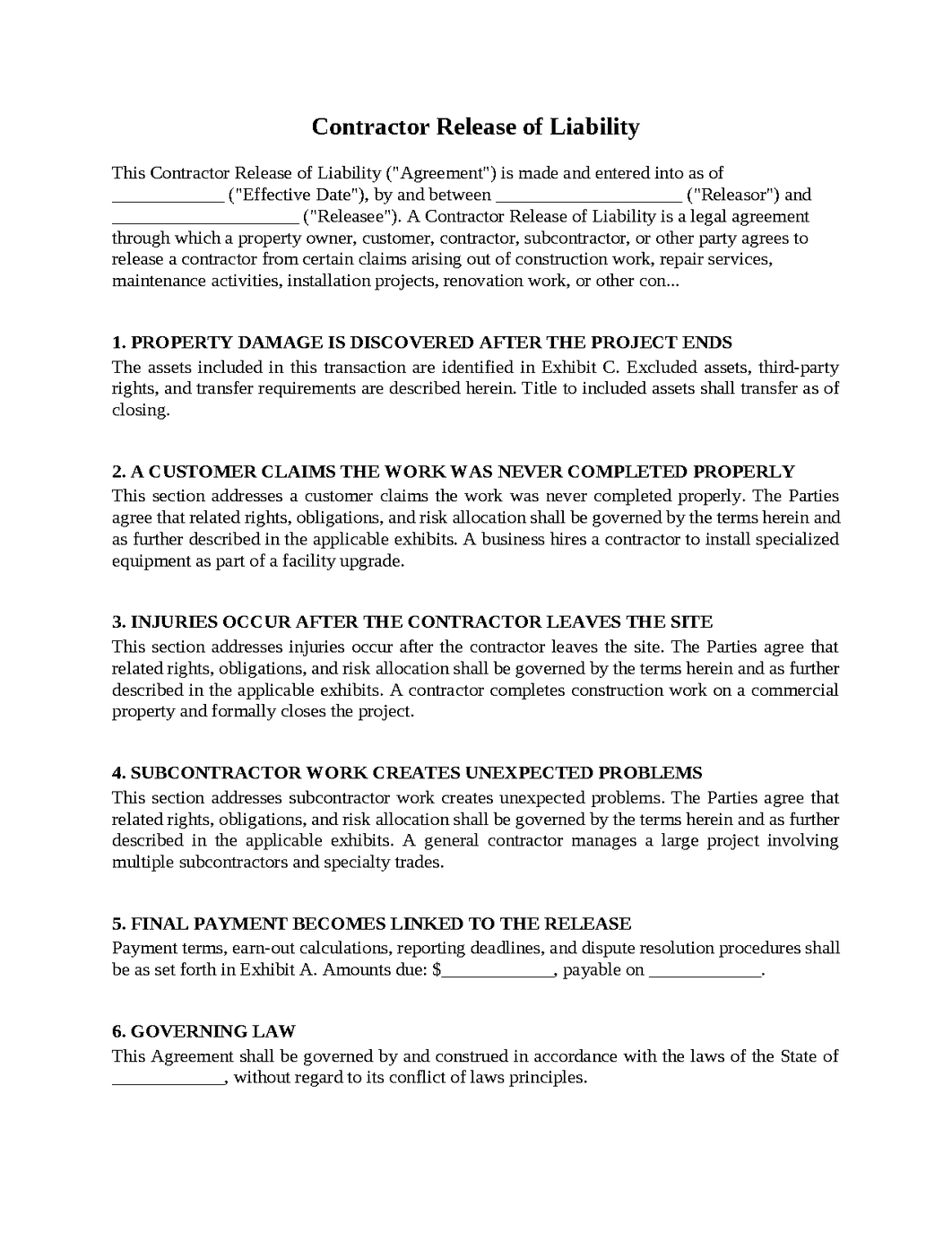
Contractor Release of Liability
A Contractor Release of Liability is a legal agreement through which a property owner, customer, contractor, subcontractor, or other party agrees to release a contractor from certain claims arising out of construction work, repair services, maintenance activities, installation projects, renovation work, or other contracted services. These agreements are commonly used in residential construction, commercial construction, remodeling projects, landscaping services, equipment installations, maintenance contracts, and specialty trade work. The purpose of a Contractor Release of Liability is to allocate risk and establish clear expectations regarding responsibility for damages, delays, defects, injuries, and other issues that may arise during or after a project. Because construction and service projects often involve changing conditions and multiple participants, disputes can arise when the parties disagree about the scope and effect of the release. A carefully drafted Contractor Release of Liability helps reduce uncertainty while protecting all parties involved.
Property Damage Is Discovered After the Project Ends
A homeowner hires a contractor to complete a substantial renovation project involving several areas of the property.
The work is completed, final inspections occur, and the homeowner signs a Contractor Release of Liability as part of the project closeout process. Both parties believe the project has been completed successfully and that all known issues have been addressed.
Several months later, the homeowner discovers water intrusion, structural concerns, or other conditions that were not apparent during the final walkthrough. The homeowner believes the newly discovered problems are connected to the contractor's work.
The contractor argues that the project was completed properly and that the release was intended to resolve claims relating to the completed work. The homeowner believes unknown defects should not be covered by a release signed before the issues were discovered.
The disagreement develops because the alleged damage was not visible when the project was closed out.
To help avoid this problem, a Contractor Release of Liability should clearly address known and unknown conditions and explain the relationship between the release and any warranties that remain in effect after project completion.
A Customer Claims the Work Was Never Completed Properly
A business hires a contractor to install specialized equipment as part of a facility upgrade.
The contractor completes the installation and demonstrates the equipment's operation. Following a final review, the customer signs a Contractor Release of Liability and makes the final payment required under the contract.
Several weeks later, operational issues begin affecting the equipment's performance. The customer believes the contractor failed to complete the installation according to specifications and seeks additional corrective work.
The contractor maintains that the equipment functioned properly when the project was accepted and that the release confirms the customer's satisfaction with the completed work. The customer argues that acceptance should not excuse deficiencies that become apparent only after normal operations begin.
The disagreement focuses on whether the release extends to claims involving alleged performance deficiencies.
To help prevent these issues, a Contractor Release of Liability should clearly distinguish project acceptance, warranty obligations, and the claims that are being released.
Injuries Occur After the Contractor Leaves the Site
A contractor completes construction work on a commercial property and formally closes the project.
The property owner signs a Contractor Release of Liability after confirming that the work appears complete. The contractor removes equipment, personnel, and materials from the site and moves on to other projects.
Several months later, an individual is injured in an area where the contractor previously performed work. Questions arise regarding whether the injury was caused by the contractor's activities, subsequent modifications, or conditions created after the contractor left the project.
The injured party believes the contractor may still bear responsibility. The contractor argues that control of the property transferred back to the owner long ago and that the release was intended to provide finality.
The parties disagree regarding where the contractor's responsibility ended and the property owner's responsibility began.
To help avoid these problems, a Contractor Release of Liability should clearly identify the claims being released and explain how responsibility is allocated following project completion.
Subcontractor Work Creates Unexpected Problems
A general contractor manages a large project involving multiple subcontractors and specialty trades.
After construction is completed, the property owner signs a Contractor Release of Liability and closes out the project. Everyone expects the completed improvements to perform as intended.
Over time, defects emerge in work performed by one of the subcontractors. The property owner seeks compensation from the general contractor, believing the contractor remains responsible for the overall project.
The general contractor argues that the issues stem from the actions of a subcontractor and points to contractual provisions addressing responsibility for third-party work. The owner believes the release did not fully explain how subcontractor-related claims would be handled.
The disagreement becomes complicated because multiple parties contributed to the final project.
To help prevent these issues, a Contractor Release of Liability should clearly address subcontractor work and explain how liability will be allocated among contractors, subcontractors, and property owners.
Final Payment Becomes Linked to the Release
A contractor completes a renovation project and submits a final invoice to the customer.
The contractor requests that the customer sign a Contractor Release of Liability before final project documents are exchanged and the work is formally closed. The customer is eager to finish the project but still has concerns regarding several items.
The contractor believes the release is a routine part of project completion and necessary to prevent future disputes. The customer worries that signing the document may eliminate important rights before all outstanding issues are resolved.
Negotiations become increasingly difficult because the final payment, project acceptance, and release obligations are all tied together. Each party believes the other is using the process to gain leverage.
What should have been a routine project closeout becomes a disagreement regarding risk allocation and final responsibility.
To help avoid these problems, a Contractor Release of Liability should clearly explain when the release becomes effective, identify any conditions that must be satisfied beforehand, and address unresolved punch-list or warranty items.
Contractor Releases of Liability are important tools for managing risk and bringing construction and service projects to a formal conclusion. However, issues involving hidden defects, performance concerns, post-completion injuries, subcontractor work, and project closeout procedures can become significant sources of conflict when expectations are not documented clearly. A carefully drafted Contractor Release of Liability provides a structured framework for allocating responsibility and reducing uncertainty. When prepared thoughtfully, it can help protect all parties involved, support efficient project completion, and provide the finality necessary for successful business relationships.

Get started with Upsign today!
Easily send, sign and track your documents