

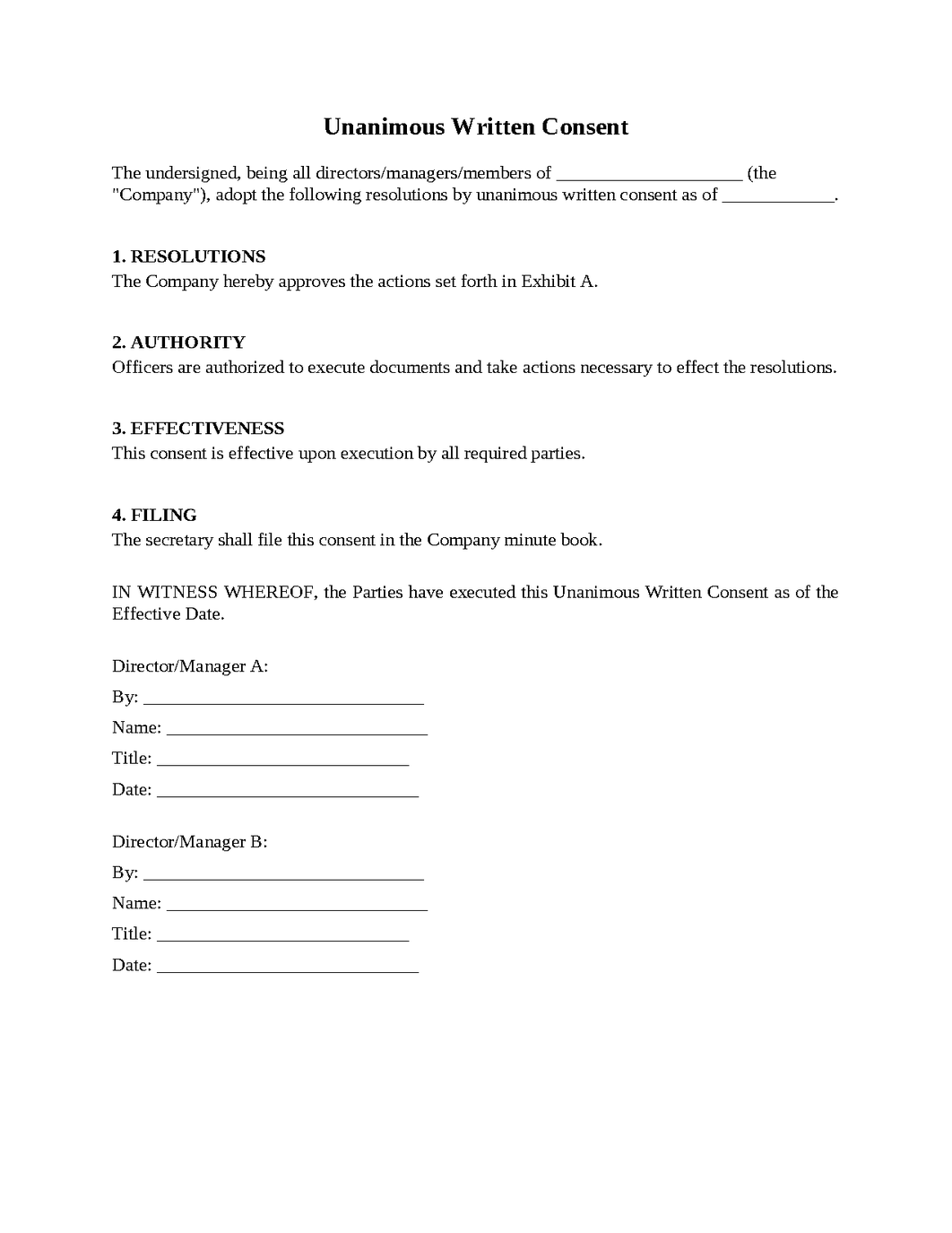
Unanimous Written Consent
A Unanimous Written Consent is a legal document that allows the shareholders, members, directors, managers, or other governing parties of an organization to approve business actions without holding a formal meeting. These documents are commonly used by corporations, limited liability companies, partnerships, nonprofit organizations, and closely held businesses to authorize significant decisions efficiently. Unanimous Written Consents are frequently used to approve contracts, elect officers, authorize financing transactions, admit owners, approve mergers, issue equity, purchase assets, and take other important corporate actions. Because these documents often serve as a substitute for formal meetings, disputes can arise when authority, approval requirements, or documentation procedures are not handled properly. A carefully prepared Unanimous Written Consent helps ensure that business decisions are legally authorized and properly documented.
An Owner Claims Approval Was Never Given
A closely held company needs to approve an important financing transaction quickly.
Rather than scheduling a formal meeting, management circulates a Unanimous Written Consent to the owners for signature. Most of the owners review the document promptly and provide their approval without objection.
Months later, questions arise regarding whether every required party actually approved the transaction. One owner claims that the document was never received, that the proposed action was not explained adequately, or that approval was assumed without proper authorization.
The remaining owners believe the consent process was completed properly and that everyone had an opportunity to participate. The dissenting owner argues that the transaction should not be considered valid because unanimous approval was never truly obtained.
The disagreement creates uncertainty regarding the validity of the underlying transaction and exposes the company to potential governance disputes.
To help avoid this problem, a Unanimous Written Consent should clearly identify the approving parties, document each required signature, and establish a reliable process for distributing and collecting approvals.
The Consent Language Is Too Broad
A company's directors use a Unanimous Written Consent to approve a specific business initiative.
The parties intend to authorize a particular transaction and believe the document accomplishes that purpose. Several months later, however, questions arise regarding whether the language also authorized additional actions that were not discussed at the time.
Some participants believe the consent was limited to the original transaction. Others argue that the wording is broad enough to permit related activities and future decisions connected to the same project.
The disagreement becomes significant because substantial business actions were taken in reliance on differing interpretations of the consent.
What initially appeared to be a simple approval document becomes a dispute regarding the scope of authority that was granted.
To help prevent these issues, a Unanimous Written Consent should describe approved actions with sufficient specificity and avoid language that could create uncertainty regarding the extent of the authorization.
A New Owner Questions Prior Actions
A company admits a new investor who acquires a significant ownership interest.
As part of the investor's due diligence process, historical company records are reviewed, including numerous Unanimous Written Consents used to authorize important decisions over many years. During the review, the investor discovers inconsistencies in signatures, dates, and supporting documentation.
The investor becomes concerned that some corporate actions may not have been approved properly. Existing owners believe the actions were valid and that any documentation issues are merely administrative oversights.
Questions arise regarding financing transactions, ownership issuances, and other decisions that relied upon the prior consents.
The disagreement creates uncertainty because the validity of past actions may affect the company's current ownership and governance structure.
To help avoid these problems, a Unanimous Written Consent should be maintained carefully within company records and supported by documentation demonstrating that all approval requirements were satisfied.
Timing Becomes a Source of Dispute
A company needs to approve a transaction involving a major customer opportunity.
Management prepares a Unanimous Written Consent and begins circulating it among the necessary decision-makers. Some parties sign immediately, while others delay their review for several weeks.
During the delay, circumstances change. Financial information evolves, market conditions shift, and new facts become available that were not known when the first signatures were obtained.
Certain participants believe the consent should remain effective because everyone ultimately signed. Others argue that approvals given weeks apart were based on different information and should not be treated as unanimous approval of the same proposal.
The disagreement creates uncertainty regarding when the action was actually authorized and whether additional approval should have been obtained.
To help prevent these issues, a Unanimous Written Consent should clearly identify effective dates, specify when approval becomes final, and establish procedures for handling material changes that occur during the approval process.
The Consent Conflicts With Governing Documents
A business uses a Unanimous Written Consent to approve a significant transaction involving company assets.
The participants believe the consent provides sufficient authority and proceed with the transaction. Later, however, someone discovers that the company's governing documents require additional approvals, notices, or procedures for certain actions.
Some owners argue that the consent alone was not enough because the governing documents imposed additional requirements. Others believe unanimous approval should cure any procedural deficiencies.
The dispute becomes increasingly important because third parties relied on the company's authorization when completing the transaction.
What began as a routine approval process evolves into a broader governance issue.
To help avoid these problems, a Unanimous Written Consent should be reviewed in conjunction with applicable governing documents and legal requirements to ensure that all necessary approvals and procedures have been satisfied.
Unanimous Written Consents are valuable tools that allow organizations to act efficiently without the delay and expense of formal meetings. However, issues involving approval authority, ambiguous language, recordkeeping, timing, and compliance with governing documents can become significant sources of conflict when the process is not handled carefully. A properly prepared Unanimous Written Consent provides a structured framework for documenting important business decisions and demonstrating valid authorization. When drafted thoughtfully, it can help reduce uncertainty, strengthen corporate governance, preserve organizational records, and support effective decision-making.

Get started with Upsign today!
Easily send, sign and track your documents