

Assignment Agreement
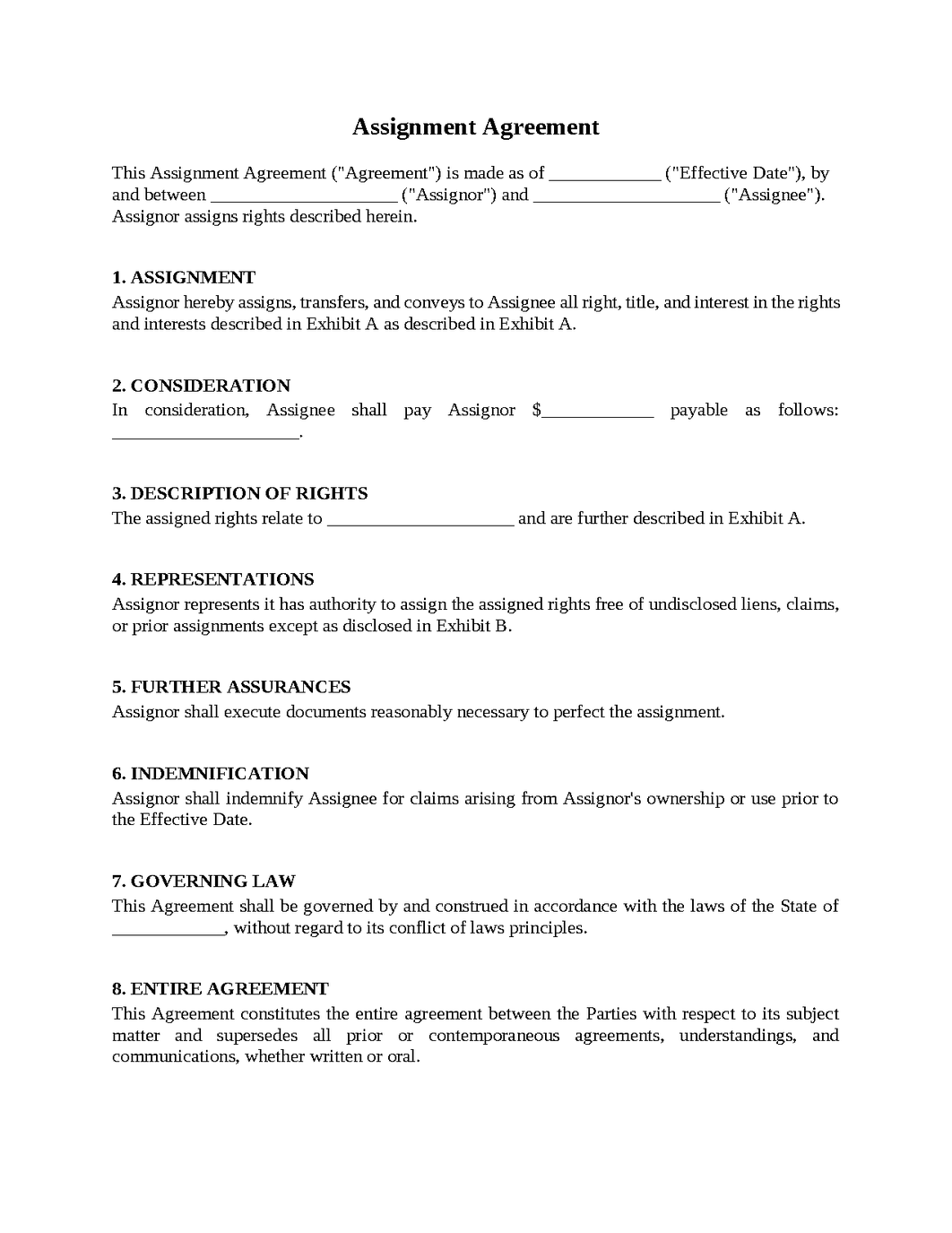
An Assignment Agreement is a contract used to transfer certain rights, interests, benefits, or obligations from one party to another. The party transferring the rights is commonly referred to as the assignor, while the party receiving the rights is known as the assignee. Assignment Agreements are frequently used in business transactions, real estate deals, intellectual property transfers, contract rights sales, lease transfers, debt assignments, and many other situations where one party wishes to transfer a legal interest to another. While assignments can provide flexibility and create valuable business opportunities, they also create important questions regarding consent, liability, performance obligations, and the scope of transferred rights. When drafted carefully, an Assignment Agreement helps ensure that everyone understands exactly what is being transferred and what responsibilities remain. When important details are overlooked, disputes can arise long after the assignment is completed.
The Original Contract Prohibits Assignments
A software company enters into a service agreement with a large corporate customer. Several years later, the software company is acquired by another business that wants to assume all existing customer contracts.
The acquiring company believes the transition will be simple. However, during its review of customer agreements, it discovers a provision stating that the contract may not be assigned without the customer's written consent.
The acquiring company argues that the assignment should still be valid because the services will continue uninterrupted. The customer disagrees and insists that it has the contractual right to approve any transfer.
Situations like this occur frequently because many contracts contain assignment restrictions. Businesses often want control over who performs services, receives payments, or assumes contractual obligations.
The consequences can be significant. Transactions may be delayed. Additional negotiations may be required. In some cases, assignments may be invalid entirely if consent requirements are ignored.
The issue becomes particularly important during mergers, acquisitions, business sales, and restructuring transactions where large numbers of contracts may be affected simultaneously.
An Assignment Agreement helps identify the rights being transferred and encourages parties to review underlying contracts before proceeding. By addressing consent requirements upfront, the agreement can reduce the risk of future disputes.
The Parties Disagree About What Was Actually Assigned
A commercial landlord assigns certain rights under a lease agreement to a property investment company. Both parties believe they understand the transaction and move forward confidently.
Several months later, a disagreement emerges regarding whether the assignment included future rent payments, security deposit rights, maintenance obligations, or all of the above.
The original assignment language referred generally to "all interests" under the lease but did not specifically identify every right being transferred.
The ambiguity creates confusion. Each party interprets the agreement differently and believes their position is supported by the contract language.
This problem is common because assignments often involve complex legal relationships. Rights, obligations, benefits, liabilities, and future interests may all exist under a single contract.
When the assignment language is broad or imprecise, parties may later discover that they had very different expectations regarding what was included.
An Assignment Agreement helps reduce these risks by clearly identifying the rights being assigned and any interests that are specifically excluded. Detailed descriptions often prevent misunderstandings before they develop into larger disputes.
The Assignee Expects Rights but Not Responsibilities
A consulting company assigns a service contract to another provider. The new provider eagerly accepts the opportunity because the contract generates substantial revenue.
After the assignment closes, however, the assignee learns that the contract also contains extensive service obligations, reporting requirements, and performance guarantees.
The assignee argues that it expected to receive the benefits of the contract but not all of the burdens associated with performing the work. The assignor disagrees and points to the assignment documents.
This type of conflict occurs because contracts often contain both rights and obligations. A party receiving payments under a contract may also be responsible for delivering products, services, support, warranties, or other commitments.
If responsibilities are not addressed clearly during the assignment process, disputes can emerge regarding who remains responsible for performance.
Customers, clients, and third parties may also become confused regarding who should fulfill contractual obligations after an assignment occurs.
An Assignment Agreement helps clarify whether obligations are being transferred along with rights and whether any responsibilities remain with the assignor. Clear allocation of duties can significantly reduce future conflicts.
A Third Party Challenges the Validity of the Assignment
A lender sells a portfolio of loans to an investment company through a series of assignment transactions. Months later, a borrower challenges the investment company's authority to collect payments.
The borrower argues that ownership of the loan was never transferred properly and requests proof that the investment company actually owns the debt.
The challenge forces the investment company to reconstruct the chain of assignments and demonstrate how ownership transferred from one entity to another.
This issue arises frequently when rights are assigned multiple times over many years. Missing documents, incomplete records, or inconsistent paperwork can create uncertainty regarding ownership.
The consequences may include delayed collections, increased legal expenses, and challenges to enforcement efforts.
Businesses involved in loan portfolios, intellectual property rights, commercial leases, and contract assignments often encounter similar issues.
An Assignment Agreement helps establish a formal record of each transfer and provides documentation supporting ownership claims. Maintaining accurate assignment records can be critical when rights are challenged later.
The Assignor Believes Liability Ended Automatically
A subcontractor assigns a construction agreement to another contractor midway through a large project. The original subcontractor assumes that once the assignment occurs, all responsibility for the project ends immediately.
Months later, performance issues arise and the project owner seeks compensation from both the new contractor and the original subcontractor.
The original subcontractor is surprised. They believed the assignment completely eliminated any future liability. The project owner argues that certain obligations remained because no formal release was ever granted.
This misunderstanding is common. Many parties assume that assigning a contract automatically eliminates all obligations under that contract.
In reality, the effect of an assignment often depends on the language of the agreements involved and whether other parties consented to release the assignor from responsibility.
Without careful planning, assignors may remain exposed to claims long after they believe their involvement has ended.
An Assignment Agreement helps address these concerns by clearly identifying what liabilities remain, what obligations transfer, and whether any releases are being granted as part of the transaction.
Assignments allow businesses and individuals to transfer valuable rights and opportunities efficiently, but they also create important questions regarding consent, ownership, obligations, liability, and contract interpretation. Disputes frequently arise when parties fail to define clearly what is being transferred and what responsibilities remain after the transaction is completed. An Assignment Agreement provides a practical framework for documenting these transfers and establishing expectations for everyone involved. When drafted carefully and supported by clear documentation, the agreement can help reduce uncertainty, facilitate transactions, and provide all parties with greater confidence regarding their rights and obligations.
:::

Get started with Upsign today!
Easily send, sign and track your documents