

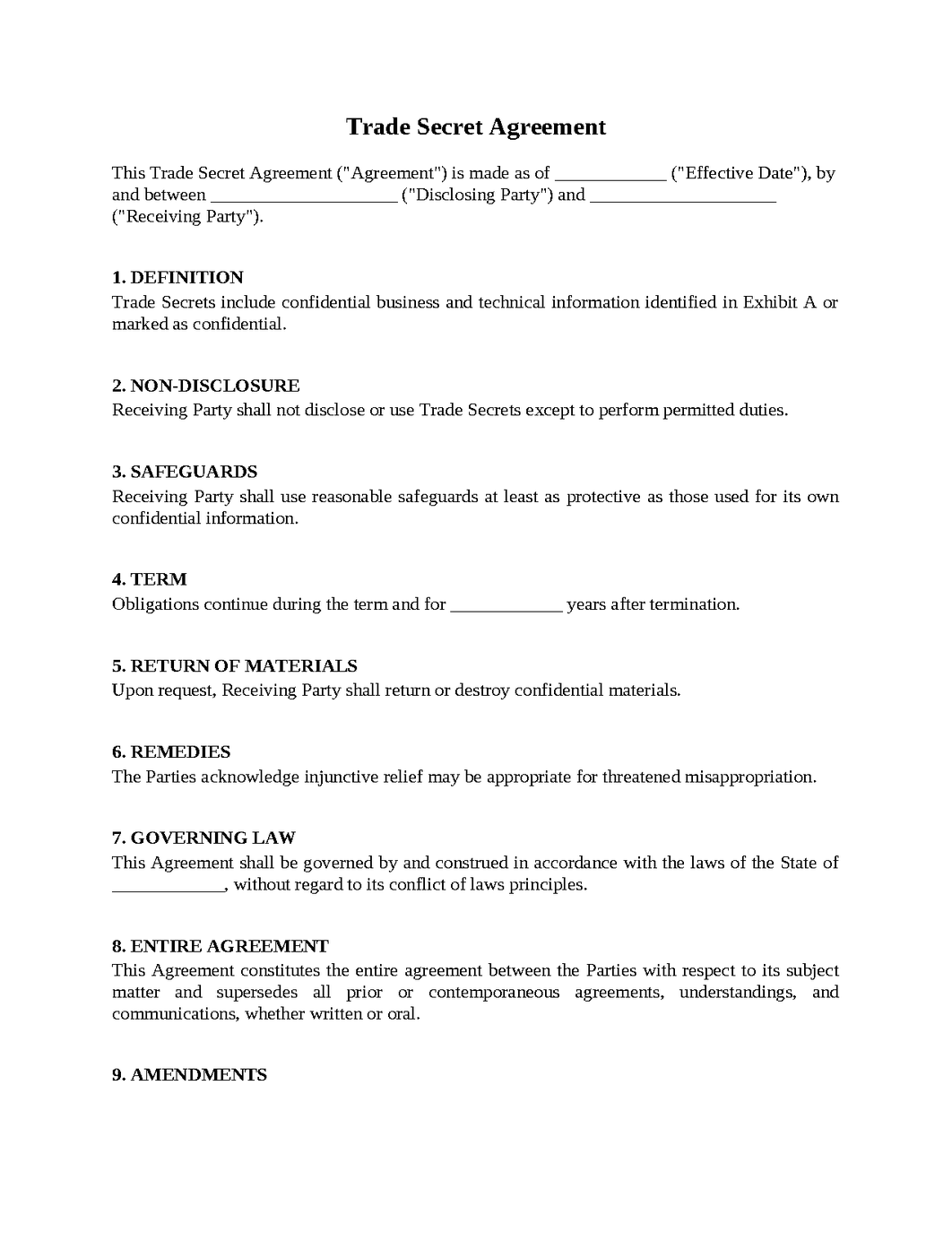
Trade Secret Agreement
A Trade Secret Agreement is a legal contract designed to protect confidential business information that derives economic value from not being generally known to the public. These agreements are commonly used between businesses and employees, contractors, consultants, vendors, investors, strategic partners, manufacturers, software developers, and other parties who may gain access to sensitive information. Trade secrets can include formulas, customer lists, pricing strategies, manufacturing processes, algorithms, source code, marketing plans, supplier relationships, business methods, and proprietary know-how. Because trade secrets often represent some of a company's most valuable assets, disputes can arise when expectations regarding confidentiality and use restrictions are not documented clearly. A well-drafted Trade Secret Agreement helps protect valuable information while reducing the risk of misuse or unauthorized disclosure.
A Former Employee Uses Confidential Information at a Competitor
A company invests years developing proprietary methods that provide a significant advantage in the marketplace.
An employee gains access to customer information, internal processes, pricing strategies, and specialized operational knowledge while working for the company. Eventually, the employee accepts a position with a competing business.
Shortly after the transition, the former employer notices that the competitor appears to be adopting remarkably similar practices and targeting many of the same customers.
The company becomes concerned that confidential information may have been used improperly. The former employee insists that only general industry knowledge and personal experience are being utilized.
The disagreement becomes difficult because distinguishing trade secrets from general professional knowledge is not always straightforward.
To help avoid this problem, a Trade Secret Agreement should clearly identify protected information, establish confidentiality obligations, and define prohibited uses of trade secrets following termination of the relationship.
A Business Partner Shares Information With Third Parties
Two companies enter into discussions regarding a potential strategic partnership.
To evaluate the opportunity, one company shares detailed information regarding operations, technology, customer relationships, and future business plans. Both parties understand that the information is sensitive and commercially valuable.
Months later, the disclosing company learns that portions of the information appear to have been shared with outside parties who were not involved in the original discussions.
The recipient argues that no intentional disclosure occurred or that the information was already known through other sources. The disclosing company believes the confidentiality obligations were violated.
Trust deteriorates because sensitive information can no longer be controlled effectively.
To reduce these risks, a Trade Secret Agreement should clearly define confidential information, restrict disclosure to authorized individuals, establish security requirements, and identify remedies for unauthorized sharing.
A Contractor Develops Improvements Using Trade Secrets
A business hires a consultant to assist with improving operational efficiency and product development.
During the engagement, the consultant gains access to proprietary methods, internal data, and trade secret information. While performing the work, the consultant develops improvements and enhancements based on the information provided.
When the engagement concludes, questions arise regarding ownership of the improvements.
The company believes any developments based on its trade secrets should belong to the business. The consultant believes independent expertise contributed significantly to the results.
The disagreement becomes increasingly important because the improvements may have substantial commercial value.
To help prevent these issues, a Trade Secret Agreement should address ownership of derivative works, define rights to improvements, and establish how intellectual property created during the relationship will be treated.
The Parties Disagree About Whether Information Is Truly Confidential
A company accuses a former contractor of disclosing trade secrets after similar information appears in the marketplace.
The company insists the information was proprietary and closely guarded. The contractor argues that the information was widely known within the industry and therefore does not qualify as a protected trade secret.
Both parties present evidence supporting their positions.
The company points to internal confidentiality procedures and restricted access. The contractor points to public sources, industry practices, and prior disclosures.
The disagreement centers on whether the information actually qualifies for trade secret protection.
To help avoid these problems, a Trade Secret Agreement should clearly identify categories of protected information, establish confidentiality procedures, and document the parties' understanding regarding the proprietary nature of the information.
Confidential Information Remains Accessible After the Relationship Ends
A technology company provides a vendor with access to sensitive systems and proprietary information necessary to perform services.
Over several years, the vendor accumulates substantial knowledge regarding internal operations, customer relationships, and technical infrastructure. Eventually, the business relationship ends.
The company expects all confidential information to be returned or destroyed. The vendor believes certain records may be retained for legal, administrative, or operational purposes.
Questions arise regarding data deletion, document retention, system access, and ongoing confidentiality obligations.
What should be a routine conclusion to the relationship becomes a dispute regarding information control.
To reduce these risks, a Trade Secret Agreement should establish post-termination obligations, define return and destruction requirements, identify permitted retention exceptions, and clarify how long confidentiality obligations remain in effect.
Trade Secret Agreements play a critical role in protecting proprietary business information that provides competitive advantages and long-term value. However, issues involving former employees, business partners, intellectual property ownership, confidentiality disputes, and post-termination obligations can become significant sources of conflict when expectations are not documented clearly. A carefully drafted Trade Secret Agreement provides a structured framework for safeguarding sensitive information and protecting all parties involved. When prepared thoughtfully, it can help preserve competitive advantages, reduce legal disputes, strengthen business relationships, and support long-term commercial success.

Get started with Upsign today!
Easily send, sign and track your documents