

Purchase Agreement
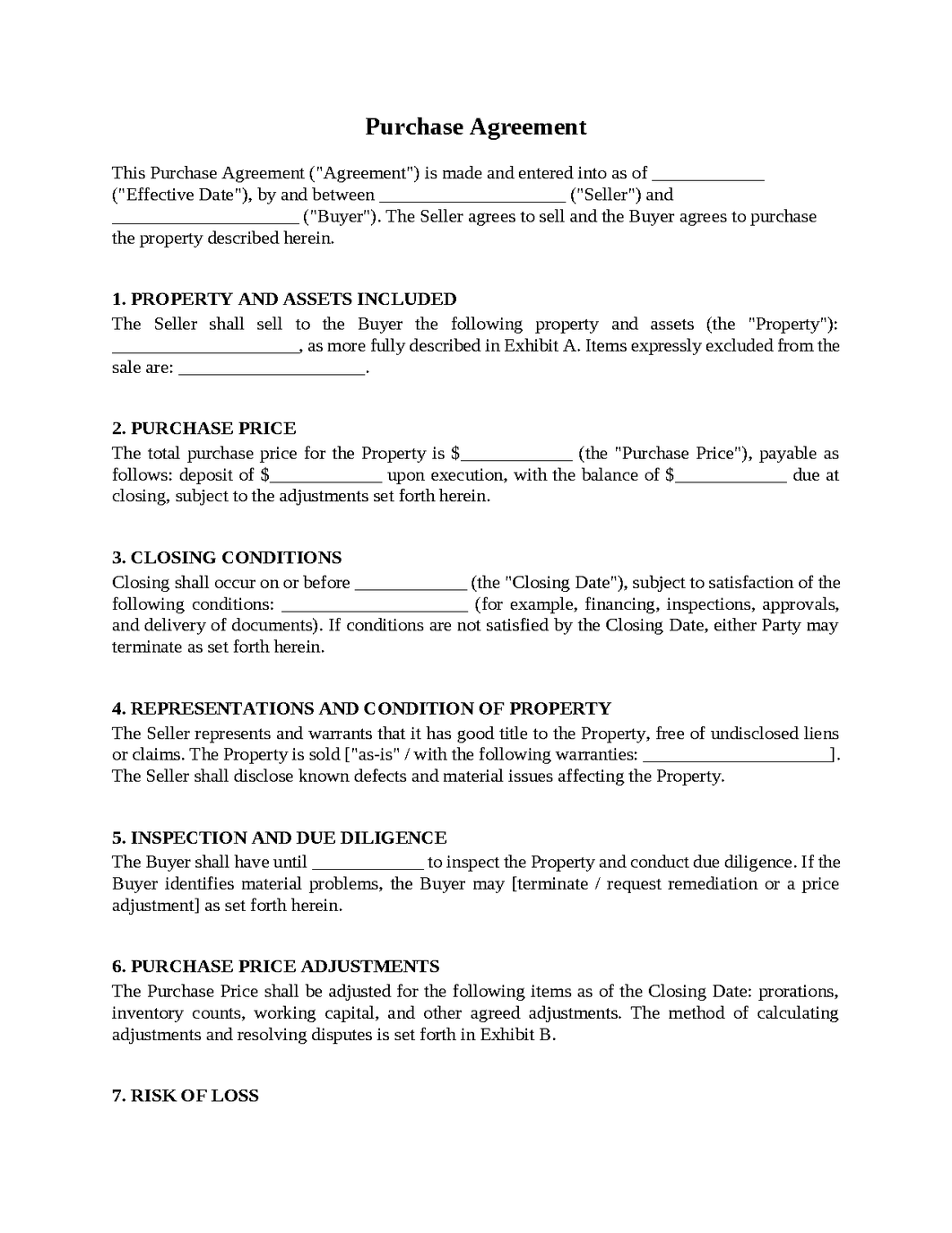
A Purchase Agreement is a legal contract that establishes the terms under which a buyer agrees to purchase and a seller agrees to sell goods, assets, equipment, inventory, real estate, businesses, intellectual property, or other property. Purchase Agreements are among the most common commercial contracts and are used in transactions ranging from simple asset sales to complex business acquisitions. Because these agreements involve the transfer of ownership, payment obligations, warranties, and risk allocation, disputes frequently arise when expectations are not documented clearly. A well-drafted Purchase Agreement helps define the rights and responsibilities of both parties and reduces the likelihood of costly misunderstandings.
The Buyer Assumes More Assets Are Included
A manufacturing company agrees to purchase certain assets from a competitor that is exiting the market. During negotiations, the parties discuss equipment, inventory, customer relationships, and operational resources.
The buyer believes the acquisition includes everything necessary to continue operating the business successfully. The seller believes only the specific assets listed in the agreement are being transferred.
After closing, the buyer discovers that certain software licenses, service contracts, and operational records were not included. The seller points out that those items were never identified as part of the transaction.
What began as an exciting acquisition becomes a dispute over what was actually purchased.
Neither side believes it acted improperly, but both entered the transaction with different assumptions.
To help avoid this problem, a Purchase Agreement should clearly identify all assets being transferred, specify excluded assets, and eliminate ambiguity regarding what is included in the sale.
Problems Are Discovered After the Sale Closes
A buyer purchases a commercial property after conducting preliminary inspections and reviewing information provided by the seller.
The transaction closes successfully, and ownership transfers without issue. Several months later, however, the buyer discovers structural problems, environmental concerns, and deferred maintenance issues that require significant repairs.
The buyer believes the seller should have disclosed the problems before closing. The seller argues that the property was sold in accordance with the agreement and that the buyer had an opportunity to conduct inspections.
The disagreement centers on whether the issues were known, whether they were disclosed properly, and who should bear the resulting costs.
The transaction that appeared complete now becomes the subject of a legal dispute.
To reduce these risks, a Purchase Agreement should clearly address representations, warranties, disclosure obligations, inspection rights, and remedies available if material issues are discovered after closing.
Closing Conditions Are Never Satisfied
A company agrees to purchase specialized equipment from a supplier as part of a major expansion project.
The agreement contains several conditions that must be satisfied before the transaction can close. Financing approvals, regulatory requirements, and delivery milestones all play important roles in the deal.
As the closing date approaches, certain conditions remain unresolved. The buyer believes additional time should be provided to complete the requirements. The seller believes the buyer has had sufficient opportunity and that the transaction should either close or terminate.
The parties disagree regarding who caused the delays and whether the conditions have been satisfied adequately.
As project timelines become affected, tensions continue to increase.
To help avoid these issues, a Purchase Agreement should clearly identify closing conditions, establish deadlines, define responsibilities for satisfying those conditions, and specify what happens if requirements are not met.
Purchase Price Adjustments Become Controversial
A buyer acquires a business based on financial information provided before closing.
The parties agree that the final purchase price may be adjusted based on working capital, inventory levels, receivables, or other financial metrics measured at closing.
After the transaction is completed, accountants review the numbers and arrive at different conclusions regarding the proper adjustment amount. The buyer believes the purchase price should be reduced significantly. The seller believes the original calculations were accurate.
The dispute becomes highly technical and involves competing interpretations of accounting principles and financial records.
Neither side anticipated such a significant disagreement during negotiations.
To help prevent these problems, a Purchase Agreement should clearly define adjustment formulas, establish accounting methodologies, identify review procedures, and provide mechanisms for resolving disputes involving financial calculations.
The Seller Competes Immediately After the Sale
A business owner sells a successful company and receives substantial compensation for the transaction.
The buyer expects to benefit from the goodwill, customer relationships, and reputation associated with the acquired business. Several months after closing, however, the seller launches a new venture targeting many of the same customers.
The buyer believes the value of the acquired business is being undermined. The seller argues that no restrictions prevent participation in the industry.
The disagreement grows because both parties had different expectations regarding post-sale competition.
What should have been a clean transition becomes a dispute over the value of what was purchased.
To help avoid these issues, a Purchase Agreement should clearly address non-compete obligations, non-solicitation restrictions, confidentiality requirements, and post-closing conduct expectations when appropriate.
Purchase Agreements serve as the foundation for countless commercial transactions involving the transfer of property, assets, and businesses. However, issues involving asset descriptions, disclosures, closing conditions, purchase price adjustments, and post-closing obligations can become significant sources of conflict when expectations are not documented clearly. A carefully drafted Purchase Agreement provides a structured framework for managing these transactions and protecting both buyers and sellers. When prepared thoughtfully, it can help reduce misunderstandings, allocate risk appropriately, facilitate successful closings, and support long-term transactional success.

Get started with Upsign today!
Easily send, sign and track your documents