

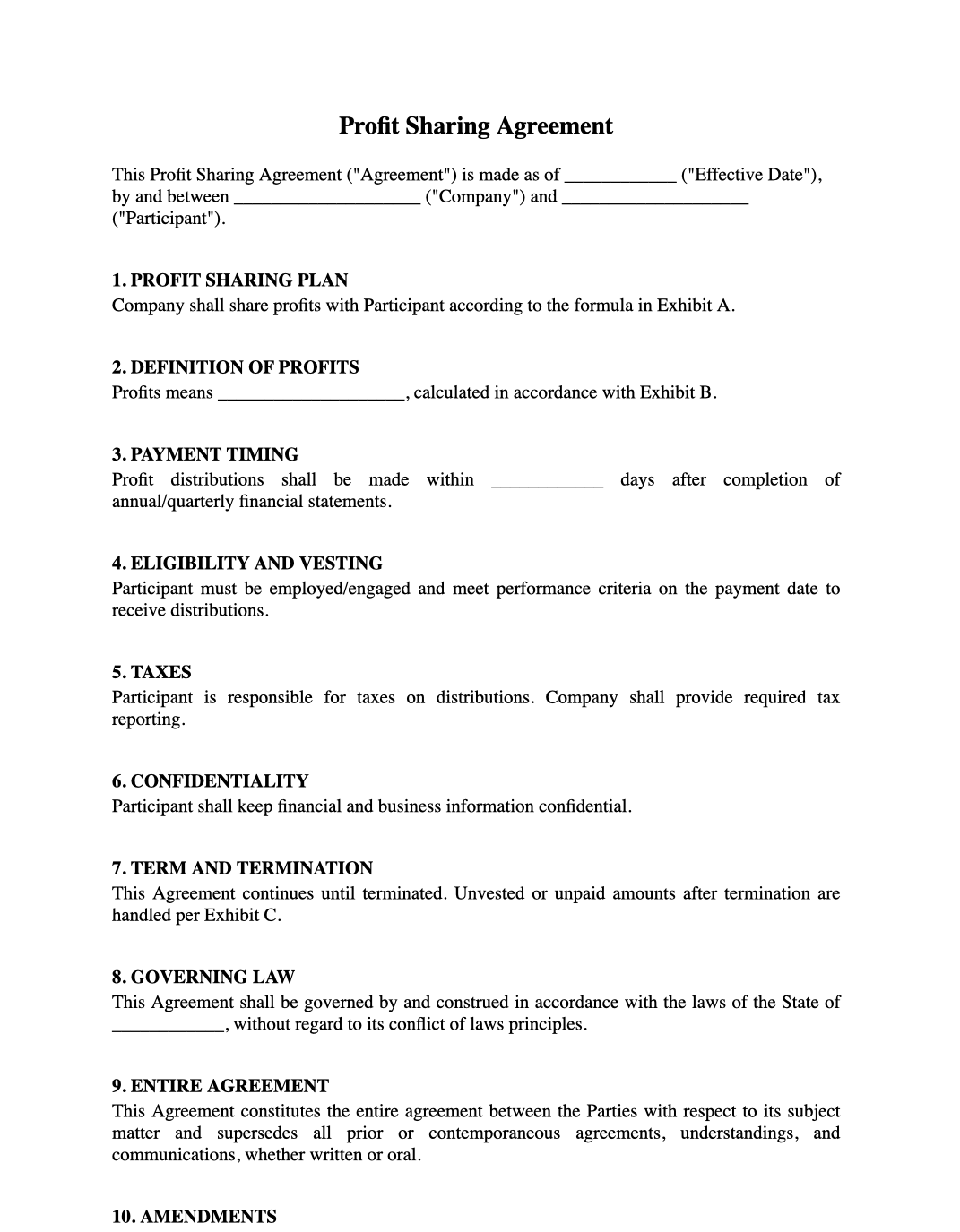
Profit Sharing Agreement
A Profit Sharing Agreement is a legal contract that establishes how profits generated by a business, project, investment, venture, or commercial relationship will be allocated among two or more parties. These agreements are commonly used among business partners, investors, consultants, sales professionals, affiliates, joint venture participants, management teams, and strategic collaborators. A Profit Sharing Agreement typically defines how profits are calculated, when distributions are made, what expenses are deducted, reporting obligations, and the circumstances under which the arrangement may be modified or terminated. Because profit-sharing arrangements directly affect compensation and financial expectations, disputes often arise when calculations, definitions, or responsibilities are not clearly documented. A well-drafted Profit Sharing Agreement helps align incentives and reduce future conflicts.
The Parties Disagree About What Counts as Profit
Two entrepreneurs launch a business together. One partner contributes capital while the other contributes operational expertise. To align incentives, they agree to share profits generated by the company.
Initially, the arrangement appears straightforward because the business is relatively simple. As the company grows, however, expenses become more complex. New employees are hired, equipment is purchased, marketing budgets increase, and various administrative costs emerge.
When the company becomes profitable, the partners discover they have different interpretations of what "profit" actually means. One believes profits should be calculated after all expenses, reserves, and future investments are considered. The other believes profits should be distributed before certain discretionary expenses are deducted.
The disagreement becomes increasingly significant as the company's earnings increase.
Neither party believes the other is acting unfairly, yet both arrive at very different profit calculations.
To help avoid this problem, a Profit Sharing Agreement should clearly define profit, identify allowable deductions, establish accounting standards, and specify how profits will be calculated before distributions occur.
One Party Controls the Financial Records
A business owner enters into a profit-sharing arrangement with a consultant who helps expand the company's operations.
The consultant's compensation depends largely on a percentage of profits generated by the business. Because the company maintains the books and records, the consultant relies heavily on financial reports provided by management.
Over time, questions arise regarding revenue recognition, expense allocations, and accounting decisions that affect profitability. The consultant becomes concerned that certain expenses may be reducing the amount available for profit-sharing distributions.
The business owner insists that all accounting practices are appropriate and necessary for managing the company responsibly.
The consultant is not accusing anyone of wrongdoing but wants greater transparency regarding how profits are determined.
To reduce these risks, a Profit Sharing Agreement should establish reporting requirements, grant reasonable access to financial information, define audit rights, and identify accounting methodologies that will be used consistently.
Unexpected Losses Create Tension
Several parties participate in a venture that is expected to generate substantial profits.
During the early stages, everyone focuses on growth opportunities and future earnings. Unfortunately, market conditions change, costs increase unexpectedly, and the venture begins operating at a loss.
Questions quickly arise regarding how losses should be treated. Some participants believe losses should reduce future profit-sharing payments. Others argue that only profits were intended to be shared and that losses should remain the responsibility of the business itself.
Because the agreement focused heavily on profit distribution and paid little attention to adverse scenarios, uncertainty develops regarding financial obligations.
What began as a promising opportunity becomes a source of conflict during difficult times.
To help prevent these issues, a Profit Sharing Agreement should address losses, reserves, negative operating results, and how future distributions may be affected by prior financial performance.
A Key Contributor Leaves the Business
A company grants a senior executive a percentage of profits as an incentive to help grow the organization.
The arrangement works well for several years and contributes to significant business success. Eventually, however, the executive decides to pursue another opportunity and resigns.
The company assumes the profit-sharing arrangement ends immediately upon departure. The executive believes entitlement exists to certain profits generated during the period of employment, even if distributions occur later.
Questions arise regarding pending profits, future payments, and whether any rights survive termination.
Both parties feel their position is reasonable, yet neither anticipated the situation when the agreement was signed.
To help avoid these disputes, a Profit Sharing Agreement should clearly address termination events, vesting provisions, post-termination rights, and the treatment of profits earned but not yet distributed.
The Business Is Sold
A successful company operating under a profit-sharing arrangement receives an acquisition offer from a larger organization.
The owners are excited by the opportunity because the transaction could generate significant value. Participants in the profit-sharing arrangement begin asking how the sale proceeds will affect their compensation.
Some believe the sale should trigger a substantial payout because the value of the business reflects years of collective effort. Others argue that profit-sharing applies only to operating profits and does not extend to proceeds from a sale or merger.
As negotiations continue, the financial implications become increasingly important.
A disagreement that never seemed relevant before suddenly becomes one of the most significant issues in the transaction.
To reduce these risks, a Profit Sharing Agreement should clearly address mergers, acquisitions, asset sales, and other liquidity events. The agreement should specify whether sale proceeds are included in profit-sharing calculations and how payments will be handled if ownership changes.
Profit-sharing arrangements can be powerful tools for aligning incentives and rewarding contributions to a business or project. However, issues involving profit calculations, financial transparency, operating losses, termination events, and business sales can become significant sources of conflict when expectations are not documented clearly. A carefully drafted Profit Sharing Agreement provides a structured framework for managing these relationships and protecting all parties involved. When prepared thoughtfully, it can help reduce misunderstandings, strengthen collaboration, improve financial transparency, and support long-term business success.

Get started with Upsign today!
Easily send, sign and track your documents