

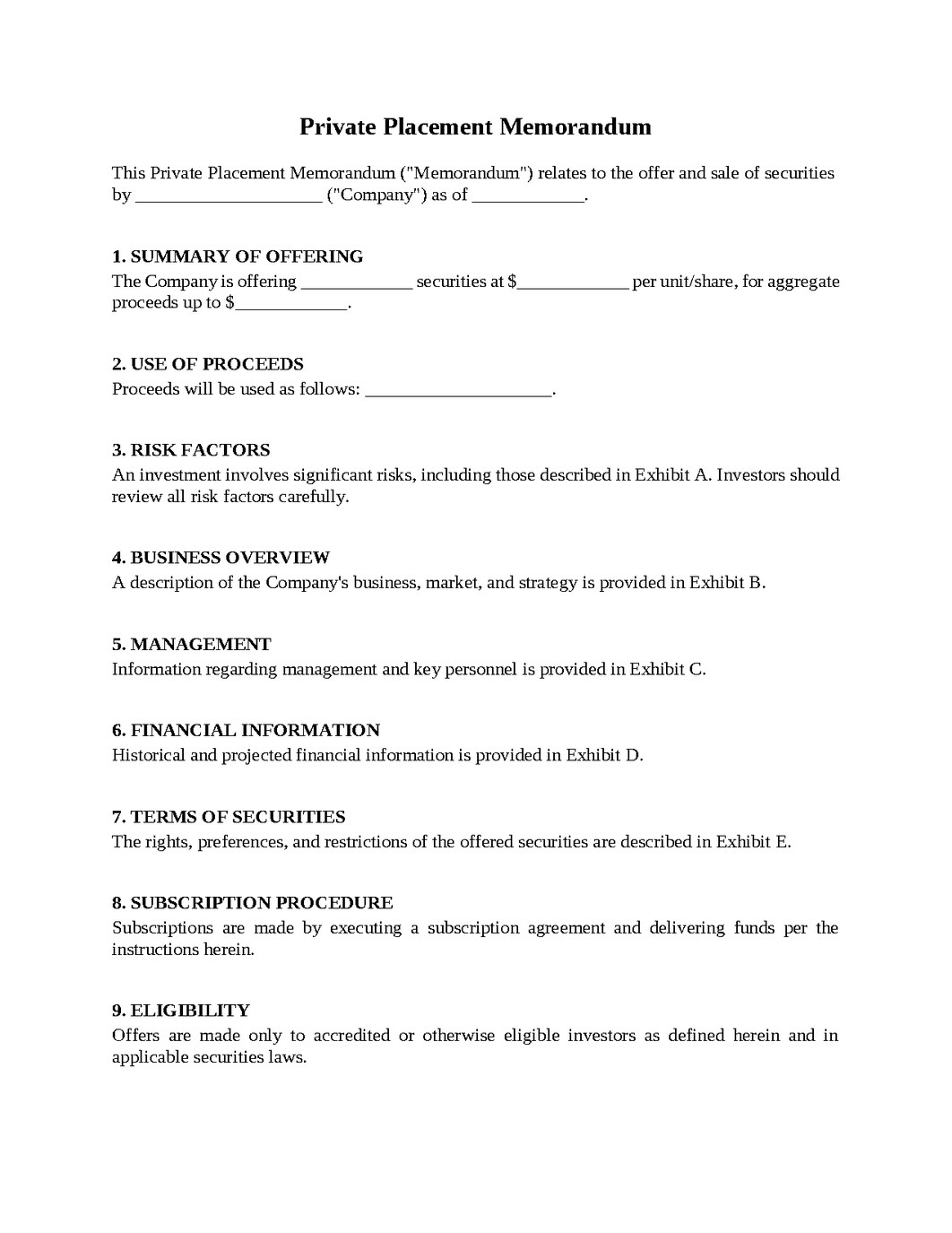
Private Placement Memorandum
A Private Placement Memorandum (PPM) is a legal disclosure document used when a company offers securities to a limited group of investors through a private offering rather than a public securities offering. Private Placement Memorandums are commonly used by startups, private equity funds, real estate investment groups, operating businesses, venture capital sponsors, hedge funds, and other organizations seeking capital from accredited or sophisticated investors. A PPM typically describes the business, investment opportunity, management team, financial information, risk factors, offering terms, and other material information that investors should consider before investing. Because investment decisions often involve substantial financial risk, disputes can arise when disclosures are incomplete, misleading, or misunderstood. A well-drafted Private Placement Memorandum helps provide transparency and reduce legal exposure for both issuers and investors.
Investors Claim Important Risks Were Not Disclosed
A growing company seeks capital from private investors to fund expansion plans. Management is optimistic about future opportunities and believes the business is positioned for significant growth.
The Private Placement Memorandum highlights the company's products, market potential, management experience, and financial projections. Investors review the materials and decide to participate in the offering.
Several years later, the business experiences challenges that reduce profitability and limit investor returns. Certain investors begin questioning whether all material risks were disclosed adequately during the fundraising process.
Management believes the offering documents contained appropriate risk disclosures and accurately described the business. Investors argue that specific operational, financial, or industry risks should have received greater attention.
The disagreement becomes particularly significant because substantial amounts of money are involved.
To help avoid this problem, a Private Placement Memorandum should clearly identify material risks, provide balanced disclosures, and avoid presenting opportunities in a manner that minimizes potential challenges. Thorough risk disclosures help investors make informed decisions.
Financial Projections Create Unrealistic Expectations
A startup prepares a Private Placement Memorandum to raise capital for a new venture.
As part of the offering materials, management includes projections showing significant revenue growth, expanding market share, and attractive returns for investors. The projections are based on assumptions that management believes are reasonable at the time.
After the investment closes, however, actual performance falls short of expectations. Market conditions change, customer acquisition proves more difficult than anticipated, and growth occurs more slowly than projected.
Some investors become frustrated and argue that the projections created unrealistic expectations regarding future performance. Management responds that projections were estimates rather than guarantees.
The dispute centers on whether investors properly understood the uncertainty associated with forward-looking information.
To reduce these risks, a Private Placement Memorandum should clearly distinguish projections from guarantees, explain underlying assumptions, and disclose the factors that could cause actual results to differ materially from expectations.
Conflicts of Interest Are Discovered After the Investment
A real estate investment sponsor raises funds from private investors to acquire and manage multiple properties.
The offering appears attractive and investors commit capital based on the information provided. After operations begin, investors learn that certain service providers involved in the project have ownership or financial relationships with the sponsor.
Although the relationships may be legitimate, investors become concerned because they were unaware of them when making investment decisions. Questions arise regarding whether contracts were negotiated at arm's length and whether conflicts of interest influenced important decisions.
The sponsor believes the arrangements are common within the industry and beneficial to the project. Investors argue that the relationships should have been disclosed more clearly.
The disagreement creates mistrust and damages investor confidence.
To help prevent these issues, a Private Placement Memorandum should identify material conflicts of interest, disclose related-party transactions, and explain how potential conflicts will be managed throughout the investment.
Investors Misunderstand Liquidity Limitations
A private company offers investment opportunities through a private placement and successfully raises capital from numerous investors.
Several investors assume they will be able to sell or transfer their interests relatively easily if circumstances change. After making the investment, however, they discover that there is no public market for the securities and that transfer restrictions apply.
As personal financial needs arise, investors become frustrated by the lack of liquidity. Management explains that the investment was always intended to be long-term and that transfer restrictions were disclosed.
The investors acknowledge the restrictions existed but argue that they did not fully appreciate their practical impact.
The disagreement highlights how investors can focus heavily on potential returns while overlooking important limitations.
To help avoid these problems, a Private Placement Memorandum should clearly describe liquidity risks, transfer restrictions, holding periods, and the possibility that investors may be unable to sell their interests for extended periods.
Regulatory Scrutiny Follows the Offering
A company successfully completes a private offering and uses the proceeds to pursue business objectives.
Months later, regulators begin reviewing aspects of the offering. Requests are made for documentation, investor communications, financial records, and offering materials.
Management believes the fundraising process complied with applicable securities laws. Regulators focus on whether disclosures were complete, investor qualifications were verified appropriately, and marketing activities remained within permitted boundaries.
The review consumes significant time and resources even if no violations ultimately occurred.
Questions arise regarding what information was disclosed, how investors were approached, and whether all legal requirements were satisfied.
To help reduce these risks, a Private Placement Memorandum should be prepared carefully, contain accurate and complete disclosures, and be supported by compliance procedures designed to satisfy applicable securities regulations.
Private Placement Memorandums play a critical role in private capital raising transactions by providing investors with information necessary to evaluate investment opportunities. However, issues involving risk disclosures, financial projections, conflicts of interest, liquidity limitations, and regulatory compliance can become significant sources of conflict when expectations are not communicated clearly. A carefully drafted Private Placement Memorandum provides a structured framework for transparency and informed decision-making. When prepared thoughtfully, it can help reduce legal risk, improve investor understanding, support compliance efforts, and facilitate successful fundraising activities.

Get started with Upsign today!
Easily send, sign and track your documents