

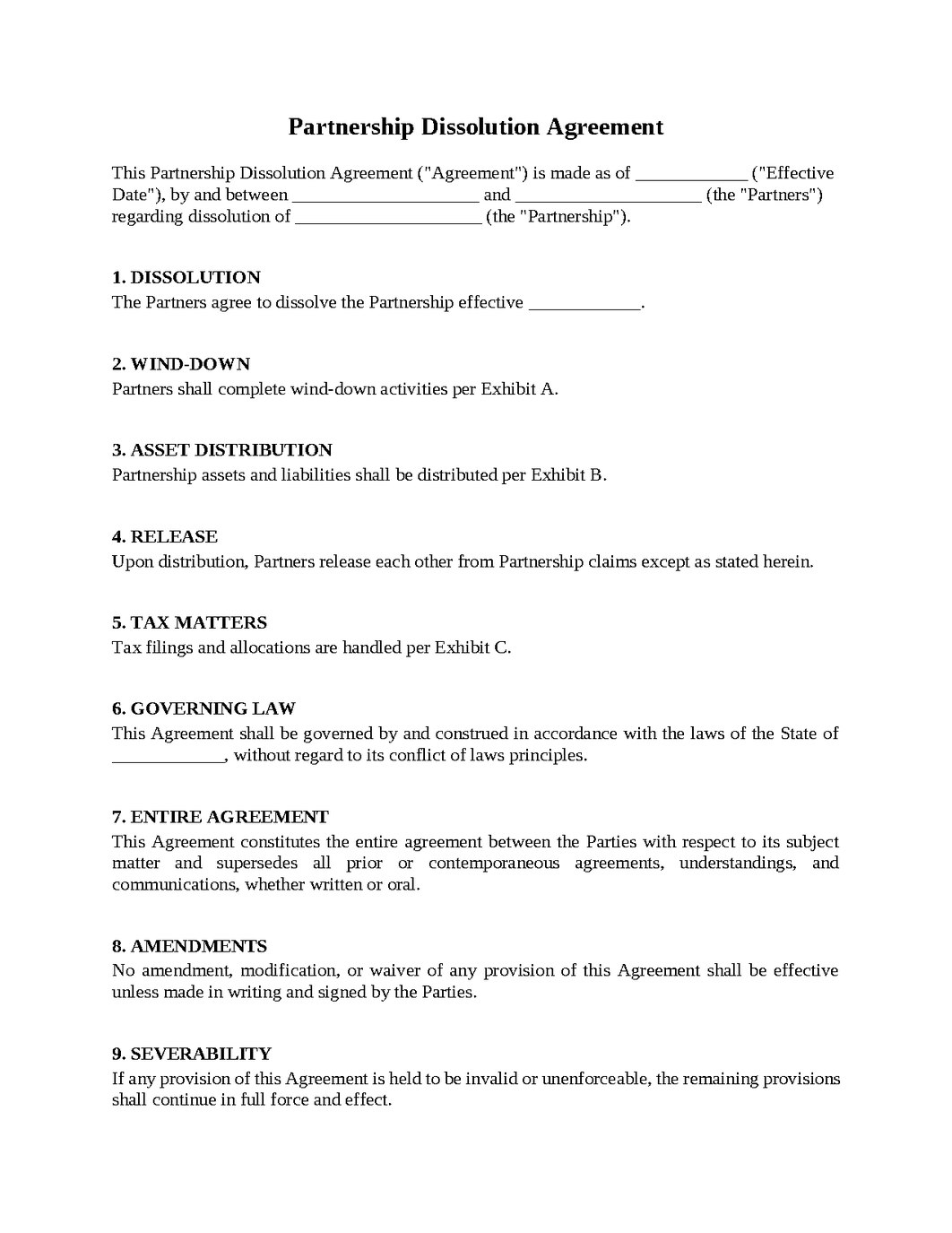
Partnership Dissolution Agreement
A Partnership Dissolution Agreement is a legal contract used when partners decide to formally terminate a partnership and wind down the business relationship. The agreement establishes how assets, liabilities, customer relationships, intellectual property, contracts, and remaining business obligations will be handled after the partnership ends. Partnership dissolutions may occur because of retirement, strategic disagreements, financial difficulties, changing business goals, death, disability, market conditions, or the successful completion of a business venture. While forming a partnership is often an optimistic process, dissolving one can be far more complicated. Without a clear written agreement, disputes frequently arise regarding ownership rights, financial distributions, ongoing obligations, and future business activities. A well-drafted Partnership Dissolution Agreement helps create an orderly process for ending the partnership while reducing the likelihood of costly legal disputes.
The Partners Cannot Agree on Business Valuation
Two partners operate a successful construction company together for more than fifteen years.
Over time, their goals begin to diverge. One partner wants to retire and enjoy the proceeds from years of hard work. The other wants to continue operating the business and believes the company has significant future growth potential.
Both agree that the partnership should be dissolved, but disagreement emerges immediately regarding value.
The retiring partner believes the business is worth substantially more because of its reputation, customer relationships, and future earnings potential. The remaining partner focuses on current assets and argues that future growth is uncertain.
The difference between their valuations amounts to hundreds of thousands of dollars.
Negotiations become increasingly contentious. Each partner hires separate advisors, and discussions that should have been straightforward become emotional and expensive.
The dissolution process stalls because neither side can agree on what the business is worth.
To help avoid this problem, a Partnership Dissolution Agreement should establish a clear valuation method for determining business value. The agreement should identify whether appraisals, formulas, independent experts, or other valuation procedures will be used and how disputes regarding value will be resolved.
Outstanding Debts Create Unexpected Conflict
Three partners decide to dissolve a retail business after several challenging years.
The partners focus heavily on dividing inventory, distributing cash, and closing operations. Initially, everyone assumes the dissolution will be relatively simple.
As the process continues, however, questions arise regarding outstanding obligations.
The business still owes money to suppliers. Equipment loans remain outstanding. Lease obligations continue for several months. Several customers have prepaid for services that have not yet been delivered.
Each partner has a different opinion regarding how these liabilities should be handled.
One partner believes debts should be paid before any distributions occur. Another argues that certain liabilities should remain with the partner who managed those areas of the business.
What began as a straightforward closure becomes a dispute regarding financial responsibility.
The partners realize they never established a formal process for allocating liabilities during dissolution.
To reduce these risks, a Partnership Dissolution Agreement should clearly identify all outstanding debts, liabilities, obligations, and contingent claims. The agreement should establish how these obligations will be satisfied and how responsibility will be allocated among the partners.
Customers and Contracts Become a Source of Dispute
A consulting partnership decides to dissolve after years of successful operations.
The partners agree to pursue separate business opportunities and initially expect the transition to occur amicably.
As dissolution planning begins, however, questions arise regarding customer relationships.
Several long-term clients have active contracts with the partnership. Both partners want to continue working with these customers after the dissolution.
Disagreements emerge regarding who has the right to service existing clients, complete ongoing projects, and receive future revenue associated with those relationships.
The clients become uncomfortable as conflicting messages are delivered by the departing partners.
What should have been a smooth transition begins damaging customer confidence and threatening future business opportunities.
The dispute grows increasingly personal because the relationships represent years of effort and substantial future income.
To help avoid these problems, a Partnership Dissolution Agreement should establish clear procedures for allocating customer relationships, ongoing contracts, unfinished projects, and future business opportunities. These provisions can help protect both the departing partners and the customers involved.
One Partner Continues Using Partnership Assets
A small technology company dissolves after several years in business.
The partners agree to divide assets and move on to separate ventures. During the dissolution process, however, one partner continues using business software, customer databases, marketing materials, and intellectual property developed by the partnership.
The other partner objects.
The assets were created jointly, and ownership rights were never clearly allocated during dissolution discussions.
As time passes, the dispute expands beyond software and data. Questions arise regarding trademarks, websites, domain names, proprietary processes, and customer records.
Both partners believe they have legitimate claims.
The disagreement eventually threatens litigation because the assets have substantial commercial value.
What began as a simple business closure becomes a fight over ownership of intellectual property and business resources.
To help prevent these issues, a Partnership Dissolution Agreement should clearly identify all assets being distributed, including intellectual property, customer data, technology systems, branding materials, websites, and proprietary information. Ownership and future usage rights should be documented carefully.
Future Claims Arise After the Business Closes
A professional services partnership dissolves after twenty years of operation.
The partners distribute assets, pay known obligations, and complete what appears to be a successful dissolution process.
Several years later, however, a former customer files a claim relating to work performed before the partnership dissolved.
Attorneys begin investigating.
Questions immediately arise regarding who is responsible for defending the claim and paying any resulting settlement or judgment.
One former partner believes responsibility should be shared because the work occurred while the partnership existed. Another argues that the claim relates primarily to activities managed by a specific partner.
Because no procedures were established during dissolution, the former partners are forced back into negotiations years after ending the business relationship.
The legal expenses and uncertainty become significant.
To reduce these risks, a Partnership Dissolution Agreement should address future claims, indemnification obligations, record retention requirements, insurance coverage, and procedures for handling liabilities that arise after the partnership has been dissolved.
Dissolving a partnership often involves far more complexity than simply ending a business relationship. Valuation disputes, outstanding liabilities, customer relationships, intellectual property rights, and future claims can all create significant challenges if expectations are not documented clearly. A Partnership Dissolution Agreement provides a structured framework for winding down operations and allocating responsibilities among departing partners. When drafted carefully, it can help reduce disputes, protect valuable assets, preserve professional relationships, and provide a clear path toward an orderly and successful dissolution.

Get started with Upsign today!
Easily send, sign and track your documents