

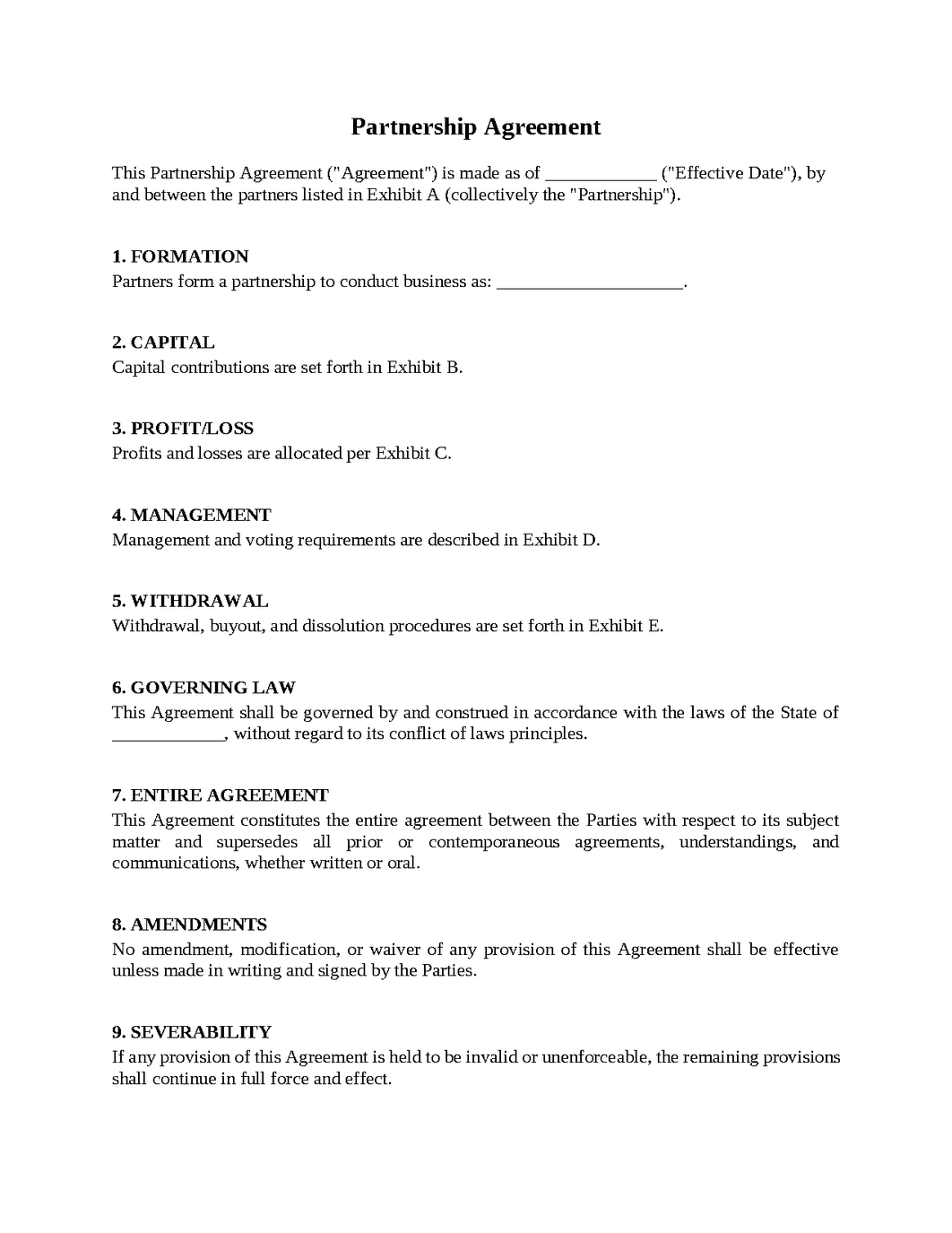
Partnership Agreement
A Partnership Agreement is a legal contract that establishes the rights, responsibilities, ownership interests, and operating procedures of two or more individuals or entities conducting business together as partners. The agreement typically addresses ownership percentages, capital contributions, profit and loss allocations, management authority, decision-making procedures, dispute resolution mechanisms, partner withdrawals, admission of new partners, and dissolution procedures. Partnership Agreements are commonly used for professional practices, family businesses, investment ventures, startups, real estate projects, consulting firms, and other jointly owned enterprises. While many partnerships begin with strong personal or professional relationships, disagreements often arise when expectations are not documented clearly. A well-drafted Partnership Agreement helps partners align expectations, reduce misunderstandings, and establish procedures for handling future challenges before they become major disputes.
Equal Ownership Creates Unequal Expectations
Two longtime friends decide to launch a landscaping business together. Both contribute modest startup capital and agree verbally that they will share ownership equally.
During the first year, the business performs well. One partner works sixty hours per week managing operations, supervising employees, and developing new customer relationships. The other partner contributes occasionally but maintains a separate full-time job and spends far less time on the business.
As profits increase, tensions begin to emerge.
The active partner believes compensation should reflect the effort being invested. The less active partner argues that equal ownership means equal entitlement to profits regardless of time commitment.
Both partners point to their original understanding, yet neither can produce documentation addressing work expectations, compensation structures, or performance requirements.
What began as a successful business partnership becomes a dispute about fairness, contribution, and ownership rights.
To help avoid this problem, a Partnership Agreement should clearly define ownership percentages, expected responsibilities, time commitments, compensation arrangements, and procedures for addressing unequal contributions. These provisions can prevent misunderstandings when partners contribute different levels of effort over time.
A Major Business Decision Leads to Deadlock
Three partners establish a consulting firm and divide ownership equally among themselves.
Initially, business decisions are made informally because the partners generally agree on strategic matters. As the company grows, however, more significant decisions arise.
One partner wants to expand into new markets. Another prefers maintaining the existing business model. The third believes the company should pursue an acquisition opportunity.
Because ownership is divided evenly, no proposal receives sufficient support to move forward.
The disagreement becomes increasingly disruptive. Employees receive conflicting instructions, growth initiatives stall, and customers begin noticing operational uncertainty.
The partners realize they never established a formal decision-making process for major business matters.
A business that should be focusing on growth instead becomes trapped by internal disagreement.
To reduce these risks, a Partnership Agreement should clearly identify which decisions require unanimous approval, which decisions may be approved by majority vote, and what procedures apply when partners reach an impasse. Deadlock-resolution provisions can be particularly important in partnerships with equal ownership interests.
One Partner Wants to Leave the Business
A successful retail business is owned by two partners who have worked together for more than a decade.
After years of operating the company, one partner decides to retire and pursue other interests. The departing partner expects to receive fair compensation for the ownership interest and believes the transition will be straightforward.
The remaining partner agrees that a buyout should occur but disagrees about valuation.
The departing partner believes the company is worth substantially more than the remaining partner believes. Neither side can agree on how the business should be valued, what assets should be included, or how payments should be structured.
Negotiations become contentious.
The departing partner threatens legal action while the remaining partner worries that an expensive buyout could jeopardize the company's financial stability.
A situation that should have been manageable becomes a significant business dispute.
To help prevent these problems, a Partnership Agreement should establish buyout procedures before they are needed. The agreement should define valuation methods, payment terms, triggering events, and procedures for handling partner withdrawals, retirements, disabilities, or deaths.
A New Partner Is Admitted Without Clear Rules
A growing technology company operates successfully under a partnership structure for several years.
As the business expands, the existing partners decide to admit a new partner who brings valuable industry expertise and potential customer relationships.
Everyone agrees that the new partner should receive an ownership interest, but little attention is given to how ownership percentages will change, how voting rights will be adjusted, or how future profits will be allocated.
After the new partner joins, disagreements emerge.
Existing partners feel their ownership interests have been diluted unfairly. The new partner believes promised authority and influence were never fully provided. Questions arise regarding voting power, profit distributions, and management responsibilities.
Relationships begin deteriorating because expectations were never documented clearly.
The business suffers as management spends more time resolving internal disputes than serving customers.
To reduce these risks, a Partnership Agreement should establish clear procedures for admitting new partners. The agreement should address ownership dilution, capital contributions, voting rights, management authority, profit allocations, and approval requirements before new partners are admitted.
A Partner Competes Against the Business
A professional services partnership operates successfully for many years.
One partner eventually begins pursuing personal opportunities outside the partnership. Initially, these activities appear unrelated to the firm's operations.
Over time, however, concerns begin emerging.
The partner starts working with clients who could have been referred to the partnership. Business opportunities are diverted elsewhere. Employees become uncertain about loyalties, and confidential information may be used to support outside activities.
The remaining partners become concerned that the partner is benefiting personally from opportunities that should belong to the business.
The accused partner argues that no written restrictions prohibit these activities.
Because expectations were never documented clearly, determining appropriate conduct becomes difficult.
The resulting conflict damages relationships and threatens the stability of the partnership.
To help avoid these disputes, a Partnership Agreement should include provisions addressing fiduciary duties, conflicts of interest, confidentiality obligations, non-solicitation restrictions, and procedures for handling outside business activities. Clearly defining these expectations can reduce uncertainty and protect partnership opportunities.
Partnerships can be highly effective business structures because they allow individuals to combine skills, resources, capital, and expertise. However, even strong partnerships can face challenges involving ownership expectations, decision-making authority, partner departures, admission of new partners, and conflicts of interest. A Partnership Agreement provides a structured framework for addressing these issues before disputes arise. When drafted carefully, it can help protect relationships, reduce uncertainty, preserve business continuity, and provide clear guidance for managing both opportunities and challenges throughout the life of the partnership.

Get started with Upsign today!
Easily send, sign and track your documents