

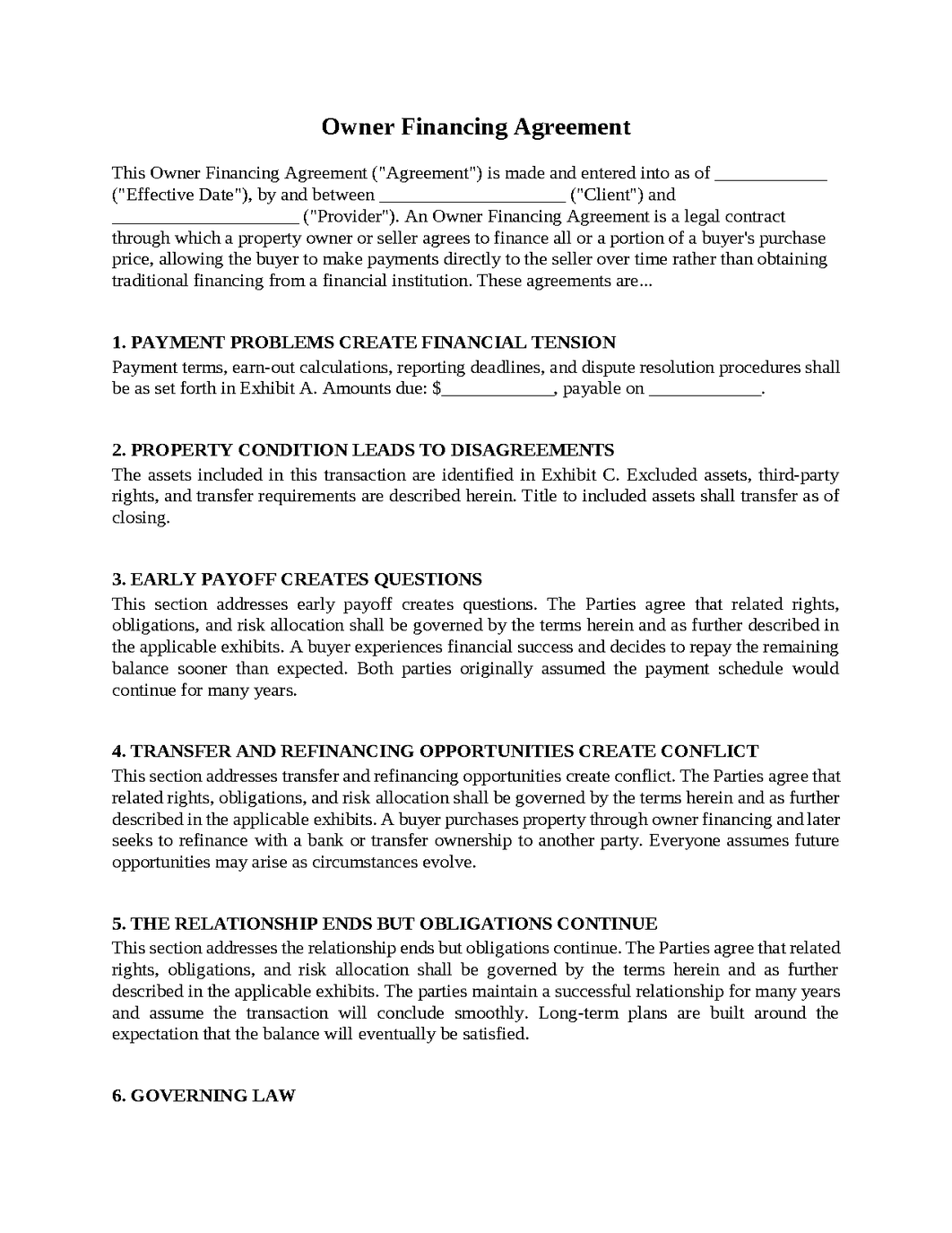
Owner Financing Agreement
An Owner Financing Agreement is a legal contract through which a property owner or seller agrees to finance all or a portion of a buyer's purchase price, allowing the buyer to make payments directly to the seller over time rather than obtaining traditional financing from a financial institution. These agreements are commonly used by homeowners, real estate investors, business sellers, and buyers seeking flexibility when conventional financing is unavailable or undesirable. An Owner Financing Agreement typically addresses the purchase price, payment schedules, interest rates, default provisions, collateral rights, and procedures governing disputes and termination. Because these arrangements involve long-term payment obligations and delayed transfers of value, disputes can arise when expectations regarding responsibilities and remedies are not documented clearly. A carefully drafted Owner Financing Agreement helps establish certainty and protect the interests of both buyers and sellers.
Payment Problems Create Financial Tension
A property owner agrees to finance the sale of a residential property and expects monthly payments to provide a reliable source of income. Both parties believe the arrangement will allow the buyer to acquire the property while providing the seller with attractive returns.
Initially, payments are made according to schedule and the relationship remains positive. Over time, however, unexpected financial challenges begin affecting the buyer's ability to make timely payments.
The seller believes payment obligations should be enforced because the agreement was structured to provide dependable income and protect the value of the property. The buyer believes temporary hardships justify flexibility and argues that continued ownership and future income will allow the obligations to be satisfied. As missed payments become more common, tensions emerge regarding remedies and repayment expectations.
To help avoid this problem, an Owner Financing Agreement should clearly establish payment obligations and define the consequences applicable to late payments and defaults.
Property Condition Leads to Disagreements
A seller finances the purchase of a commercial property and expects the buyer to maintain the premises properly. Everyone assumes the property will remain in good condition and preserve its value.
As years pass, deferred maintenance and repairs begin affecting the property. Questions arise regarding whether the buyer is meeting obligations associated with preserving the collateral.
The seller believes maintaining the property is essential because the asset secures the remaining balance owed under the agreement. The buyer believes ordinary wear and changing financial conditions have limited the ability to complete improvements and argues that the property's overall value remains adequate. As conditions deteriorate, disagreements emerge regarding maintenance responsibilities.
To help prevent these issues, an Owner Financing Agreement should clearly establish maintenance obligations and define the standards applicable to preserving the collateral.
Early Payoff Creates Questions
A buyer experiences financial success and decides to repay the remaining balance sooner than expected. Both parties originally assumed the payment schedule would continue for many years.
Questions arise regarding whether prepayment penalties apply and whether interest calculations should change. Different expectations create uncertainty regarding the financial consequences of early repayment.
The buyer believes flexibility is important because paying off the obligation early reduces financial burdens and strengthens ownership rights. The seller believes future interest income formed an important part of the transaction and argues that early repayment should not eliminate anticipated returns without compensation. As payoff discussions continue, tensions develop regarding prepayment rights.
To help avoid these problems, an Owner Financing Agreement should clearly establish prepayment provisions and define the financial consequences associated with early payoff.
Transfer and Refinancing Opportunities Create Conflict
A buyer purchases property through owner financing and later seeks to refinance with a bank or transfer ownership to another party. Everyone assumes future opportunities may arise as circumstances evolve.
As refinancing discussions progress, questions emerge regarding consent requirements and whether the original agreement restricts transfers or assignments.
The buyer believes flexibility is important because changing circumstances may create opportunities to improve financial terms. The seller believes transfer restrictions are necessary because the original arrangement depended upon the buyer's financial condition and trustworthiness. As new opportunities arise, disagreements emerge regarding assignment rights.
To help prevent these issues, an Owner Financing Agreement should clearly establish transfer provisions and define the circumstances under which refinancing or assignments are permitted.
The Relationship Ends but Obligations Continue
The parties maintain a successful relationship for many years and assume the transaction will conclude smoothly. Long-term plans are built around the expectation that the balance will eventually be satisfied.
Eventually, the loan reaches maturity and questions arise regarding releases, title transfers, and any obligations that survive repayment. Different interpretations create uncertainty regarding the procedures necessary to conclude the arrangement.
The buyer believes repayment should result in a prompt release of liens and unrestricted ownership rights. The seller believes all obligations and documentation requirements should be satisfied completely before relinquishing rights. As the transaction reaches completion, disagreements emerge regarding the obligations that survive repayment.
To help avoid this problem, an Owner Financing Agreement should clearly establish payoff procedures and identify the rights and responsibilities that continue after the financial obligations have been satisfied.
Owner Financing Agreements are valuable tools that provide flexibility to buyers and sellers while creating opportunities that traditional financing may not support. However, issues involving payment difficulties, property maintenance, early payoff rights, transfer restrictions, and post-repayment obligations can become significant sources of conflict when expectations are not documented clearly. A carefully drafted Owner Financing Agreement provides a structured framework for allocating responsibilities and protecting the interests of both buyers and sellers. When prepared thoughtfully, it can reduce uncertainty, strengthen business relationships, facilitate transactions, and provide the foundation necessary for successful long-term financing arrangements.

Get started with Upsign today!
Easily send, sign and track your documents