

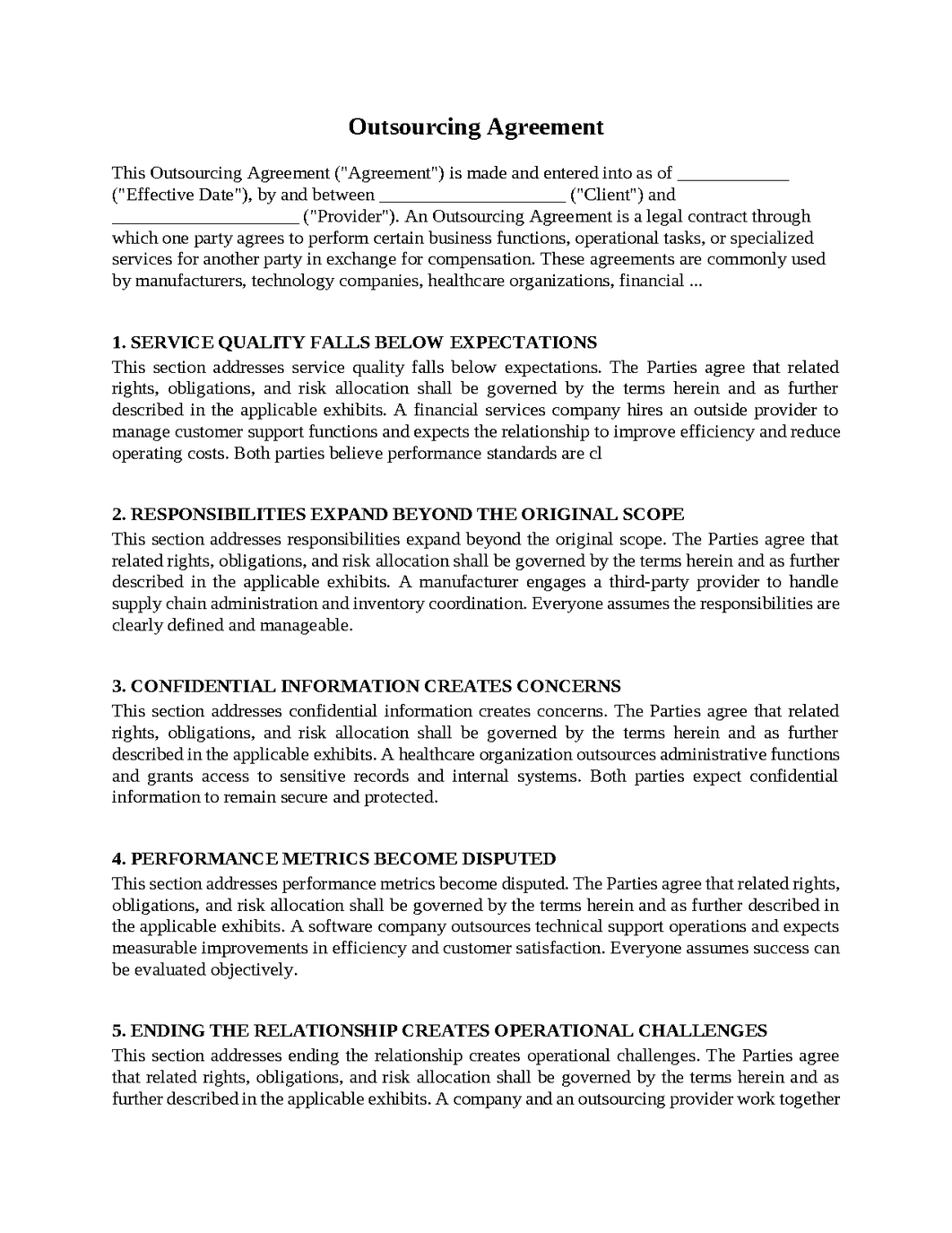
Outsourcing Agreement
An Outsourcing Agreement is a legal contract through which one party agrees to perform certain business functions, operational tasks, or specialized services for another party in exchange for compensation. These agreements are commonly used by manufacturers, technology companies, healthcare organizations, financial institutions, retailers, and professional service firms seeking to improve efficiency, reduce costs, and access specialized expertise. An Outsourcing Agreement typically addresses the scope of services, performance standards, compensation, confidentiality obligations, service levels, and procedures governing disputes and termination. Because outsourcing relationships often involve critical business functions and long-term cooperation, disputes can arise when expectations regarding responsibilities and performance are not documented clearly. A carefully drafted Outsourcing Agreement helps establish certainty and protect the interests of both customers and service providers.
Service Quality Falls Below Expectations
A financial services company hires an outside provider to manage customer support functions and expects the relationship to improve efficiency and reduce operating costs. Both parties believe performance standards are clearly understood and achievable.
Initially, customer inquiries are handled promptly and service levels remain satisfactory. Over time, however, response times increase and customer complaints become more frequent, affecting the company's reputation.
The client believes the provider should maintain higher standards because service quality was one of the primary reasons for outsourcing the work. The provider believes increased workloads and changing requirements contributed to the challenges and argues that reasonable efforts were made to maintain performance. As customer dissatisfaction increases, tensions emerge regarding accountability.
To help avoid this problem, an Outsourcing Agreement should clearly establish performance standards and define the service levels expected throughout the relationship.
Responsibilities Expand Beyond the Original Scope
A manufacturer engages a third-party provider to handle supply chain administration and inventory coordination. Everyone assumes the responsibilities are clearly defined and manageable.
As the business grows, additional requests involving analytics, vendor management, and reporting functions begin increasing the complexity of the arrangement. Questions arise regarding whether these new tasks are included within the original agreement.
The client believes the additional services are natural extensions of the relationship because they support the same business objectives. The provider believes the expanded duties require additional personnel and resources and argues that extra compensation is appropriate. As demands increase, disagreements emerge regarding the scope of work.
To help prevent these issues, an Outsourcing Agreement should clearly establish the services being provided and define how changes and additional work will be approved.
Confidential Information Creates Concerns
A healthcare organization outsources administrative functions and grants access to sensitive records and internal systems. Both parties expect confidential information to remain secure and protected.
As operations expand and additional personnel become involved, concerns arise regarding access controls and the possibility of unauthorized disclosures. Questions develop regarding whether existing safeguards are sufficient.
The client believes protecting sensitive information is essential because privacy obligations and customer trust depend upon confidentiality. The provider believes reasonable security measures are already in place and argues that no system can eliminate every risk. As concerns increase, tensions develop regarding responsibility for safeguarding information.
To help avoid these problems, an Outsourcing Agreement should clearly establish confidentiality obligations and define how sensitive information must be protected.
Performance Metrics Become Disputed
A software company outsources technical support operations and expects measurable improvements in efficiency and customer satisfaction. Everyone assumes success can be evaluated objectively.
Over time, disagreements arise regarding response times, customer feedback, and productivity targets. Different interpretations create uncertainty regarding whether expectations are being met.
The client believes performance should be judged according to measurable outcomes because the outsourcing arrangement was intended to improve operations. The provider believes external factors and customer behavior affect results and argues that performance metrics should account for those realities. As reports become more important, disagreements emerge regarding how success should be measured.
To help prevent these issues, an Outsourcing Agreement should clearly establish performance metrics and define the methods used to evaluate results.
Ending the Relationship Creates Operational Challenges
A company and an outsourcing provider work together successfully for many years and gradually integrate systems, employees, and operational processes. Both parties assume the relationship will continue indefinitely and organize their businesses around that expectation.
Eventually, changing priorities lead the company to bring operations back in-house or select another provider. Questions arise regarding data transfers, unfinished projects, outstanding fees, and ongoing responsibilities.
The company believes a smooth transition is necessary to avoid disruptions and preserve business continuity. The provider believes contractual obligations and compensation issues should be resolved before providing additional assistance and expects its rights to be respected. As the relationship concludes, disagreements emerge regarding the obligations that survive termination.
To help avoid this problem, an Outsourcing Agreement should clearly establish termination procedures and identify the rights and responsibilities that continue after the relationship ends.
Outsourcing Agreements are valuable tools that allow businesses to improve efficiency and access specialized expertise while focusing on their core operations. However, issues involving service quality, changing responsibilities, confidentiality concerns, performance expectations, and post-termination obligations can become significant sources of conflict when expectations are not documented clearly. A carefully drafted Outsourcing Agreement provides a structured framework for allocating responsibilities and protecting the interests of both clients and service providers. When prepared thoughtfully, it can reduce uncertainty, strengthen business relationships, improve operational efficiency, and provide the foundation necessary for successful outsourcing arrangements.

Get started with Upsign today!
Easily send, sign and track your documents