

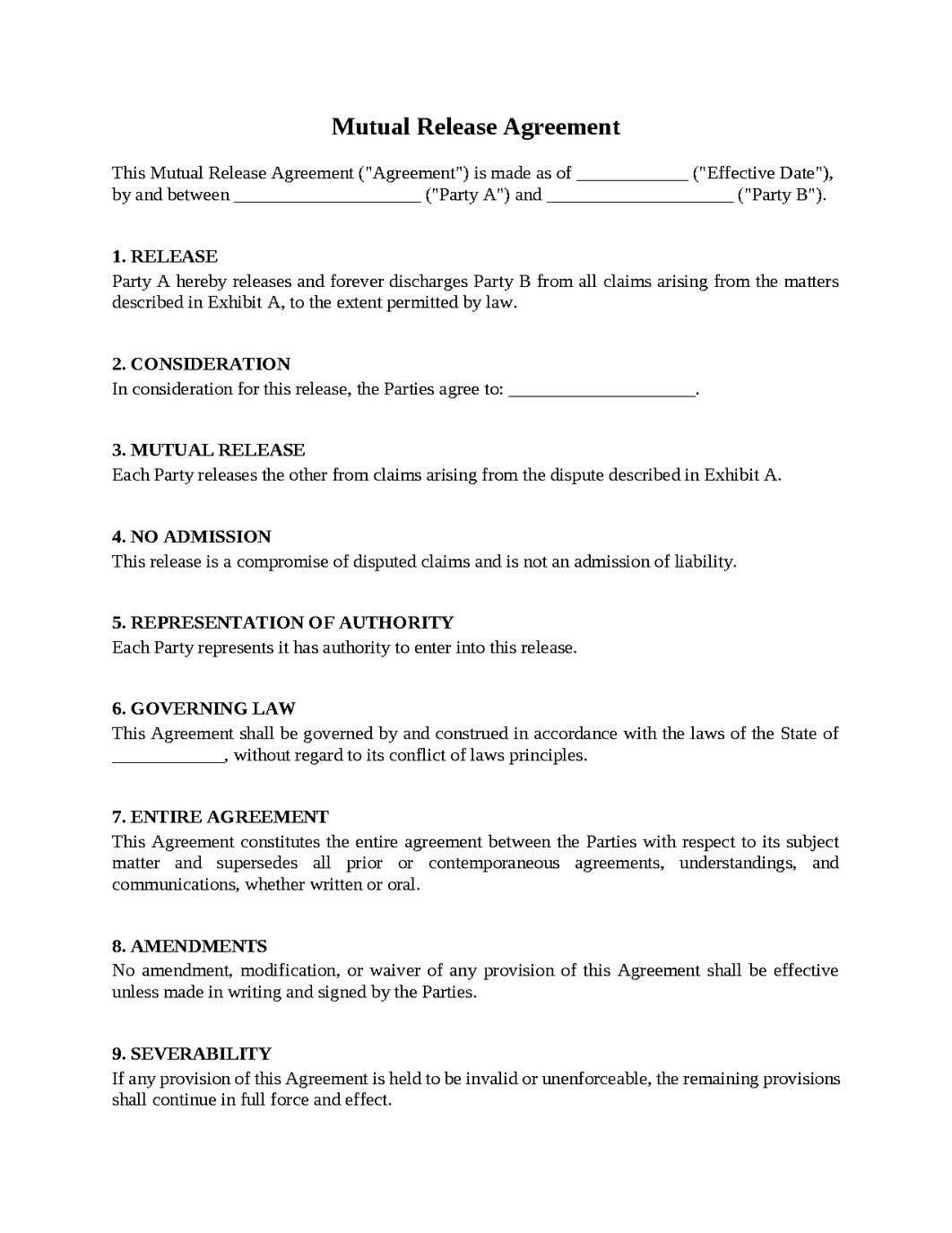
Mutual Release Agreement
A Mutual Release Agreement is a legal contract through which two or more parties agree to release each other from existing claims, demands, liabilities, damages, and causes of action arising from a particular relationship, transaction, dispute, or series of events. Unlike a General Release Agreement, which often involves one party releasing another, a Mutual Release Agreement provides reciprocal releases, allowing all parties to walk away from a dispute with certainty that future claims relating to the covered matters will not be pursued. These agreements are commonly used in business disputes, partnership dissolutions, contract terminations, shareholder disagreements, vendor relationships, employment matters, and settlement negotiations. Because both sides are giving up legal rights, disagreements can arise when the parties have different understandings regarding what claims are being released and what obligations remain. A carefully drafted Mutual Release Agreement helps bring finality to disputes and allows all parties to move forward without lingering uncertainty.
Former Business Partners Cannot Agree on What Was Settled
Two entrepreneurs build a successful business together over several years.
As the company grows, disagreements emerge regarding management decisions, financial priorities, and the future direction of the business. Eventually, the partners decide that separating their interests is the best solution and negotiate a buyout arrangement.
As part of the separation, both parties sign a Mutual Release Agreement. They believe the agreement resolves all issues connected to their business relationship and allows each person to pursue future opportunities independently.
Several months later, one former partner discovers transactions that allegedly occurred before the separation and believes those actions caused financial harm. The former partner argues that the newly discovered issues were never discussed during negotiations and therefore should not be covered by the release.
The other partner maintains that the entire purpose of the Mutual Release Agreement was to eliminate all claims arising from the business relationship, whether known or unknown at the time of signing.
To help avoid this problem, a Mutual Release Agreement should clearly define the scope of released claims, address unknown claims where permitted by law, and specify whether newly discovered issues remain subject to the release.
A Contract Ends but the Parties Continue Working Together
A manufacturer and distributor work together under a long-term supply arrangement.
After several years, disputes arise regarding pricing, delivery schedules, and inventory obligations. Rather than continue litigating the matter, the parties negotiate a settlement and execute a Mutual Release Agreement.
The settlement resolves the historical disputes, but the companies continue doing business together under a new arrangement. Initially, the relationship improves and both parties believe the prior issues are behind them.
Over time, however, one party begins referencing conduct that occurred before the release and attempts to use those events to support new claims and business demands. The other party objects and argues that the release permanently resolved those matters.
The disagreement creates uncertainty regarding where the old dispute ends and the new business relationship begins.
To help prevent these issues, a Mutual Release Agreement should clearly identify the time period covered by the release and distinguish historical claims from future obligations and conduct.
One Side Believes Certain Claims Were Excluded
Two companies become involved in a dispute involving several contracts and multiple projects.
After extensive negotiations, the parties decide that resolving the matter through a Mutual Release Agreement is preferable to continuing litigation. Both sides exchange releases and dismiss their pending claims.
Months later, one company files a new claim relating to intellectual property rights that were discussed briefly during negotiations but never expressly addressed in the final agreement.
The company bringing the claim argues that the release was intended to cover only the contract dispute. The other company believes all issues arising from the relationship were settled as part of the agreement.
Both parties point to different communications and negotiating history to support their interpretation.
The disagreement transforms a completed settlement into a new dispute regarding what claims survived the release.
To help avoid these problems, a Mutual Release Agreement should clearly identify any claims that are excluded and expressly state whether specific categories of claims remain preserved.
Employees and Affiliates Become Involved
Two businesses resolve a dispute through a Mutual Release Agreement after years of contentious negotiations.
The agreement identifies the companies by name and provides reciprocal releases. Following the settlement, however, claims are asserted against officers, employees, consultants, and affiliated entities connected to the original dispute.
The party bringing the claims argues that the release applies only to the companies that signed the agreement. The opposing party contends that the release was intended to protect everyone associated with the dispute.
The disagreement becomes significant because the potential liability facing the affiliated individuals may be substantial.
The parties realize that they never fully discussed whether related persons and entities would receive the benefit of the release.
To help prevent these issues, a Mutual Release Agreement should clearly identify all released parties and define whether affiliates, employees, officers, directors, agents, insurers, successors, and related entities are protected.
Future Performance Obligations Create Conflict
Two parties settle a dispute through a Mutual Release Agreement that is part of a broader settlement arrangement.
In addition to exchanging releases, both parties agree to perform certain actions after signing the agreement. These obligations include transferring assets, making payments, delivering records, and completing other post-settlement requirements.
Initially, both parties intend to fulfill their obligations. As time passes, however, one party fails to complete several required actions, causing the other party to question whether the release should remain effective.
The non-breaching party believes the release should no longer apply if the promised consideration is not delivered. The other party argues that the release became binding immediately upon execution and survives any later performance issues.
The dispute shifts from the original disagreement to the consequences of a failed settlement.
To help avoid these problems, a Mutual Release Agreement should clearly explain when the releases become effective, identify the consideration supporting the agreement, and address the consequences of failing to perform post-settlement obligations.
Mutual Release Agreements are valuable tools for resolving disputes and ending business relationships on mutually agreed terms. However, issues involving the scope of released claims, continuing business relationships, excluded claims, affiliated parties, and post-settlement performance can become significant sources of conflict when expectations are not documented clearly. A carefully drafted Mutual Release Agreement provides a structured framework for achieving finality while protecting the interests of all parties involved. When prepared thoughtfully, it can reduce litigation risk, promote certainty, preserve negotiated resolutions, and allow the parties to move forward with confidence.

Get started with Upsign today!
Easily send, sign and track your documents