

Joint Venture Agreement
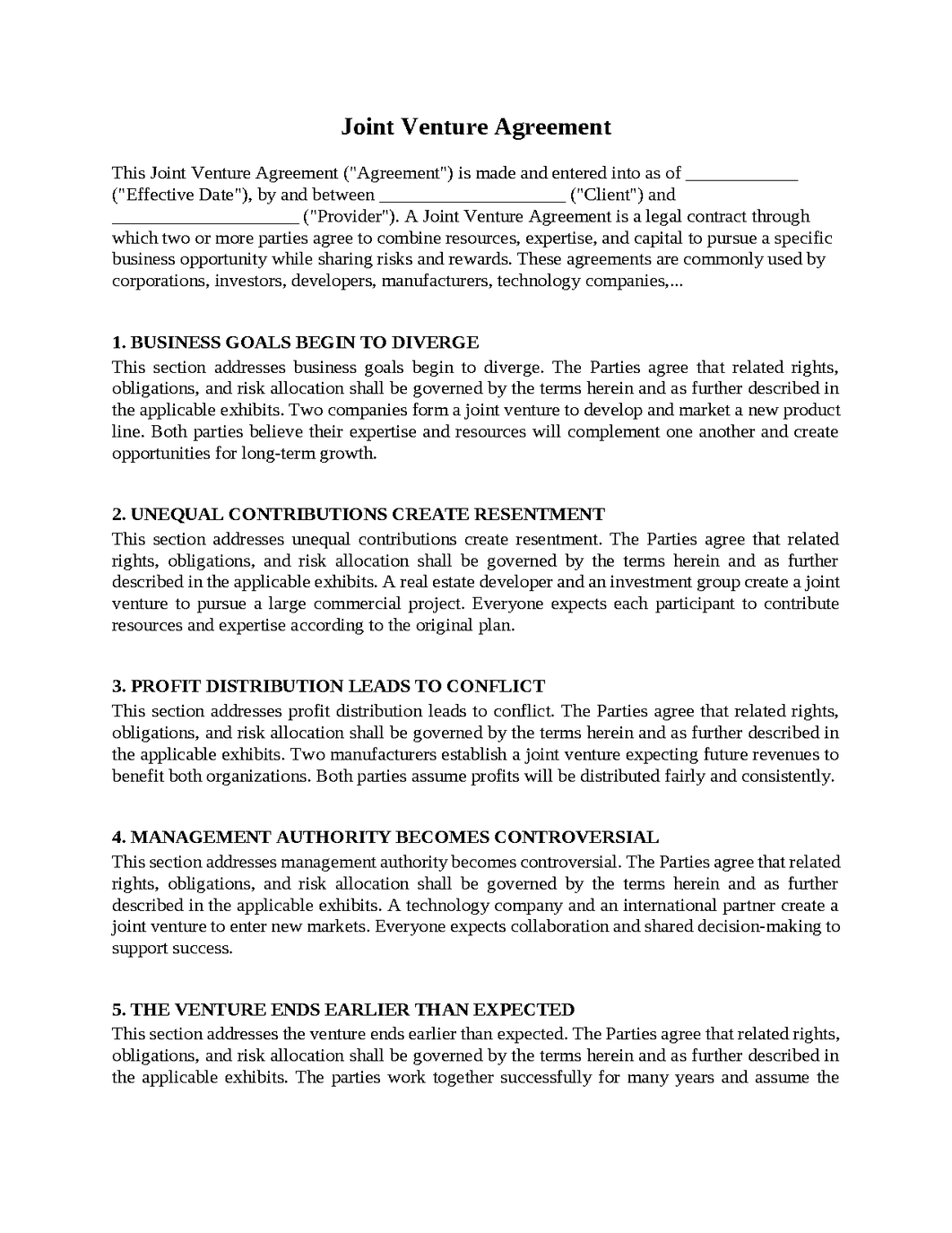
A Joint Venture Agreement is a legal contract through which two or more parties agree to combine resources, expertise, and capital to pursue a specific business opportunity while sharing risks and rewards. These agreements are commonly used by corporations, investors, developers, manufacturers, technology companies, and international businesses seeking to collaborate on projects that would be difficult to accomplish independently. A Joint Venture Agreement typically addresses ownership interests, capital contributions, management authority, profit sharing, liability allocation, and procedures governing disputes and termination. Because joint ventures bring together parties with different objectives and expectations, disputes can arise when responsibilities and rights are not documented clearly. A carefully drafted Joint Venture Agreement helps establish certainty and protect the interests of all participants.
Business Goals Begin to Diverge
Two companies form a joint venture to develop and market a new product line. Both parties believe their expertise and resources will complement one another and create opportunities for long-term growth.
During the early stages, cooperation is strong and milestones are achieved according to schedule. Over time, however, one company begins focusing on rapid expansion while the other prefers maintaining profitability and minimizing risk.
The first company believes aggressive growth is necessary to establish market leadership before competitors gain an advantage. The second company believes a more measured approach will preserve resources and protect long-term returns. As strategic differences become more pronounced, tensions emerge regarding the direction of the venture.
To help avoid this problem, a Joint Venture Agreement should clearly establish management procedures and define how strategic decisions will be made.
Unequal Contributions Create Resentment
A real estate developer and an investment group create a joint venture to pursue a large commercial project. Everyone expects each participant to contribute resources and expertise according to the original plan.
As the project progresses, one party contributes substantially more capital and personnel than originally anticipated while the other struggles to meet its obligations. Questions arise regarding whether ownership percentages and profit allocations remain fair.
The party making additional contributions believes its increased involvement should result in greater economic benefits because the project's success depends upon those efforts. The other participant believes the original arrangement should remain intact and argues that temporary imbalances are unavoidable. As frustrations increase, disagreements emerge regarding fairness and ownership.
To help prevent these issues, a Joint Venture Agreement should clearly establish contribution requirements and define how additional investments affect ownership interests.
Profit Distribution Leads to Conflict
Two manufacturers establish a joint venture expecting future revenues to benefit both organizations. Both parties assume profits will be distributed fairly and consistently.
After several profitable years, disagreements arise regarding whether earnings should be reinvested into the business or distributed to the owners. Different priorities create uncertainty.
One party believes retaining profits is necessary to fund expansion and strengthen the venture's competitive position. The other believes distributions should occur regularly because investors expect returns on their contributions. As financial success increases, tensions develop regarding the use of profits.
To help avoid these problems, a Joint Venture Agreement should clearly establish profit distribution policies and define the circumstances under which earnings will be retained or distributed.
Management Authority Becomes Controversial
A technology company and an international partner create a joint venture to enter new markets. Everyone expects collaboration and shared decision-making to support success.
As operations expand, disagreements emerge regarding hiring decisions, budgets, and operational priorities. Questions arise concerning who possesses authority over important matters.
One party believes equal participation in management is essential because both organizations contributed valuable resources. The other believes operational efficiency requires centralized decision-making and argues that delays caused by excessive approvals hinder growth. As disputes become more frequent, tensions emerge regarding governance.
To help prevent these issues, a Joint Venture Agreement should clearly establish management authority and define the procedures governing important decisions.
The Venture Ends Earlier Than Expected
The parties work together successfully for many years and assume the relationship will continue indefinitely. Future investments and strategic plans are built around that expectation.
Eventually, changing market conditions and corporate priorities lead one participant to withdraw from the venture. Questions arise regarding ownership interests, unfinished obligations, intellectual property, and the distribution of assets.
The departing party believes its years of investment justify a fair and orderly exit process. The remaining party believes continuity is essential and expects ongoing rights necessary to preserve the value of the business. As the relationship concludes, disagreements emerge regarding the obligations that survive termination.
To help avoid this problem, a Joint Venture Agreement should clearly establish exit procedures and identify the rights and responsibilities that continue after the venture ends.
Joint Venture Agreements are valuable tools that allow organizations to combine resources and pursue opportunities that may not be achievable independently. However, issues involving strategic disagreements, unequal contributions, profit distributions, management authority, and early termination can become significant sources of conflict when expectations are not documented clearly. A carefully drafted Joint Venture Agreement provides a structured framework for allocating responsibilities and protecting the interests of all participants. When prepared thoughtfully, it can reduce uncertainty, strengthen business relationships, encourage collaboration, and provide the foundation necessary for successful joint ventures.

Get started with Upsign today!
Easily send, sign and track your documents