

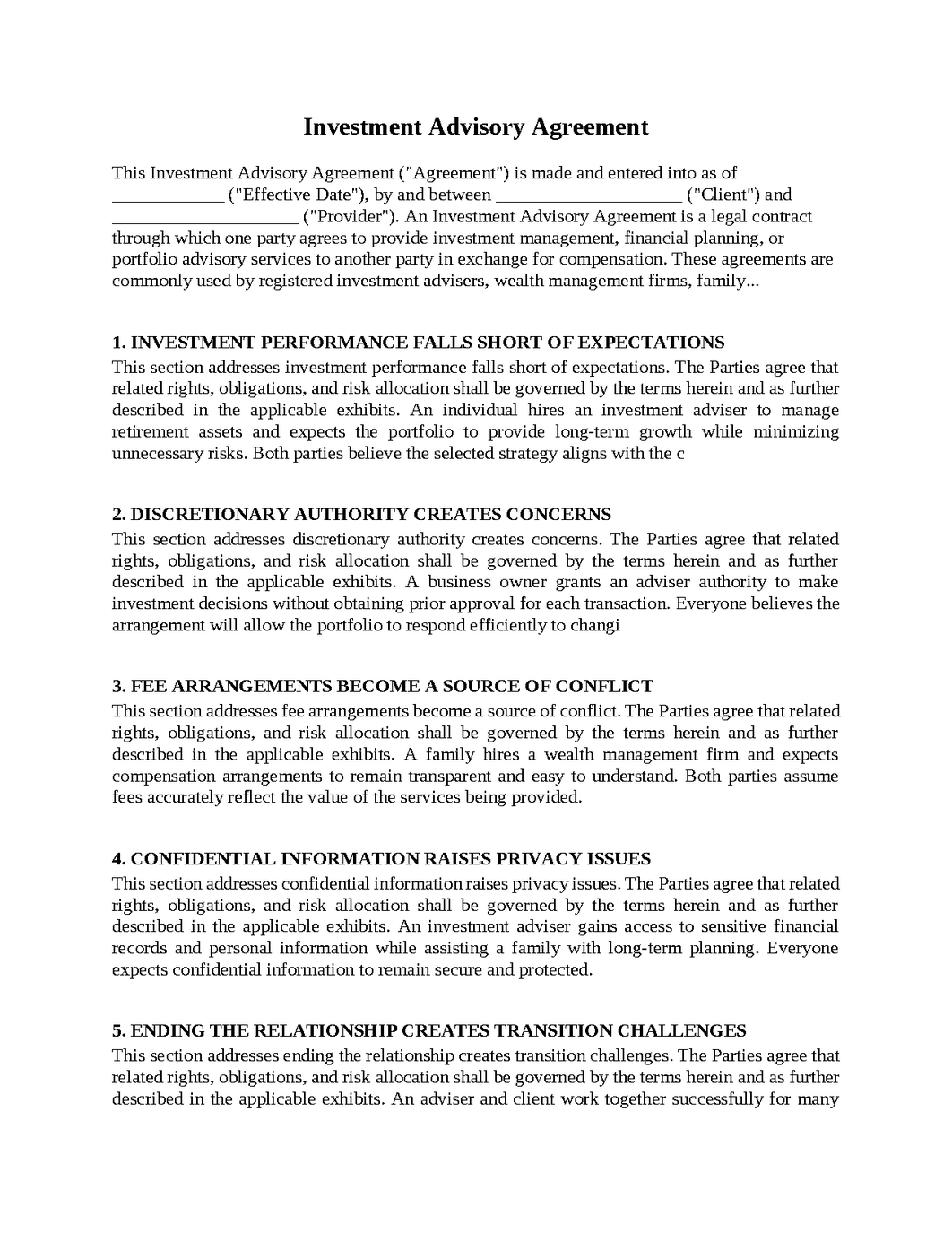
Investment Advisory Agreement
An Investment Advisory Agreement is a legal contract through which one party agrees to provide investment management, financial planning, or portfolio advisory services to another party in exchange for compensation. These agreements are commonly used by registered investment advisers, wealth management firms, family offices, retirement plan sponsors, institutions, and individual investors seeking professional guidance regarding investments and financial goals. An Investment Advisory Agreement typically addresses the scope of advisory services, fee arrangements, discretionary authority, fiduciary obligations, reporting requirements, and procedures governing termination and disputes. Because investment decisions involve significant financial consequences and changing market conditions, disputes can arise when expectations regarding responsibilities and performance are not documented clearly. A carefully drafted Investment Advisory Agreement helps establish certainty and protect the interests of both advisers and clients.
Investment Performance Falls Short of Expectations
An individual hires an investment adviser to manage retirement assets and expects the portfolio to provide long-term growth while minimizing unnecessary risks. Both parties believe the selected strategy aligns with the client's objectives and risk tolerance.
For several years, market conditions support steady returns and the relationship remains positive. Eventually, however, economic volatility causes losses that reduce the value of the portfolio and create concerns about the investment approach.
The client believes the adviser should have anticipated risks and adjusted the portfolio because preserving wealth was one of the primary reasons for hiring professional assistance. The adviser believes market fluctuations are unavoidable and argues that the investment strategy remained consistent with the agreed objectives. As losses continue, tensions emerge regarding responsibility for the disappointing results.
To help avoid this problem, an Investment Advisory Agreement should clearly establish investment objectives and define the limitations applicable to advisory services.
Discretionary Authority Creates Concerns
A business owner grants an adviser authority to make investment decisions without obtaining prior approval for each transaction. Everyone believes the arrangement will allow the portfolio to respond efficiently to changing market conditions.
As market conditions shift, the adviser executes transactions that the client later questions. Different opinions emerge regarding whether those decisions were appropriate.
The client believes major changes should have been discussed because the assets represent years of accumulated wealth. The adviser believes discretionary authority is necessary to react promptly to market developments and argues that the actions were consistent with the investment strategy. As portfolio values fluctuate, disagreements emerge regarding decision-making authority.
To help prevent these issues, an Investment Advisory Agreement should clearly establish discretionary powers and define the circumstances requiring client approval.
Fee Arrangements Become a Source of Conflict
A family hires a wealth management firm and expects compensation arrangements to remain transparent and easy to understand. Both parties assume fees accurately reflect the value of the services being provided.
Over time, account balances grow and questions arise regarding asset-based fees, additional charges, and the costs associated with specialized planning services. Different expectations create uncertainty.
The clients believe all fees should be fully disclosed because transparency is essential to maintaining trust. The adviser believes the compensation structure is consistent with industry standards and argues that the fees reflect the expertise and services provided. As account values increase, tensions develop regarding compensation.
To help avoid these problems, an Investment Advisory Agreement should clearly establish fee arrangements and define how additional charges and expenses will be disclosed.
Confidential Information Raises Privacy Issues
An investment adviser gains access to sensitive financial records and personal information while assisting a family with long-term planning. Everyone expects confidential information to remain secure and protected.
As technology systems evolve, concerns arise regarding cybersecurity and the possibility of unauthorized access to private information. Questions develop about whether existing safeguards are sufficient.
The clients believe protecting personal information is essential because trust and privacy are fundamental to the relationship. The adviser believes appropriate measures are already in place and argues that no system can eliminate every risk. As concerns increase, disagreements emerge regarding data security responsibilities.
To help prevent these issues, an Investment Advisory Agreement should clearly establish confidentiality obligations and define how sensitive information will be protected.
Ending the Relationship Creates Transition Challenges
An adviser and client work together successfully for many years and gradually develop a strong professional relationship. Both parties assume the arrangement will continue indefinitely and make financial plans accordingly.
Eventually, changing priorities lead the client to select another adviser. Questions arise regarding account transfers, outstanding fees, access to records, and responsibilities relating to ongoing investment plans.
The client believes a smooth transition is necessary to preserve continuity and avoid unnecessary disruptions. The adviser believes contractual obligations should be satisfied before providing additional assistance and expects established procedures to be followed. As the relationship concludes, disagreements emerge regarding the rights and responsibilities that survive termination.
To help avoid this problem, an Investment Advisory Agreement should clearly establish termination procedures and identify the obligations that continue after the relationship ends.
Investment Advisory Agreements are valuable tools that allow individuals and organizations to obtain professional guidance while pursuing long-term financial goals. However, issues involving investment performance, discretionary authority, compensation arrangements, confidentiality concerns, and post-termination obligations can become significant sources of conflict when expectations are not documented clearly. A carefully drafted Investment Advisory Agreement provides a structured framework for allocating responsibilities and protecting the interests of both advisers and clients. When prepared thoughtfully, it can reduce uncertainty, strengthen professional relationships, encourage transparency, and provide the foundation necessary for successful investment management.

Get started with Upsign today!
Easily send, sign and track your documents