

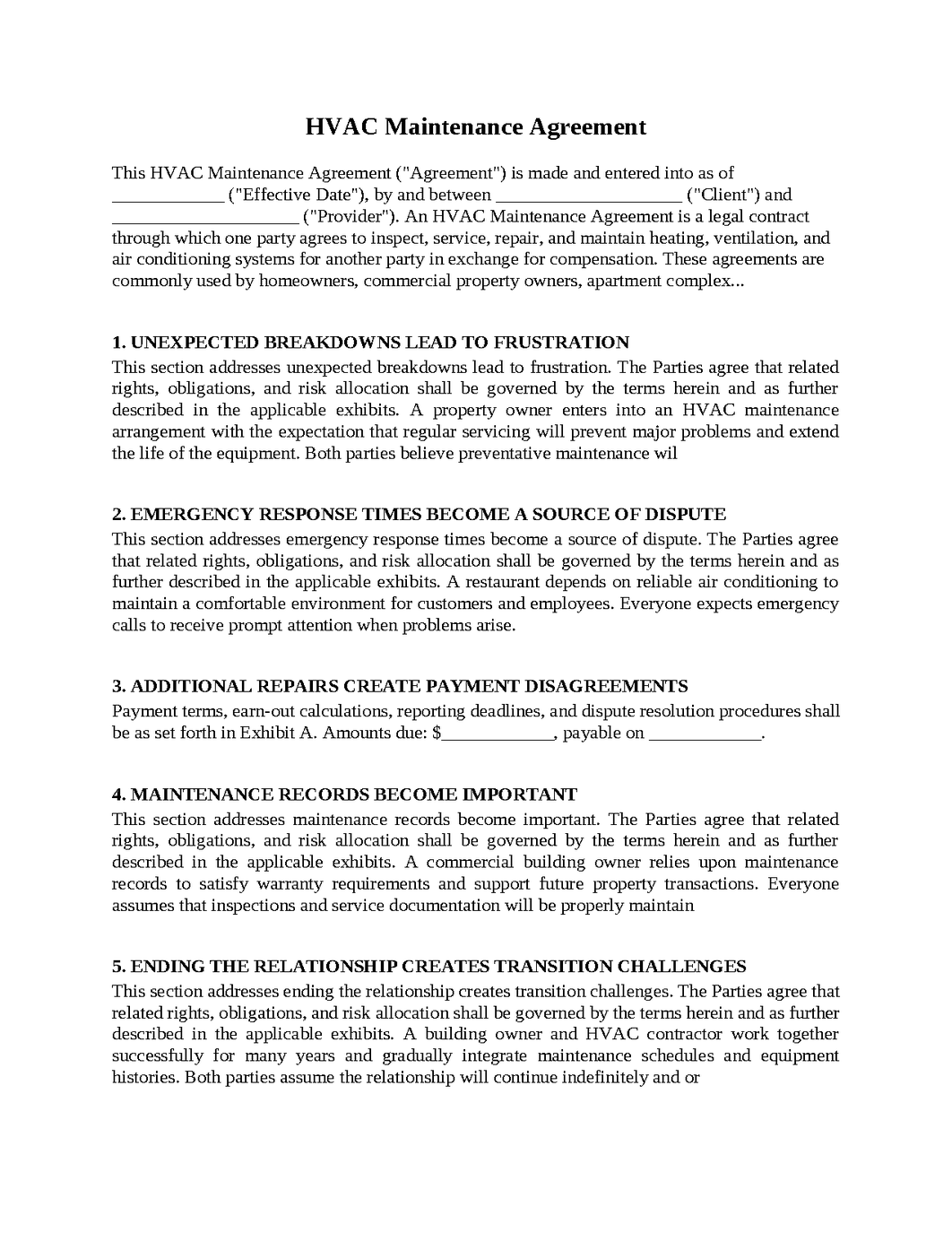
HVAC Maintenance Agreement
An HVAC Maintenance Agreement is a legal contract through which one party agrees to inspect, service, repair, and maintain heating, ventilation, and air conditioning systems for another party in exchange for compensation. These agreements are commonly used by homeowners, commercial property owners, apartment complexes, schools, healthcare facilities, and businesses seeking to preserve the efficiency and reliability of climate control systems. An HVAC Maintenance Agreement typically addresses service schedules, preventative maintenance procedures, emergency repairs, fees, warranties, and processes governing termination and disputes. Because heating and cooling systems are essential to comfort and operations, disputes can arise when expectations regarding service and responsibilities are not documented clearly. A carefully drafted HVAC Maintenance Agreement helps establish certainty and protect the interests of both customers and service providers.
Unexpected Breakdowns Lead to Frustration
A property owner enters into an HVAC maintenance arrangement with the expectation that regular servicing will prevent major problems and extend the life of the equipment. Both parties believe preventative maintenance will reduce unexpected disruptions.
For several years, inspections and tune-ups are performed consistently and the system operates efficiently. Eventually, however, a major component fails during extreme weather, resulting in costly repairs and discomfort for occupants.
The property owner believes the maintenance company should have identified the issue earlier because preventing breakdowns was one of the primary reasons for entering into the agreement. The contractor believes some failures are impossible to predict and argues that regular maintenance does not guarantee uninterrupted operation. As repair costs increase, tensions emerge regarding responsibility for the unexpected failure.
To help avoid this problem, an HVAC Maintenance Agreement should clearly establish the scope of preventative services and define the limitations applicable to equipment performance.
Emergency Response Times Become a Source of Dispute
A restaurant depends on reliable air conditioning to maintain a comfortable environment for customers and employees. Everyone expects emergency calls to receive prompt attention when problems arise.
During the summer, the system fails and the business requests immediate service. High demand and technician shortages delay the response, forcing the restaurant to operate under difficult conditions.
The owner believes priority service should be provided because ongoing maintenance fees were intended to ensure quick assistance. The service company believes emergency requests must be handled according to existing schedules and argues that unusual circumstances affected response times. As lost business and customer complaints increase, disagreements emerge regarding service expectations.
To help prevent these issues, an HVAC Maintenance Agreement should clearly establish response times and define how emergency situations will be prioritized.
Additional Repairs Create Payment Disagreements
A homeowner purchases a maintenance plan expecting routine service costs to remain predictable. Both parties assume that the agreement covers ordinary maintenance needs.
During an annual inspection, technicians discover failing components that require replacement. Additional charges are presented for parts and labor beyond the scheduled maintenance visit.
The homeowner believes many repairs should be included because maintaining the equipment was the purpose of the agreement. The contractor believes replacement parts and major repairs fall outside routine maintenance obligations and argues that separate compensation is appropriate. As costs increase, tensions develop regarding what services are included.
To help avoid these problems, an HVAC Maintenance Agreement should clearly establish covered services and define which repairs require additional approval and compensation.
Maintenance Records Become Important
A commercial building owner relies upon maintenance records to satisfy warranty requirements and support future property transactions. Everyone assumes that inspections and service documentation will be properly maintained.
Over time, questions arise regarding whether all required maintenance visits occurred and whether records accurately reflect the work performed. Concerns develop when warranty claims are submitted.
The owner believes detailed records are essential because equipment manufacturers and future buyers may rely on them. The service company believes ordinary documentation practices are sufficient and argues that missing records do not necessarily indicate that work was not performed. As warranty issues arise, disagreements emerge regarding recordkeeping responsibilities.
To help prevent these issues, an HVAC Maintenance Agreement should clearly establish documentation requirements and define how service records will be maintained.
Ending the Relationship Creates Transition Challenges
A building owner and HVAC contractor work together successfully for many years and gradually integrate maintenance schedules and equipment histories. Both parties assume the relationship will continue indefinitely and organize operations around that expectation.
Eventually, changing priorities lead the owner to hire another service provider. Questions arise regarding maintenance records, outstanding invoices, warranties, and responsibilities involving previously completed repairs.
The owner believes a smooth transition is necessary to preserve system performance and continuity. The contractor believes its obligations should conclude promptly and expects all outstanding balances to be resolved before providing additional assistance. As the relationship ends, disagreements emerge regarding the rights and responsibilities that survive termination.
To help avoid this problem, an HVAC Maintenance Agreement should clearly establish termination procedures and identify the obligations that continue after the relationship ends.
HVAC Maintenance Agreements are valuable tools that help property owners preserve the reliability and efficiency of heating and cooling systems while relying on professional expertise. However, issues involving equipment failures, emergency response times, additional repairs, recordkeeping, and post-termination obligations can become significant sources of conflict when expectations are not documented clearly. A carefully drafted HVAC Maintenance Agreement provides a structured framework for allocating responsibilities and protecting the interests of both customers and service providers. When prepared thoughtfully, it can reduce uncertainty, strengthen business relationships, improve equipment performance, and provide the foundation necessary for successful long-term maintenance services.

Get started with Upsign today!
Easily send, sign and track your documents