

Home Remodeling Agreement
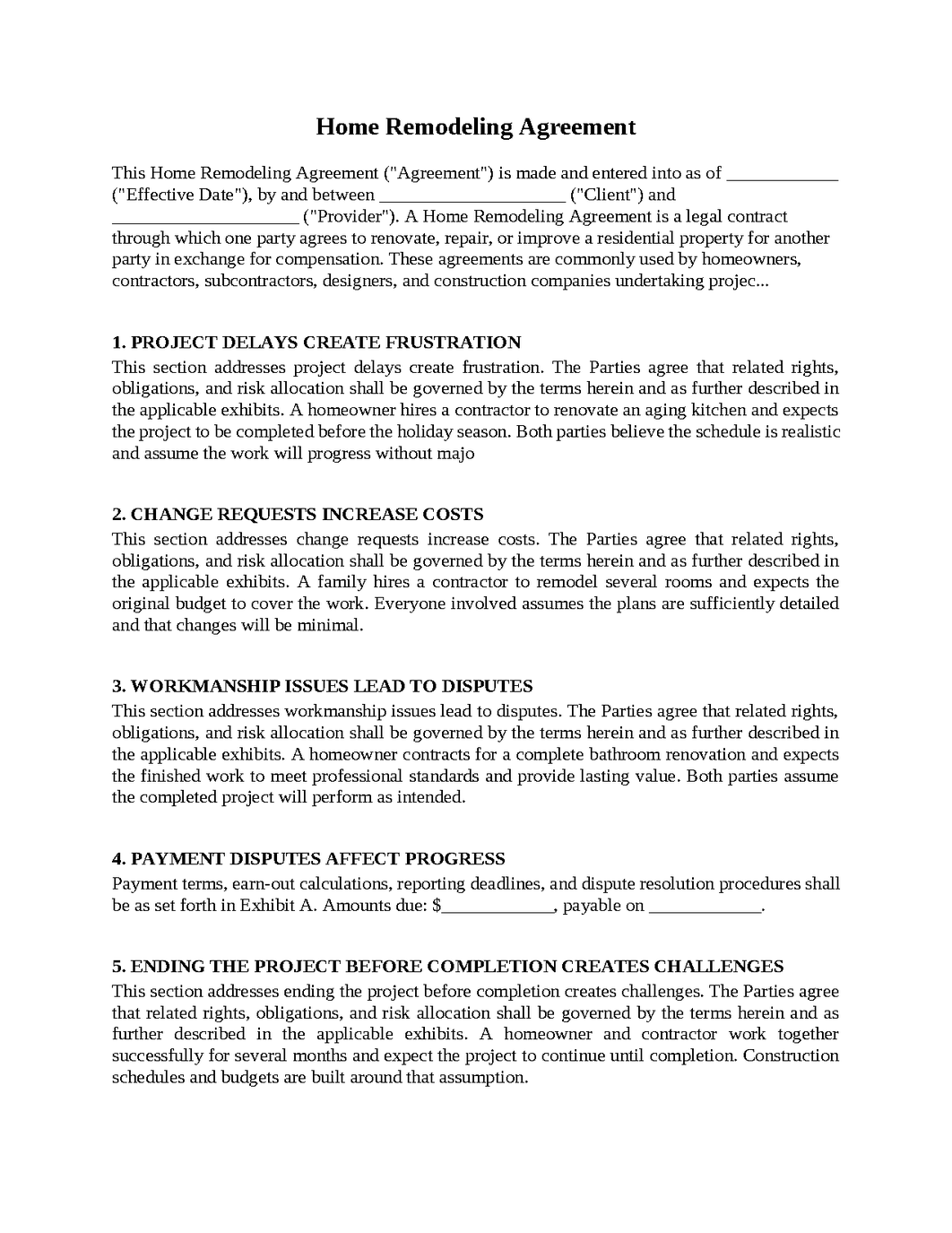
A Home Remodeling Agreement is a legal contract through which one party agrees to renovate, repair, or improve a residential property for another party in exchange for compensation. These agreements are commonly used by homeowners, contractors, subcontractors, designers, and construction companies undertaking projects involving kitchens, bathrooms, additions, flooring, roofing, and other improvements. A Home Remodeling Agreement typically addresses the scope of work, project schedules, payment terms, materials, change orders, warranties, and procedures governing disputes and termination. Because remodeling projects involve substantial investments and frequently evolve as work progresses, disputes can arise when expectations regarding responsibilities and costs are not documented clearly. A carefully drafted Home Remodeling Agreement helps establish certainty and protect the interests of both homeowners and contractors.
Project Delays Create Frustration
A homeowner hires a contractor to renovate an aging kitchen and expects the project to be completed before the holiday season. Both parties believe the schedule is realistic and assume the work will progress without major interruptions.
Initially, demolition and construction proceed according to plan. Over time, however, material shortages, subcontractor scheduling issues, and unexpected structural problems begin delaying progress.
The homeowner believes the contractor should have anticipated potential setbacks because timely completion was an important consideration. The contractor believes unforeseen conditions and supply chain disruptions affected the project and argues that reasonable efforts were made to maintain progress. As delays continue and temporary living arrangements become inconvenient, tensions emerge regarding responsibility for the scheduling problems.
To help avoid this problem, a Home Remodeling Agreement should clearly establish project timelines and define how delays and extensions will be handled.
Change Requests Increase Costs
A family hires a contractor to remodel several rooms and expects the original budget to cover the work. Everyone involved assumes the plans are sufficiently detailed and that changes will be minimal.
As construction progresses, the homeowners request upgraded fixtures, additional cabinetry, and design modifications. The contractor submits revised estimates reflecting the expanded scope of work.
The homeowners believe many of the changes are relatively minor and should not result in significant additional charges. The contractor believes the extra work requires additional labor and materials and argues that compensation should reflect the revised scope. As invoices increase, disagreements emerge regarding pricing and approvals.
To help prevent these issues, a Home Remodeling Agreement should clearly establish change order procedures and define how modifications and additional costs will be approved.
Workmanship Issues Lead to Disputes
A homeowner contracts for a complete bathroom renovation and expects the finished work to meet professional standards and provide lasting value. Both parties assume the completed project will perform as intended.
Several months after completion, tile cracks appear and plumbing fixtures begin leaking. Questions arise regarding whether the problems resulted from poor workmanship or defective materials.
The homeowner believes the contractor should correct the issues because the defects appeared shortly after completion. The contractor believes certain products were supplied by third parties and argues that not all problems are attributable to installation. As repair costs increase, tensions develop regarding warranties and responsibility for corrective work.
To help avoid these problems, a Home Remodeling Agreement should clearly establish workmanship standards and define warranty obligations.
Payment Disputes Affect Progress
A contractor begins work on a major remodeling project and expects periodic payments to support labor and material expenses. Both parties believe the payment schedule provides fairness and flexibility.
As the project advances, disagreements arise regarding whether certain milestones have been completed and whether payment requests are justified. Construction slows while the issues remain unresolved.
The contractor believes timely payments are necessary because subcontractors and suppliers depend on steady cash flow. The homeowner believes payments should only be made after confirming that the work satisfies expectations. As communication deteriorates, disagreements emerge regarding the amount and timing of payments.
To help prevent these issues, a Home Remodeling Agreement should clearly establish payment schedules and define the procedures governing inspections and milestone approvals.
Ending the Project Before Completion Creates Challenges
A homeowner and contractor work together successfully for several months and expect the project to continue until completion. Construction schedules and budgets are built around that assumption.
Unexpected financial difficulties and disagreements eventually lead one side to terminate the relationship before the project is finished. Questions arise regarding unfinished work, materials on site, outstanding balances, and responsibilities involving subcontractors.
The homeowner believes an orderly transition is necessary to avoid further delays and complete the renovation efficiently. The contractor believes compensation should be provided for work already performed and expects contractual rights to be honored. As the relationship ends, disagreements emerge regarding the obligations that survive termination.
To help avoid this problem, a Home Remodeling Agreement should clearly establish termination procedures and identify the rights and responsibilities that continue after the relationship ends.
Home Remodeling Agreements are valuable tools that provide structure and accountability throughout residential renovation projects. However, issues involving delays, change requests, workmanship concerns, payment disputes, and early termination can become significant sources of conflict when expectations are not documented clearly. A carefully drafted Home Remodeling Agreement provides a structured framework for allocating responsibilities and protecting the interests of both homeowners and contractors. When prepared thoughtfully, it can reduce uncertainty, strengthen working relationships, encourage successful project completion, and provide the foundation necessary for effective home improvement projects.

Get started with Upsign today!
Easily send, sign and track your documents