

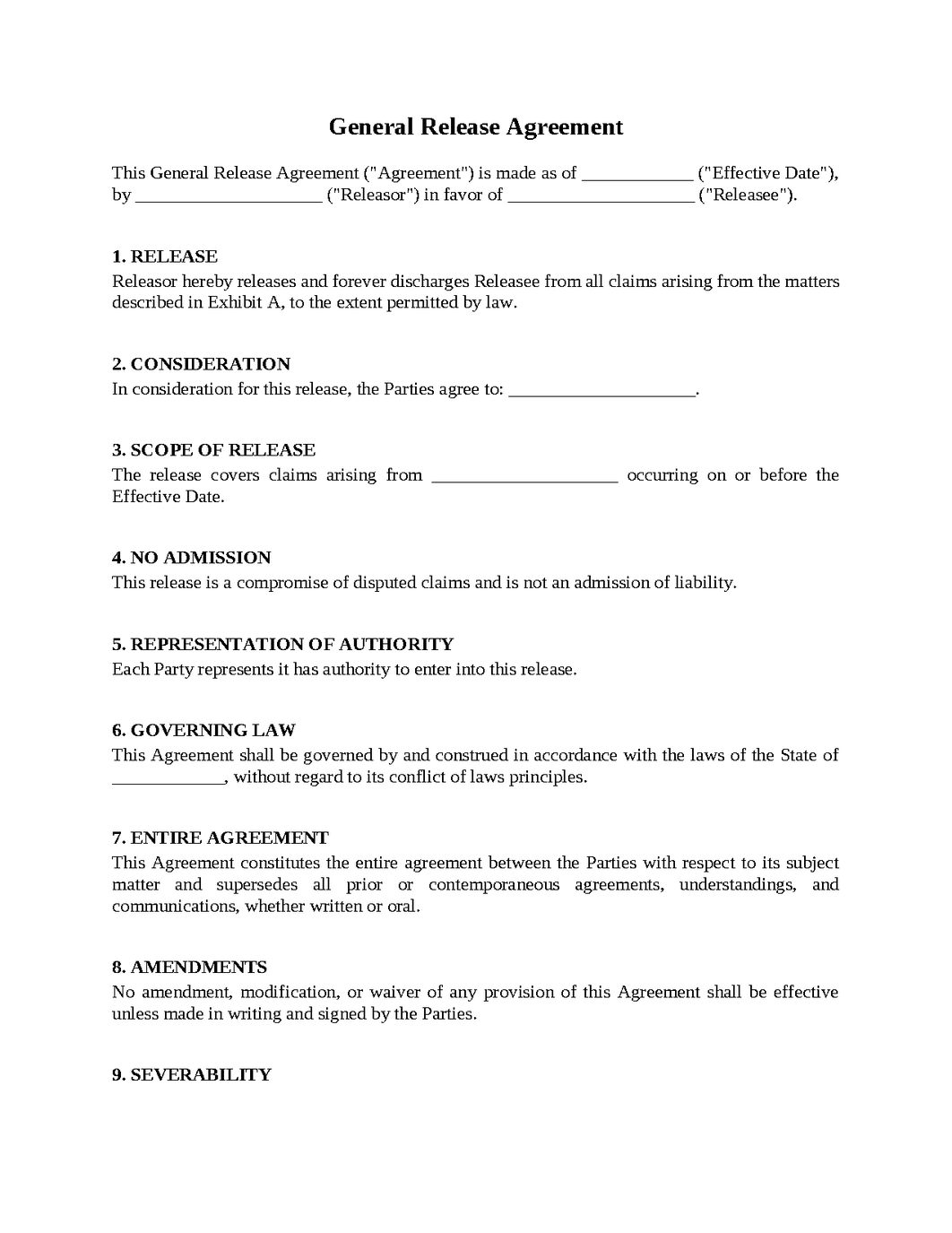
General Release Agreement
A General Release Agreement is a legal contract through which one party agrees to release another party from known and unknown claims, demands, causes of action, liabilities, damages, and disputes arising from specified events, transactions, relationships, or circumstances. These agreements are commonly used in business settlements, contract disputes, employment separations, partnership dissolutions, commercial negotiations, personal injury matters, and other situations where parties seek to resolve disagreements permanently. The primary purpose of a General Release Agreement is to provide finality by preventing future claims relating to matters that occurred before the agreement was signed. Because parties often execute these agreements at the conclusion of significant disputes or business relationships, disagreements can arise when the scope and effect of the release are not fully understood. A carefully drafted General Release Agreement helps protect all parties involved while reducing the risk of future litigation and uncertainty.
One Party Believes the Release Covers More Than Intended
Two companies work together for several years under a series of contracts involving products, services, and ongoing business obligations.
Eventually, disagreements arise regarding performance issues and unpaid amounts. After lengthy negotiations, the parties agree to settle their differences and execute a General Release Agreement in exchange for a negotiated payment.
Both sides initially believe the settlement resolves the matter completely. Several months later, however, one company discovers what it believes to be a separate claim arising from the same business relationship but involving different transactions that were never discussed during settlement negotiations.
The company pursuing the claim argues that the new issue falls outside the scope of the release because it was not specifically identified. The other company maintains that the purpose of the General Release Agreement was to end all disputes connected to the relationship, whether known or unknown at the time.
What began as a successful settlement becomes a new disagreement regarding the meaning and scope of the release itself.
To help avoid this problem, a General Release Agreement should clearly define the claims being released, identify any excluded claims, and specify whether unknown or subsequently discovered claims are intended to be covered.
A Party Signs Without Fully Appreciating the Rights Being Released
An individual becomes involved in a dispute with a former business partner following the termination of a joint venture.
After months of discussions, the parties negotiate a settlement that includes a financial payment and a General Release Agreement. The individual focuses primarily on receiving the settlement funds and moving on from the dispute.
At the time of signing, little attention is given to the broader legal consequences of the release language. Years later, information surfaces suggesting that additional damages may have existed that were not known when the settlement was reached.
The individual attempts to pursue a new claim but discovers that the previously signed release may prevent any further recovery. The former business partner argues that the agreement was intended to bring complete closure to all matters arising from the relationship.
The disagreement shifts from the original dispute to whether the release should be enforced according to its terms.
To help prevent these issues, a General Release Agreement should be written clearly, provide sufficient opportunity for review, and ensure that all parties understand the rights and claims they are relinquishing.
Newly Discovered Facts Change the Parties' Perspectives
A supplier and customer resolve a commercial dispute involving alleged contract breaches and operational losses.
During settlement negotiations, both parties evaluate the information available and eventually agree on a compromise. A General Release Agreement is signed, and the settlement is completed.
Several months later, internal records reveal information that significantly changes one party's understanding of the events that led to the dispute. The newly discovered evidence suggests that the financial impact may have been substantially greater than originally believed.
The disappointed party argues that the settlement was based on incomplete information and should not prevent additional recovery. The other party responds that uncertainty is inherent in settlements and that the release was specifically designed to bring finality despite unknown facts.
The disagreement creates renewed tension over issues that both sides believed had already been resolved.
To help avoid these problems, a General Release Agreement should clearly address unknown claims and explain whether future discoveries will affect the validity of the release.
Claims Are Brought Against Related Parties
A company settles a dispute with a former contractor through a negotiated payment and a General Release Agreement.
The parties execute the agreement and assume that all issues arising from the relationship have been resolved. Some time later, however, claims are asserted against the contractor's employees, officers, affiliates, and related entities.
The claimant argues that the release applied only to the contractor named in the agreement. The contractor contends that the release was intended to protect a broader group of individuals and organizations connected to the dispute.
Each side points to different portions of the agreement to support its interpretation. The outcome may determine whether substantial liability continues to exist despite the prior settlement.
What appeared to be a fully resolved matter becomes a dispute regarding who was actually protected by the release.
To help prevent these issues, a General Release Agreement should clearly identify all released parties and specify whether affiliates, employees, agents, successors, insurers, and related entities are included within the scope of the release.
Settlement Obligations Are Never Fully Performed
Two parties resolve a business dispute through a settlement that includes installment payments over an extended period.
The General Release Agreement is signed at the beginning of the settlement process, and both parties expect the remaining obligations to be completed according to schedule. Initially, payments are made as promised.
Over time, however, the paying party encounters financial difficulties and misses several required payments. The receiving party believes the failure to perform should invalidate the release and restore the right to pursue the original claims.
The paying party argues that the release became effective when the agreement was signed and should remain enforceable despite later performance issues. Both sides disagree regarding the relationship between the release and the settlement obligations.
The dispute creates uncertainty regarding whether the original claims have been extinguished permanently.
To help avoid these problems, a General Release Agreement should clearly describe the consideration supporting the release, establish when the release becomes effective, and explain the consequences of failing to perform settlement obligations.
General Release Agreements are among the most commonly used legal tools for bringing disputes and business relationships to a final conclusion. However, issues involving the scope of released claims, informed consent, newly discovered information, related-party protections, and settlement performance can become significant sources of conflict when expectations are not documented clearly. A carefully drafted General Release Agreement provides a structured framework for achieving certainty and reducing future disputes. When prepared thoughtfully, it can help protect all parties involved, preserve the value of negotiated settlements, and provide the finality necessary for everyone to move forward with confidence.

Get started with Upsign today!
Easily send, sign and track your documents