

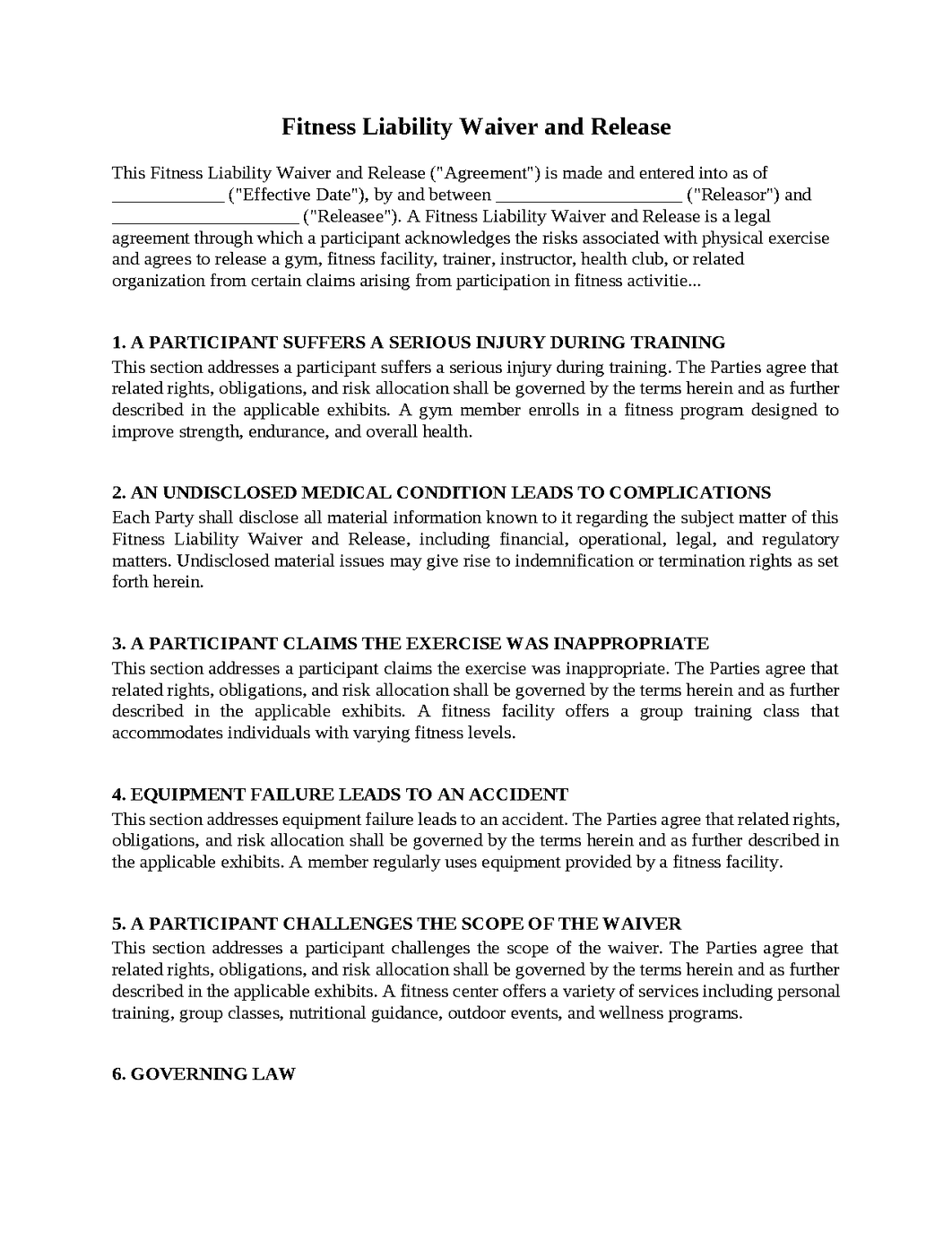
Fitness Liability Waiver and Release
A Fitness Liability Waiver and Release is a legal agreement through which a participant acknowledges the risks associated with physical exercise and agrees to release a gym, fitness facility, trainer, instructor, health club, or related organization from certain claims arising from participation in fitness activities. These agreements are commonly used by gyms, personal trainers, CrossFit facilities, yoga studios, martial arts schools, boot camps, wellness centers, and other fitness-related businesses. Because exercise inherently involves physical exertion and the possibility of injury, disputes can arise when participants and fitness providers have different expectations regarding responsibility for accidents, injuries, and health conditions. A carefully drafted Fitness Liability Waiver and Release helps communicate risks, establish responsibilities, and reduce uncertainty regarding potential claims.
A Participant Suffers a Serious Injury During Training
A gym member enrolls in a fitness program designed to improve strength, endurance, and overall health.
Before beginning the program, the participant signs a Fitness Liability Waiver and Release acknowledging that exercise activities involve inherent physical risks. The participant attends classes regularly and experiences positive results during the first several months.
During a training session, the participant suffers a significant injury while performing an exercise. Medical treatment becomes necessary, and the participant is unable to continue exercising for an extended period.
The participant believes the injury resulted from inadequate instruction, supervision, or safety precautions. The fitness facility believes the participant voluntarily accepted the known risks associated with physical exercise and training.
What began as a routine fitness program becomes a dispute regarding whether the injury falls within the risks assumed by the participant.
To help avoid this problem, a Fitness Liability Waiver and Release should clearly identify the risks associated with exercise activities and explain the claims that participants are agreeing to release.
An Undisclosed Medical Condition Leads to Complications
A personal trainer begins working with a new client who wants to improve physical fitness and lose weight.
The trainer conducts an initial consultation and asks the client about health history, physical limitations, and prior injuries. The client completes intake paperwork and signs a Fitness Liability Waiver and Release before training begins.
Several weeks into the program, the client experiences a medical emergency during a workout. Later investigations reveal that the client had an underlying health condition that was never disclosed to the trainer.
The client believes the workout program contributed to the medical event. The trainer believes important information was withheld and that exercise recommendations would have been different had the condition been disclosed.
The disagreement centers on whether responsibility rests with the trainer, the client, or a combination of both.
To help prevent these issues, a Fitness Liability Waiver and Release should clearly address participant health disclosures, encourage consultation with healthcare providers, and explain the participant's responsibility to provide accurate medical information.
A Participant Claims the Exercise Was Inappropriate
A fitness facility offers a group training class that accommodates individuals with varying fitness levels.
Participants sign Fitness Liability Waiver and Release forms before joining the program. Instructors provide demonstrations and encourage participants to modify exercises when necessary.
During a class, one participant attempts an advanced movement and suffers an injury. The participant later argues that the exercise was inappropriate given personal fitness limitations and that better guidance should have been provided.
The instructor believes modifications were offered and that participants were encouraged to exercise within their abilities. The participant believes the class environment created pressure to perform activities beyond what was safe.
The disagreement develops because each side views responsibility for exercise selection differently.
To help avoid these problems, a Fitness Liability Waiver and Release should clearly explain participant responsibilities and acknowledge that individuals must exercise within their own abilities and limitations.
Equipment Failure Leads to an Accident
A member regularly uses equipment provided by a fitness facility.
The gym performs routine maintenance and inspections and believes its equipment is safe for normal use. One day, an accident occurs involving equipment that allegedly malfunctions during a workout.
The member suffers injuries and believes the facility failed to maintain the equipment properly. The gym argues that inspections were conducted regularly and that the waiver addresses many of the risks associated with participation.
Questions arise regarding whether the injury resulted from equipment failure, misuse, ordinary wear and tear, or circumstances beyond anyone's control.
The disagreement becomes significant because both parties believe the other bears primary responsibility.
To help prevent these issues, a Fitness Liability Waiver and Release should clearly address risks associated with equipment use while remaining consistent with applicable safety and maintenance obligations.
A Participant Challenges the Scope of the Waiver
A fitness center offers a variety of services including personal training, group classes, nutritional guidance, outdoor events, and wellness programs.
New members sign a Fitness Liability Waiver and Release during enrollment and begin participating in various activities. Most members assume the waiver applies generally to the fitness center's operations.
After an injury occurs during an off-site fitness event, a participant argues that the waiver applied only to activities conducted inside the facility. The fitness center believes the release covers all authorized activities offered through the membership program.
Both parties review the agreement and discover that certain activities were described more clearly than others.
The disagreement focuses on whether the specific activity falls within the scope of the waiver.
To help avoid these problems, a Fitness Liability Waiver and Release should clearly identify the activities covered by the agreement and explain whether off-site events, special programs, and related services are included.
Fitness Liability Waiver and Release agreements are essential tools for communicating risks and allocating responsibility in fitness-related activities. However, issues involving exercise injuries, undisclosed medical conditions, participant decision-making, equipment-related accidents, and the scope of covered activities can become significant sources of conflict when expectations are not documented clearly. A carefully drafted Fitness Liability Waiver and Release provides a structured framework for informing participants and reducing uncertainty regarding potential claims. When prepared thoughtfully, it can support safer participation, improve communication, and provide greater certainty for both fitness providers and their members.

Get started with Upsign today!
Easily send, sign and track your documents