

Final Waiver and Release Upon Payment
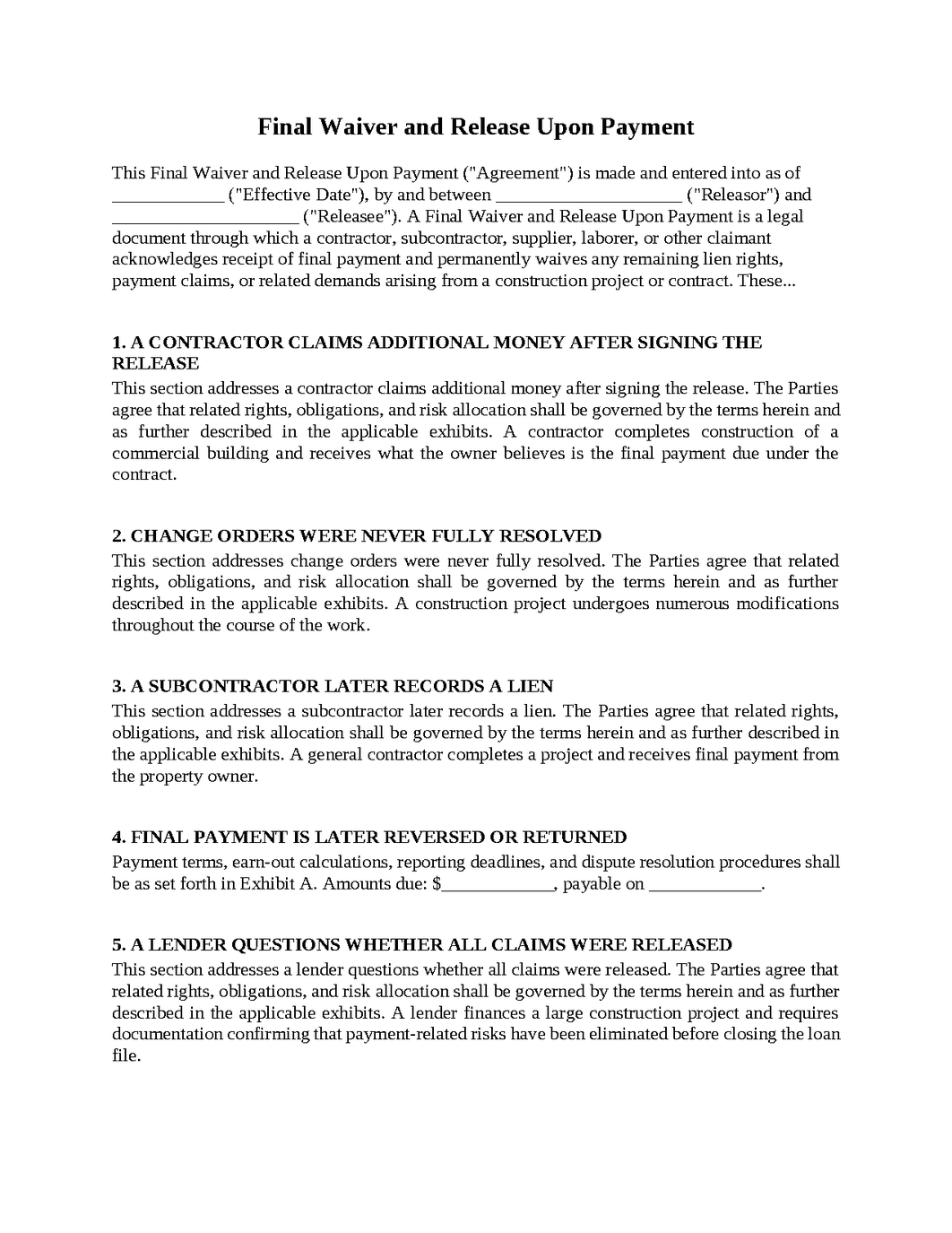
A Final Waiver and Release Upon Payment is a legal document through which a contractor, subcontractor, supplier, laborer, or other claimant acknowledges receipt of final payment and permanently waives any remaining lien rights, payment claims, or related demands arising from a construction project or contract. These documents are commonly used in residential construction, commercial construction, public works projects, remodeling projects, subcontractor relationships, and construction financing transactions. Unlike a Partial Lien Release, which preserves rights relating to unpaid amounts, a Final Waiver and Release Upon Payment is intended to bring complete closure to payment-related claims associated with the project. Because final payments often occur near project completion when multiple parties, invoices, change orders, and disputes may still exist, disagreements can arise when expectations regarding the effect of the release are not documented clearly. A carefully drafted Final Waiver and Release Upon Payment helps establish certainty and prevent future claims.
A Contractor Claims Additional Money After Signing the Release
A contractor completes construction of a commercial building and receives what the owner believes is the final payment due under the contract.
As part of the payment process, the contractor signs a Final Waiver and Release Upon Payment confirming receipt of funds and waiving future claims relating to the project. The owner views the document as confirmation that all financial obligations have been satisfied.
Several months later, the contractor submits additional invoices for alleged extra work, project delays, and unforeseen conditions encountered during construction. The contractor argues that these claims were not fully considered when the release was signed.
The owner believes the Final Waiver and Release Upon Payment permanently resolved all outstanding payment issues. The contractor maintains that certain claims survived because they were not specifically addressed.
The disagreement becomes a dispute regarding whether any payment rights remained after execution of the release.
To help avoid this problem, a Final Waiver and Release Upon Payment should clearly identify the claims being waived and specify whether any exceptions survive the release.
Change Orders Were Never Fully Resolved
A construction project undergoes numerous modifications throughout the course of the work.
The contractor performs additional services under various change orders, some of which are approved formally while others are discussed informally during construction. As the project nears completion, the owner and contractor negotiate a final payment.
The contractor signs a Final Waiver and Release Upon Payment and accepts the funds. Shortly thereafter, disagreements emerge regarding several change orders that were never documented completely.
The contractor believes additional compensation remains owed. The owner believes the release eliminated all claims relating to the project, including disputed change-order requests.
The disagreement develops because the parties never reached a clear understanding regarding unresolved project modifications.
To help prevent these issues, a Final Waiver and Release Upon Payment should clearly address change orders, disputed claims, and any amounts that remain excluded from the release.
A Subcontractor Later Records a Lien
A general contractor completes a project and receives final payment from the property owner.
In exchange, the contractor provides a Final Waiver and Release Upon Payment confirming that all project-related claims have been satisfied. The owner believes the project is financially closed.
Months later, a subcontractor records a lien against the property claiming that payment was never received for a portion of the work performed. The owner becomes concerned because the release from the general contractor did not eliminate claims by other project participants.
The general contractor believes the issue is a dispute between the subcontractor and the contractor. The owner believes the final release should have protected the property from future lien claims.
The disagreement becomes complicated because multiple payment relationships exist within the same project.
To help avoid these problems, a Final Waiver and Release Upon Payment should clearly address subcontractor payments and may require supporting releases from lower-tier participants before final payment is made.
Final Payment Is Later Reversed or Returned
A property owner issues a final payment to a contractor at the conclusion of a successful construction project.
The contractor deposits the payment and signs a Final Waiver and Release Upon Payment acknowledging receipt of funds and waiving future claims. Both parties consider the project complete.
Shortly thereafter, a banking error, stop-payment request, or other issue causes the payment transaction to fail. The contractor discovers that the funds were never actually received despite signing the release.
The contractor argues that the release should not remain effective because the payment was never completed successfully. The owner believes the signed document remains binding.
The disagreement focuses on whether the release became effective when signed or only after the payment was fully collected.
To help prevent these issues, a Final Waiver and Release Upon Payment should clearly state whether effectiveness depends upon actual receipt and clearance of the final payment.
A Lender Questions Whether All Claims Were Released
A lender finances a large construction project and requires documentation confirming that payment-related risks have been eliminated before closing the loan file.
The borrower provides Final Waiver and Release Upon Payment documents from key contractors and suppliers. Initially, the lender believes the project has been completed without significant financial exposure.
During a later review, questions arise regarding whether the releases cover warranty claims, retention amounts, disputed invoices, or other obligations that may still exist. The lender becomes concerned that unresolved claims could affect the property's value or title.
The borrower believes the releases provide complete protection. The lender believes additional clarification is necessary.
The disagreement centers on the scope and completeness of the waivers provided.
To help avoid these problems, a Final Waiver and Release Upon Payment should clearly define the obligations being released and identify any rights that intentionally survive project completion.
Final Waiver and Release Upon Payment documents are among the most important project closeout tools in the construction industry because they provide evidence that payment obligations have been satisfied and lien rights have been relinquished. However, issues involving additional compensation claims, unresolved change orders, subcontractor disputes, failed payments, and lender requirements can become significant sources of conflict when expectations are not documented clearly. A carefully drafted Final Waiver and Release Upon Payment provides a structured framework for concluding payment obligations and protecting all parties involved. When prepared thoughtfully, it can reduce uncertainty, facilitate financing and property transfers, support successful project completion, and provide the finality necessary for everyone to move forward with confidence.

Get started with Upsign today!
Easily send, sign and track your documents