

Fiduciary Agreement
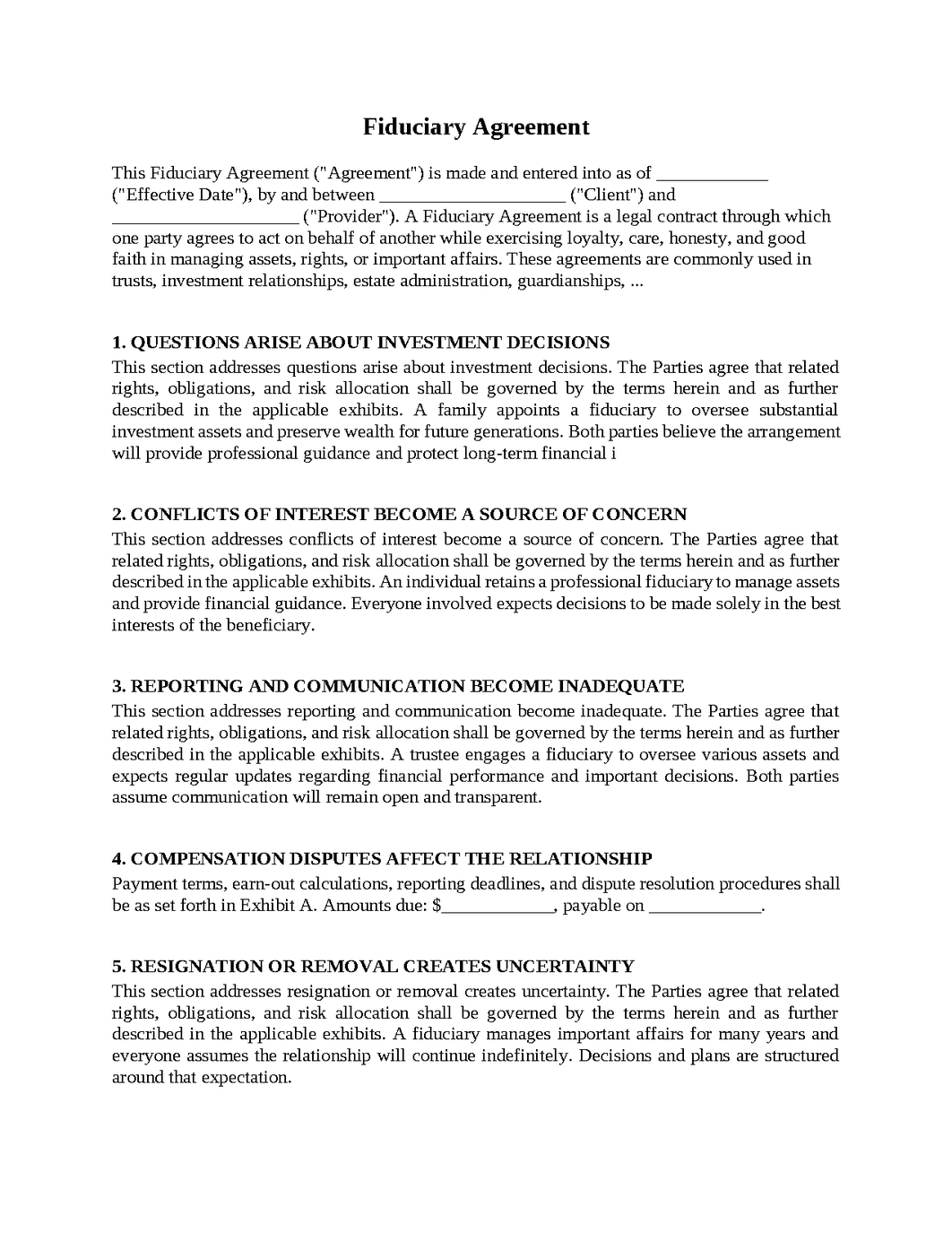
A Fiduciary Agreement is a legal contract through which one party agrees to act on behalf of another while exercising loyalty, care, honesty, and good faith in managing assets, rights, or important affairs. These agreements are commonly used in trusts, investment relationships, estate administration, guardianships, corporate governance, and professional advisory services. A Fiduciary Agreement typically addresses the scope of authority, standards of conduct, reporting requirements, compensation, conflicts of interest, and procedures governing resignation or termination. Because fiduciary relationships involve trust and significant responsibilities, disputes can arise when expectations regarding duties and accountability are not documented clearly. A carefully drafted Fiduciary Agreement helps establish certainty and protect the interests of everyone involved.
Questions Arise About Investment Decisions
A family appoints a fiduciary to oversee substantial investment assets and preserve wealth for future generations. Both parties believe the arrangement will provide professional guidance and protect long-term financial interests.
For several years, the investments perform well and communication remains positive. Eventually, changing market conditions and economic uncertainty lead to investment losses that concern the beneficiaries.
The beneficiaries believe the fiduciary should be held accountable because the losses resulted from decisions made under the fiduciary's control. The fiduciary believes prudent judgment was exercised and argues that market fluctuations are unavoidable. As financial results deteriorate, tensions emerge regarding the standard of care required under the relationship.
To help avoid this problem, a Fiduciary Agreement should clearly establish investment authority and define the standards governing the fiduciary's conduct.
Conflicts of Interest Become a Source of Concern
An individual retains a professional fiduciary to manage assets and provide financial guidance. Everyone involved expects decisions to be made solely in the best interests of the beneficiary.
Over time, questions arise regarding transactions involving businesses and investments connected to the fiduciary. Family members begin wondering whether certain recommendations benefited the fiduciary more than the person being represented.
The beneficiaries believe complete transparency is essential and expect all conflicts to be disclosed immediately. The fiduciary believes the transactions were appropriate and argues that no improper motives influenced decision-making. As suspicions increase, disagreements develop regarding loyalty and independence.
To help prevent these issues, a Fiduciary Agreement should clearly establish conflict-of-interest standards and define disclosure obligations.
Reporting and Communication Become Inadequate
A trustee engages a fiduciary to oversee various assets and expects regular updates regarding financial performance and important decisions. Both parties assume communication will remain open and transparent.
As responsibilities increase, reports become less frequent and beneficiaries begin receiving incomplete information. Uncertainty develops regarding asset values, expenses, and transactions performed on behalf of the estate.
The beneficiaries believe detailed reports are necessary because trust and accountability are central to the relationship. The fiduciary believes excessive reporting requirements interfere with efficient management and argues that ordinary summaries should be sufficient. As concerns about transparency increase, tensions emerge regarding communication obligations.
To help avoid these problems, a Fiduciary Agreement should clearly establish reporting requirements and define how information will be shared with interested parties.
Compensation Disputes Affect the Relationship
A professional fiduciary agrees to manage complex assets requiring significant time and expertise. Both parties initially believe the compensation arrangement is fair and expect the relationship to continue successfully.
Unexpected legal issues and administrative challenges increase the workload substantially. Additional time and resources become necessary to fulfill the fiduciary's responsibilities.
The fiduciary believes the increased complexity justifies additional compensation because the scope of services has expanded. The beneficiaries believe the original arrangement should control and argue that unexpected costs should not continually increase fees. As invoices become larger, disagreements emerge regarding compensation and reimbursements.
To help prevent these issues, a Fiduciary Agreement should clearly establish compensation arrangements and define how extraordinary services and expenses will be handled.
Resignation or Removal Creates Uncertainty
A fiduciary manages important affairs for many years and everyone assumes the relationship will continue indefinitely. Decisions and plans are structured around that expectation.
Unexpected health issues and changing circumstances eventually cause the fiduciary to step aside. Questions arise regarding successor appointments, access to records, and the transfer of responsibilities.
The beneficiaries believe continuity is essential and expect a smooth transition that preserves the value of the assets. The fiduciary believes personal circumstances justify resignation and expects cooperation in transferring responsibilities. As uncertainty grows, disagreements emerge regarding the obligations that survive the end of the relationship.
To help avoid this problem, a Fiduciary Agreement should clearly establish resignation and succession procedures and identify the responsibilities that continue after the fiduciary's service ends.
Fiduciary Agreements are valuable tools that establish trust and accountability in relationships involving significant responsibilities and assets. However, issues involving investment decisions, conflicts of interest, reporting obligations, compensation disputes, and succession can become significant sources of conflict when expectations are not documented clearly. A carefully drafted Fiduciary Agreement provides a structured framework for allocating responsibilities and protecting the interests of everyone involved. When prepared thoughtfully, it can reduce uncertainty, strengthen trust, encourage transparency, and provide the foundation necessary for responsible stewardship and effective decision-making.

Get started with Upsign today!
Easily send, sign and track your documents