

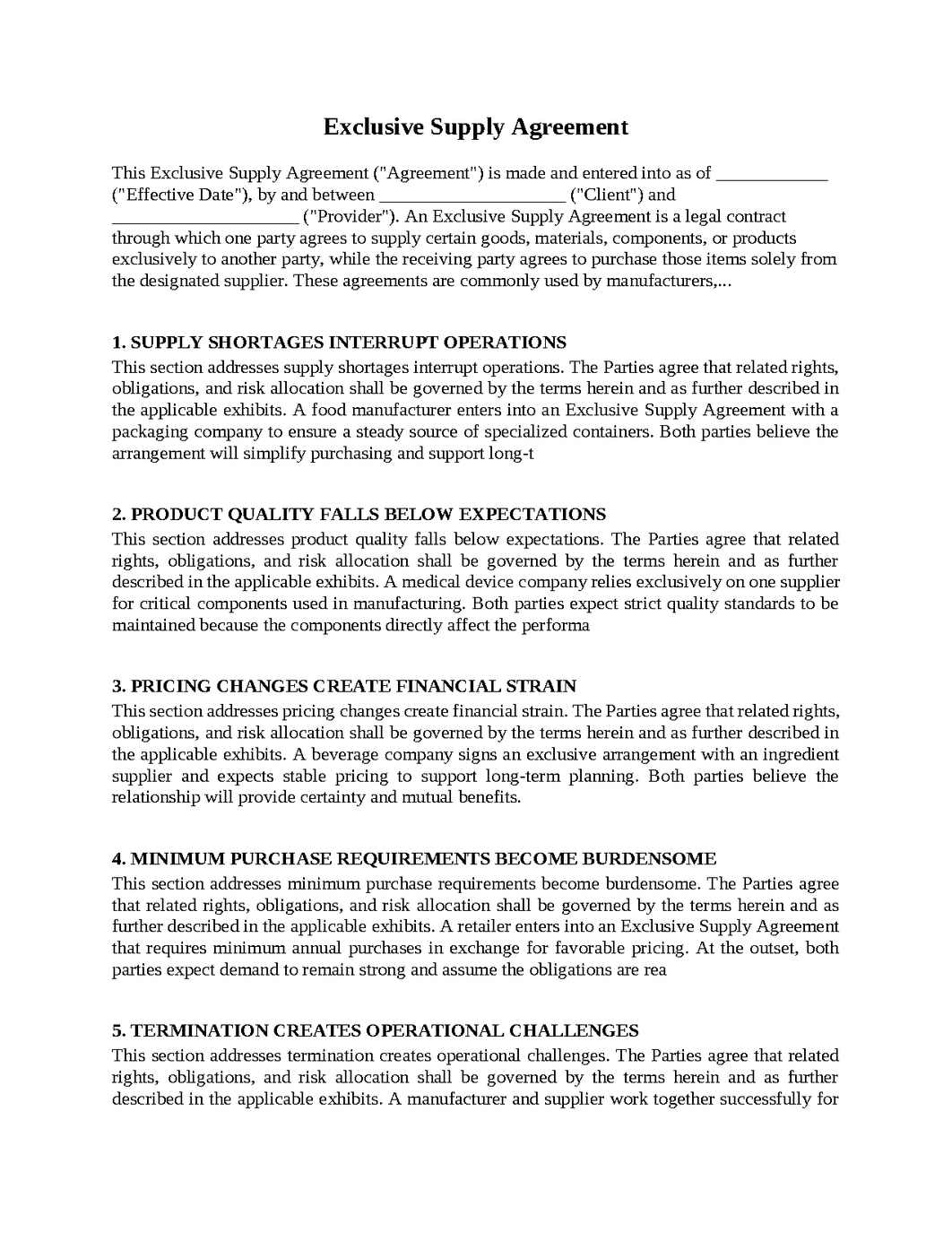
Exclusive Supply Agreement
An Exclusive Supply Agreement is a legal contract through which one party agrees to supply certain goods, materials, components, or products exclusively to another party, while the receiving party agrees to purchase those items solely from the designated supplier. These agreements are commonly used by manufacturers, retailers, restaurants, pharmaceutical companies, automotive businesses, and technology firms seeking reliable access to essential products. An Exclusive Supply Agreement typically addresses product specifications, pricing, minimum purchase obligations, delivery schedules, quality standards, and procedures governing termination and renewal. Because exclusive supply arrangements often create mutual dependence and require significant investments, disputes can arise when expectations regarding performance and obligations are not documented clearly. A carefully drafted Exclusive Supply Agreement helps establish certainty and protect the interests of both suppliers and purchasers.
Supply Shortages Interrupt Operations
A food manufacturer enters into an Exclusive Supply Agreement with a packaging company to ensure a steady source of specialized containers. Both parties believe the arrangement will simplify purchasing and support long-term growth.
For several years, deliveries arrive on schedule and production operates efficiently. Eventually, raw material shortages and transportation problems begin affecting the supplier's ability to meet demand.
The manufacturer believes the supplier assumed responsibility for maintaining adequate production capacity and expects uninterrupted service. The supplier argues that industry-wide disruptions and shortages were beyond its control and that reasonable efforts were made to satisfy orders. As inventory levels decline and production slows, frustrations increase regarding responsibility for the interruptions.
To help avoid this problem, an Exclusive Supply Agreement should clearly establish delivery requirements and define how shortages and interruptions will be handled.
Product Quality Falls Below Expectations
A medical device company relies exclusively on one supplier for critical components used in manufacturing. Both parties expect strict quality standards to be maintained because the components directly affect the performance of finished products.
Over time, customer complaints begin increasing and internal inspections reveal inconsistencies in the materials being supplied. Production delays and warranty claims create financial pressure on the manufacturer.
The purchaser believes the supplier should bear responsibility because the products no longer satisfy the agreed specifications. The supplier believes the issues are isolated and argues that the manufacturer contributed to the problems through changes in production processes. As losses increase, tensions emerge regarding the standards required under the agreement.
To help prevent these issues, an Exclusive Supply Agreement should clearly establish quality requirements and define the procedures for inspecting and rejecting nonconforming products.
Pricing Changes Create Financial Strain
A beverage company signs an exclusive arrangement with an ingredient supplier and expects stable pricing to support long-term planning. Both parties believe the relationship will provide certainty and mutual benefits.
Unexpected inflation and rising production costs eventually increase the supplier's expenses. The supplier seeks higher prices, while the beverage company struggles to preserve profitability and maintain competitive pricing.
The supplier believes changing market conditions justify adjustments because continuing losses threaten the viability of the relationship. The purchaser believes predictable pricing was one of the primary reasons for entering into an exclusive arrangement and expects the original terms to remain in place. As negotiations become more difficult, both sides begin reevaluating the relationship.
To help avoid these problems, an Exclusive Supply Agreement should clearly establish pricing mechanisms and define the procedures governing adjustments and cost increases.
Minimum Purchase Requirements Become Burdensome
A retailer enters into an Exclusive Supply Agreement that requires minimum annual purchases in exchange for favorable pricing. At the outset, both parties expect demand to remain strong and assume the obligations are reasonable.
Changing consumer preferences eventually reduce sales and leave the retailer with excess inventory. Meeting the minimum purchase requirements becomes increasingly difficult and creates financial strain.
The retailer believes unexpected market conditions justify modifying the agreement and reducing the required volumes. The supplier believes production and pricing decisions were based on the expected purchases and argues that the commitments should remain enforceable. As inventory accumulates, tensions increase regarding the parties' respective obligations.
To help prevent these issues, an Exclusive Supply Agreement should clearly establish minimum purchase requirements and define the circumstances under which adjustments may be made.
Termination Creates Operational Challenges
A manufacturer and supplier work together successfully for many years and gradually integrate systems, forecasting procedures, and inventory management. Both parties assume the relationship will continue indefinitely and make substantial investments based upon that expectation.
Eventually, strategic changes lead one party to terminate the arrangement. Questions arise regarding remaining inventory, open purchase orders, proprietary information, and transition responsibilities.
The purchaser believes additional cooperation is necessary to avoid disrupting operations and customer relationships. The supplier believes its obligations should conclude promptly so resources can be redirected elsewhere. As the separation becomes increasingly complicated, both parties realize that ending the relationship is more difficult than establishing it.
To help avoid this problem, an Exclusive Supply Agreement should clearly establish termination procedures and identify the obligations that survive after the relationship ends.
Exclusive Supply Agreements are valuable tools that provide businesses with stable sourcing relationships and predictable access to important products. However, issues involving shortages, quality concerns, pricing disputes, minimum purchase requirements, and termination responsibilities can become significant sources of conflict when expectations are not documented clearly. A carefully drafted Exclusive Supply Agreement provides a structured framework for allocating responsibilities and protecting the interests of both suppliers and purchasers. When prepared thoughtfully, it can reduce uncertainty, strengthen commercial relationships, encourage investment, and provide the foundation necessary for long-term operational success.

Get started with Upsign today!
Easily send, sign and track your documents