

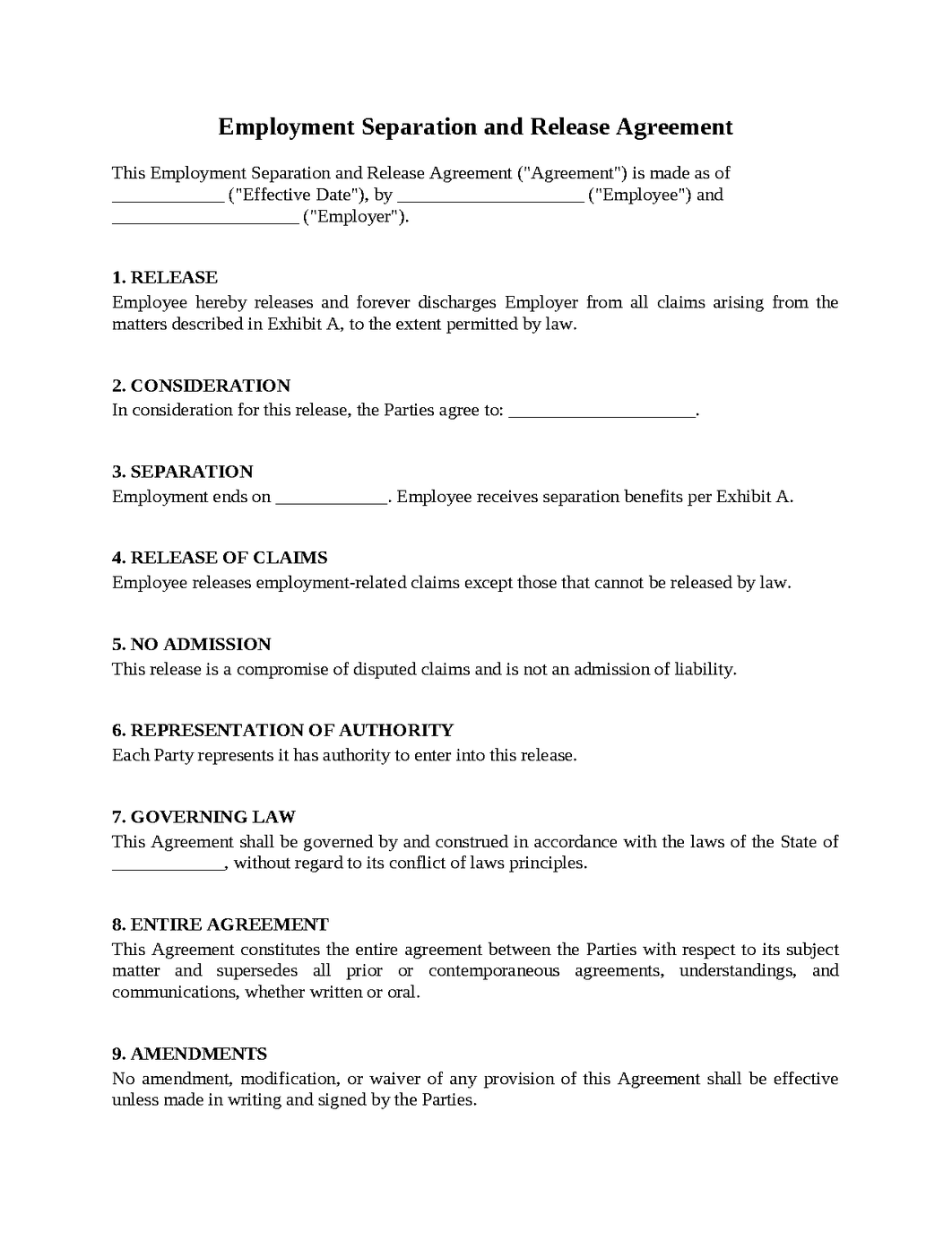
Employment Separation and Release Agreement
An Employment Separation and Release Agreement is a legal contract through which an employer and employee establish the terms of an employment separation while resolving actual or potential claims arising from the employment relationship. These agreements are commonly used in layoffs, workforce reductions, executive departures, negotiated resignations, retirement transitions, performance-related terminations, and dispute resolutions. An Employment Separation and Release Agreement typically addresses severance payments, benefits continuation, confidentiality obligations, non-disparagement provisions, return of company property, and the release of legal claims. Because the end of an employment relationship can involve significant financial, professional, and emotional consequences, disputes can arise when the parties have different expectations regarding their rights and obligations. A carefully drafted Employment Separation and Release Agreement helps provide certainty, reduce litigation risk, and facilitate an orderly transition.
The Employee Believes the Severance Was Promised Differently
A company decides to eliminate a management position as part of a broader organizational restructuring.
The affected employee has worked for the company for many years and has consistently received positive performance evaluations. During discussions regarding the separation, company representatives describe a severance package intended to assist the employee during the transition.
The employee reviews the proposed Employment Separation and Release Agreement and becomes concerned that the written terms differ from prior conversations. Certain benefits appear more limited than expected, and some payments are subject to conditions the employee did not anticipate.
Management believes the agreement accurately reflects the company's offer and standard separation practices. The employee believes important promises made during earlier discussions are not fully reflected in the document.
The disagreement delays the separation process and creates uncertainty regarding whether a final agreement can be reached.
To help avoid this problem, an Employment Separation and Release Agreement should clearly describe all severance benefits, identify any conditions attached to those benefits, and ensure that the written agreement accurately reflects the parties' understanding.
The Employee Later Attempts to Bring a Legal Claim
An employee's position is terminated following a lengthy period of employment.
After consulting with advisors, the employee signs an Employment Separation and Release Agreement in exchange for severance compensation. Both parties believe the agreement resolves any potential disputes arising from the employment relationship.
Several months later, the former employee files a legal claim alleging that certain workplace issues were not fully understood at the time the agreement was signed. The employee argues that the claim falls outside the scope of the release or that the release should not be enforced under the circumstances.
The employer maintains that the severance payment was provided specifically in exchange for the release of claims. The company believes the agreement was entered into voluntarily and should provide the certainty it was intended to create.
The dispute shifts away from the underlying employment issues and focuses on the enforceability and scope of the release itself.
To help prevent these issues, an Employment Separation and Release Agreement should clearly define the claims being released, identify any claims that are excluded, and provide employees with adequate opportunity to review and consider the agreement.
Confidential Information Is Shared After the Separation
A senior employee leaves a company after negotiating a separation package.
As part of the Employment Separation and Release Agreement, both parties agree to maintain confidentiality regarding certain business information and the terms of the separation. Initially, the transition proceeds smoothly and both sides move forward professionally.
Over time, however, company leaders learn that details regarding the separation package are being discussed with current employees, customers, or industry contacts. The company becomes concerned that the disclosures may create workplace disruption and competitive risks.
The former employee believes the conversations involved information that was already widely known or did not violate the agreement. The employer believes the disclosures undermine the protections that were negotiated as part of the separation.
The disagreement creates tension long after the employment relationship has ended.
To help avoid these problems, an Employment Separation and Release Agreement should clearly define confidential information, identify permitted disclosures, and explain the consequences of violating confidentiality obligations.
Disputes Arise Regarding Company Property
A technology company separates from a long-term employee who had access to laptops, mobile devices, documents, customer information, and proprietary systems.
The Employment Separation and Release Agreement requires the return of all company property before certain severance benefits become payable. Both parties initially believe the process will be straightforward.
After the separation occurs, the company discovers that certain devices, records, or electronic files have not been returned. The former employee insists that everything of value was provided back to the company and that any missing items are insignificant.
The company becomes concerned about information security, regulatory compliance, and intellectual property protection. The former employee believes the issue is being exaggerated and should not affect severance payments.
The dispute grows because each side views the significance of the missing property differently.
To help prevent these issues, an Employment Separation and Release Agreement should clearly identify return-of-property requirements, establish deadlines for compliance, and explain how unresolved property issues may affect post-employment obligations.
Non-Disparagement Obligations Become Controversial
A company and departing executive negotiate a separation intended to avoid public conflict.
As part of the agreement, both parties commit to avoiding statements that could harm the reputation of the other. The arrangement appears beneficial because it allows everyone to move forward without ongoing controversy.
Several months after the separation, comments begin appearing in interviews, industry discussions, and social media posts that reference the former employment relationship. Each side believes the other has crossed the line between factual discussion and harmful criticism.
The former employee argues that truthful statements should not violate the agreement. The company believes the comments undermine the purpose of the separation arrangement and damage its reputation.
What began as a cooperative departure evolves into a dispute regarding post-employment conduct.
To help avoid these problems, an Employment Separation and Release Agreement should clearly define non-disparagement obligations, identify permitted communications, and establish remedies if either party violates those commitments.
Employment Separation and Release Agreements are important tools for managing the end of an employment relationship while reducing the risk of future disputes. However, issues involving severance benefits, released claims, confidentiality obligations, company property, and non-disparagement commitments can become significant sources of conflict when expectations are not documented clearly. A carefully drafted Employment Separation and Release Agreement provides a structured framework for resolving employment matters and facilitating an orderly transition. When prepared thoughtfully, it can reduce uncertainty, protect both parties' interests, preserve professional relationships, and provide the finality necessary for a successful separation.

Get started with Upsign today!
Easily send, sign and track your documents