

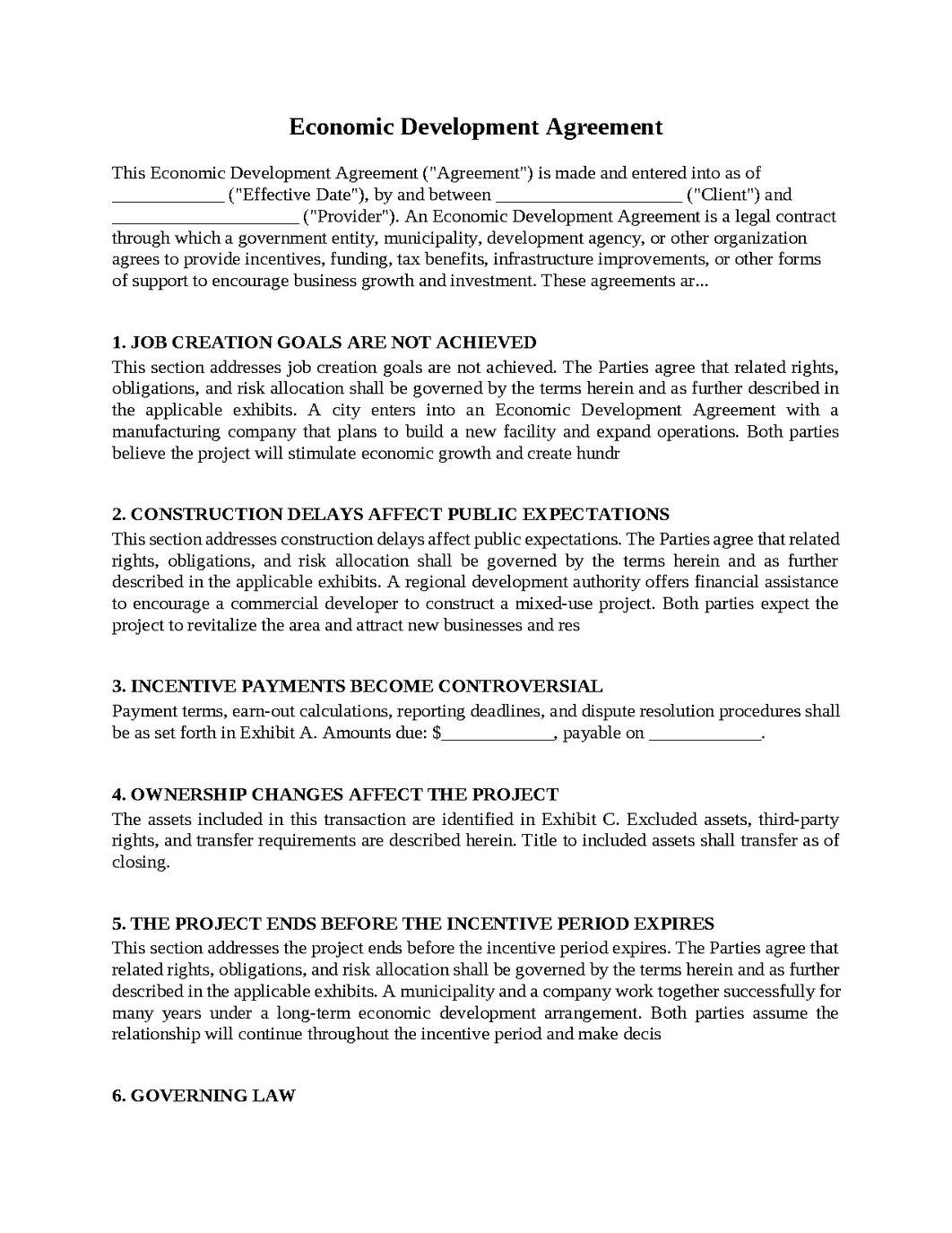
Economic Development Agreement
An Economic Development Agreement is a legal contract through which a government entity, municipality, development agency, or other organization agrees to provide incentives, funding, tax benefits, infrastructure improvements, or other forms of support to encourage business growth and investment. These agreements are commonly used for manufacturing facilities, office developments, mixed-use projects, distribution centers, technology campuses, and job creation initiatives. An Economic Development Agreement typically addresses performance obligations, employment targets, construction timelines, reporting requirements, incentive payments, and the circumstances under which benefits may be reduced or recaptured. Because these projects often involve substantial public and private investments, disputes can arise when expectations regarding performance and accountability are not documented clearly. A carefully drafted Economic Development Agreement helps establish certainty and protect the interests of all parties involved.
Job Creation Goals Are Not Achieved
A city enters into an Economic Development Agreement with a manufacturing company that plans to build a new facility and expand operations. Both parties believe the project will stimulate economic growth and create hundreds of new jobs within the community.
Construction proceeds successfully and the facility begins operations according to schedule. Over time, however, changing market conditions and automation reduce hiring needs, causing employment levels to fall below the targets originally promised.
The municipality believes the incentives were justified only because of the anticipated economic benefits and expects the company to satisfy its commitments. The company believes unforeseen industry conditions made the original projections unrealistic and argues that significant investments were still made in the community. As reporting deadlines approach, tensions develop regarding whether incentives should be reduced or repaid.
To help avoid this problem, an Economic Development Agreement should clearly establish performance benchmarks and define the consequences that apply when job creation goals are not achieved.
Construction Delays Affect Public Expectations
A regional development authority offers financial assistance to encourage a commercial developer to construct a mixed-use project. Both parties expect the project to revitalize the area and attract new businesses and residents.
During the early phases, planning and permitting proceed smoothly. Unexpected labor shortages and rising construction costs eventually slow progress and delay completion far beyond the original schedule.
The development authority believes timely performance was essential because public resources and infrastructure improvements were committed in reliance upon the proposed timeline. The developer argues that economic conditions beyond its control created unavoidable delays and that additional flexibility is necessary to complete the project successfully. As community expectations increase, disagreements emerge regarding extensions and performance obligations.
To help prevent these issues, an Economic Development Agreement should clearly establish construction milestones and define how delays and schedule modifications will be handled.
Incentive Payments Become Controversial
A county government approves tax incentives and grants to encourage a company to relocate its headquarters. Everyone involved believes the arrangement will generate long-term economic benefits and increase local employment.
As the project moves forward, questions arise regarding whether certain requirements have been satisfied and whether the company is entitled to receive additional incentive payments. Audits and performance reviews reveal conflicting interpretations of the agreement.
The company believes it has substantially complied with its obligations and expects to receive the promised benefits. The government believes strict compliance is necessary because public funds are involved and argues that additional documentation is required. As the financial amounts increase, frustrations develop regarding the timing and availability of the incentives.
To help avoid these problems, an Economic Development Agreement should clearly establish eligibility requirements and define the procedures governing incentive payments and audits.
Ownership Changes Affect the Project
A technology company enters into an Economic Development Agreement while planning a major expansion. Both parties assume the business will continue operating independently and maintain the same strategic direction for many years.
Several years later, the company is acquired by another corporation with different priorities. The new owners begin reconsidering the scale of the project and evaluating alternative locations.
Local officials believe the obligations associated with the agreement should continue despite the change in ownership. The acquiring company believes changing circumstances justify revisiting the commitments made by prior management. As strategic decisions evolve, tensions increase regarding whether the agreement remains fully enforceable.
To help prevent these issues, an Economic Development Agreement should clearly address successor ownership and establish procedures that apply when control of the business changes.
The Project Ends Before the Incentive Period Expires
A municipality and a company work together successfully for many years under a long-term economic development arrangement. Both parties assume the relationship will continue throughout the incentive period and make decisions based on that expectation.
Unexpected economic challenges eventually force the company to close the facility and relocate operations. Questions arise regarding outstanding obligations, previously received benefits, and whether certain incentives must be repaid.
The government believes taxpayers should be protected and expects repayment provisions to apply when projects fail prematurely. The company believes extraordinary circumstances justify relief and argues that years of investment and employment provided meaningful benefits to the community. As negotiations become more difficult, both sides begin reevaluating their respective obligations.
To help avoid this problem, an Economic Development Agreement should clearly establish termination provisions and define the circumstances under which incentives may be reduced, terminated, or recaptured.
Economic Development Agreements are valuable tools that encourage investment, create jobs, and strengthen local economies. However, issues involving performance targets, construction delays, incentive payments, ownership changes, and early project termination can become significant sources of conflict when expectations are not documented clearly. A carefully drafted Economic Development Agreement provides a structured framework for balancing public and private interests while promoting accountability and long-term success. When prepared thoughtfully, it can reduce uncertainty, encourage economic growth, preserve public trust, and provide the foundation necessary for successful development initiatives.

Get started with Upsign today!
Easily send, sign and track your documents