

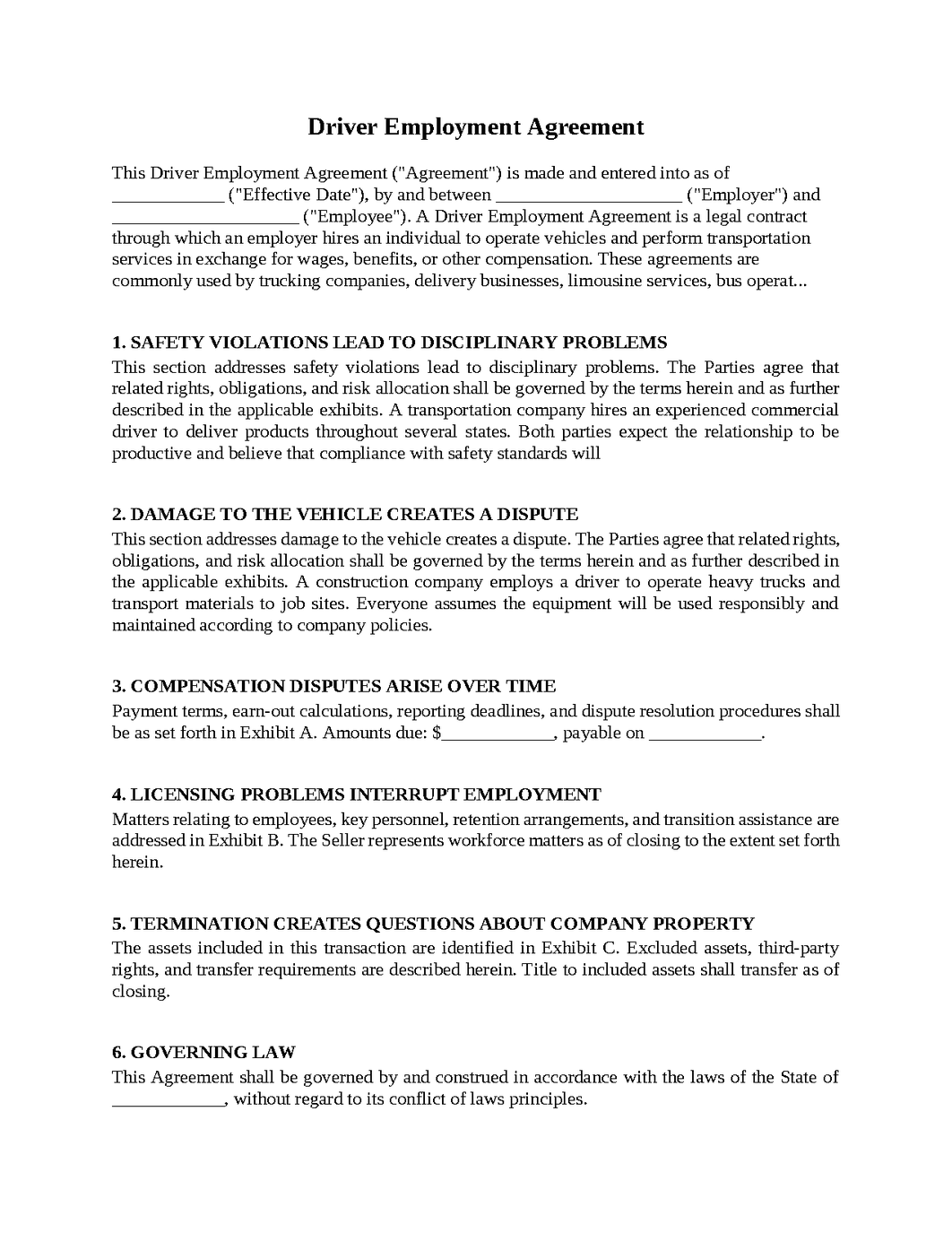
Driver Employment Agreement
A Driver Employment Agreement is a legal contract through which an employer hires an individual to operate vehicles and perform transportation services in exchange for wages, benefits, or other compensation. These agreements are commonly used by trucking companies, delivery businesses, limousine services, bus operators, construction companies, logistics providers, and organizations that rely upon professional drivers. A Driver Employment Agreement typically addresses compensation, schedules, safety requirements, licensing obligations, vehicle use policies, insurance coverage, and procedures governing discipline or termination. Because drivers often work independently and are entrusted with valuable equipment and cargo, disputes can arise when expectations regarding responsibilities and conduct are not documented clearly. A carefully drafted Driver Employment Agreement helps establish certainty and protect the interests of both employers and employees.
Safety Violations Lead to Disciplinary Problems
A transportation company hires an experienced commercial driver to deliver products throughout several states. Both parties expect the relationship to be productive and believe that compliance with safety standards will minimize risks.
For several years, deliveries are completed successfully and the driver maintains a strong performance record. Eventually, however, repeated violations involving hours-of-service requirements and vehicle inspections begin attracting regulatory attention.
The employer believes strict compliance with safety regulations is essential to protecting customers and preserving operating authority. The driver argues that demanding schedules and unexpected delays made perfect compliance difficult and believes the discipline imposed is excessive. As warnings accumulate, tensions increase and both sides begin questioning whether the employment relationship can continue.
To help avoid this problem, a Driver Employment Agreement should clearly establish safety requirements and explain the consequences associated with regulatory violations.
Damage to the Vehicle Creates a Dispute
A construction company employs a driver to operate heavy trucks and transport materials to job sites. Everyone assumes the equipment will be used responsibly and maintained according to company policies.
During a difficult project, an accident causes significant damage to one of the trucks. Repairs are expensive and operations are interrupted while the vehicle remains out of service.
The employer believes the damage resulted from careless operation and expects the driver to accept responsibility. The driver believes poor road conditions and equipment issues contributed to the accident and argues that the loss should be treated as an ordinary business expense. As repair costs continue increasing, disagreements emerge regarding liability and insurance coverage.
To help prevent these issues, a Driver Employment Agreement should clearly address vehicle use policies and define responsibilities relating to accidents and property damage.
Compensation Disputes Arise Over Time
A delivery company hires a driver and establishes compensation based upon mileage and productivity incentives. At the outset, both parties believe the payment structure fairly rewards performance and encourages efficiency.
As workloads fluctuate, questions emerge regarding overtime, waiting time, fuel stops, and compensation for delays beyond the driver's control. The complexity of the schedules makes it increasingly difficult to calculate earnings consistently.
The driver believes additional compensation is justified because long hours and delays consume valuable time. The employer believes the agreed structure adequately compensates the driver and argues that the calculations are consistent with industry practices. As frustrations increase, both sides begin disputing how compensation should be measured.
To help avoid these problems, a Driver Employment Agreement should clearly establish compensation terms and define how wages and incentives are calculated.
Licensing Problems Interrupt Employment
A logistics company employs a commercial driver who possesses all necessary licenses and certifications. Both parties assume those qualifications will remain valid throughout the employment relationship.
Unexpected medical issues and regulatory complications eventually affect the driver's ability to maintain the required credentials. Questions arise regarding whether the driver may continue working and what obligations remain during the period of suspension.
The employer believes maintaining proper licensing is a fundamental requirement of the position and expects immediate compliance. The driver believes temporary issues should not jeopardize years of successful service and hopes additional accommodations can be provided. As delivery schedules become affected, uncertainty develops regarding the future of the relationship.
To help prevent these issues, a Driver Employment Agreement should clearly establish licensing requirements and explain the consequences that apply if qualifications are suspended or revoked.
Termination Creates Questions About Company Property
A driver works for a transportation company for many years and develops strong relationships with customers and coworkers. Both parties expect the employment relationship to continue indefinitely and invest heavily in operations.
Eventually, changing business conditions lead to the driver's separation from the company. Questions arise regarding uniforms, fuel cards, electronic devices, company records, and ongoing obligations relating to customers and confidential information.
The employer believes all company property should be returned immediately and certain obligations should survive the end of employment. The driver believes the transition should be handled more gradually and worries about restrictions that may affect future opportunities. As the separation becomes more complicated, tensions develop regarding the rights and responsibilities that continue after employment ends.
To help avoid this problem, a Driver Employment Agreement should clearly establish termination procedures and identify the obligations that survive after the employment relationship concludes.
Driver Employment Agreements are valuable tools that help employers and drivers establish clear expectations while promoting safety and operational efficiency. However, issues involving safety violations, vehicle damage, compensation disputes, licensing requirements, and termination responsibilities can become significant sources of conflict when expectations are not documented clearly. A carefully drafted Driver Employment Agreement provides a structured framework for allocating responsibilities and protecting the interests of both parties. When prepared thoughtfully, it can reduce uncertainty, strengthen compliance, preserve working relationships, and provide the foundation necessary for successful transportation operations.

Get started with Upsign today!
Easily send, sign and track your documents