

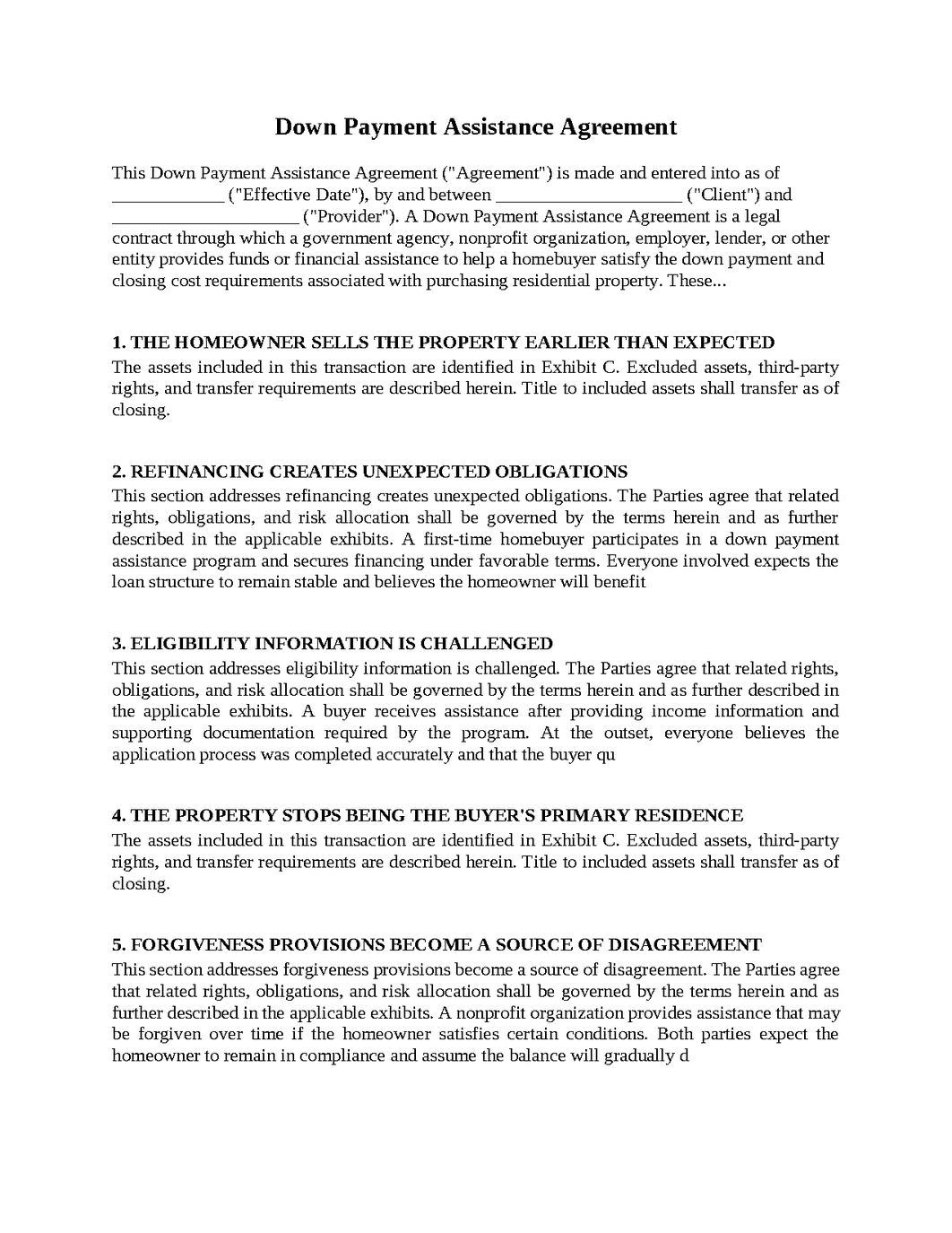
Down Payment Assistance Agreement
A Down Payment Assistance Agreement is a legal contract through which a government agency, nonprofit organization, employer, lender, or other entity provides funds or financial assistance to help a homebuyer satisfy the down payment and closing cost requirements associated with purchasing residential property. These agreements are commonly used by first-time homebuyers, affordable housing programs, municipal housing authorities, and employers seeking to encourage homeownership. A Down Payment Assistance Agreement typically addresses eligibility requirements, repayment obligations, occupancy requirements, forgiveness provisions, and the consequences that apply if the property is sold or refinanced. Because these programs often involve long-term commitments and regulatory requirements, disputes can arise when expectations regarding repayment and ownership are not documented clearly. A carefully drafted Down Payment Assistance Agreement helps establish certainty and protect the interests of both the homeowner and the organization providing assistance.
The Homeowner Sells the Property Earlier Than Expected
A young family receives financial assistance from a local housing authority to purchase its first home. Both the family and the housing authority believe the buyers will remain in the property for many years and satisfy all program requirements.
For several years, the arrangement works as intended and the family enjoys the stability of homeownership. Unexpected career opportunities eventually require a move to another state, making it necessary to sell the property much sooner than anticipated.
The homeowners believe they should retain the appreciation they earned through years of mortgage payments and maintenance. The housing authority believes the assistance was conditioned upon satisfying certain occupancy requirements and expects repayment according to the terms of the program. As closing approaches, disagreements emerge regarding how much assistance must be repaid and whether any forgiveness provisions apply.
To help avoid this problem, a Down Payment Assistance Agreement should clearly establish occupancy requirements and explain the circumstances that trigger repayment obligations.
Refinancing Creates Unexpected Obligations
A first-time homebuyer participates in a down payment assistance program and secures financing under favorable terms. Everyone involved expects the loan structure to remain stable and believes the homeowner will benefit from long-term affordability.
Several years later, declining interest rates create an opportunity to refinance the mortgage and reduce monthly payments. During the refinancing process, questions arise regarding whether the assistance agreement permits the transaction and whether repayment must occur.
The homeowner believes refinancing should be encouraged because it strengthens financial stability and reduces expenses. The organization providing assistance believes certain restrictions were necessary to protect the integrity of the program and preserve funds for future applicants. As the refinancing deadline approaches, uncertainty increases regarding how the agreement should be interpreted.
To help prevent these issues, a Down Payment Assistance Agreement should clearly address refinancing rights and establish the circumstances under which repayment or subordination may be required.
Eligibility Information Is Challenged
A buyer receives assistance after providing income information and supporting documentation required by the program. At the outset, everyone believes the application process was completed accurately and that the buyer qualified under the applicable guidelines.
Years later, a routine review uncovers discrepancies involving income calculations and employment records. Questions emerge regarding whether the assistance should have been approved and whether the homeowner remains eligible for the benefits received.
The homeowner believes any inaccuracies were unintentional and relied upon guidance provided during the application process. The organization believes accurate disclosures are essential to maintaining fairness and protecting limited housing resources. As concerns increase, both sides begin evaluating whether repayment obligations should be enforced.
To help avoid these problems, a Down Payment Assistance Agreement should clearly establish eligibility requirements and define the consequences that apply if inaccurate information is later discovered.
The Property Stops Being the Buyer's Primary Residence
A homebuyer receives down payment assistance under a program designed to encourage owner occupancy. Both parties assume the property will remain the homeowner's principal residence and that the assistance will support long-term stability.
Unexpected family circumstances eventually require the homeowner to relocate temporarily. Rather than selling the home, the owner rents the property to tenants while living elsewhere.
The homeowner believes temporary rental arrangements should not affect the benefits previously received. The housing provider believes owner occupancy was a fundamental condition of the program and argues that converting the property into an investment changes the original understanding. As rental income continues, disagreements arise regarding whether repayment obligations have been triggered.
To help prevent these issues, a Down Payment Assistance Agreement should clearly define occupancy requirements and explain how changes in the use of the property affect the homeowner's obligations.
Forgiveness Provisions Become a Source of Disagreement
A nonprofit organization provides assistance that may be forgiven over time if the homeowner satisfies certain conditions. Both parties expect the homeowner to remain in compliance and assume the balance will gradually disappear.
After many years, the homeowner believes the requirements have been satisfied and requests confirmation that the obligation has been forgiven. During the review process, questions arise regarding occupancy periods, reporting requirements, and whether all conditions were actually met.
The homeowner believes years of compliance justify complete forgiveness and the release of any remaining claims. The organization believes certain administrative requirements were not fully satisfied and argues that some obligations may still remain. As documentation is reviewed, frustrations increase and both sides begin interpreting the agreement differently.
To help avoid this problem, a Down Payment Assistance Agreement should clearly establish forgiveness provisions and define the procedures necessary to document compliance and release any remaining obligations.
Down Payment Assistance Agreements are valuable tools that make homeownership more accessible and support affordable housing initiatives. However, issues involving early sales, refinancing transactions, eligibility disputes, occupancy requirements, and forgiveness provisions can become significant sources of conflict when expectations are not documented clearly. A carefully drafted Down Payment Assistance Agreement provides a structured framework for allocating responsibilities and protecting the interests of both homeowners and assistance providers. When prepared thoughtfully, it can reduce uncertainty, preserve housing opportunities, strengthen communities, and provide families with the confidence necessary to achieve long-term homeownership.

Get started with Upsign today!
Easily send, sign and track your documents