

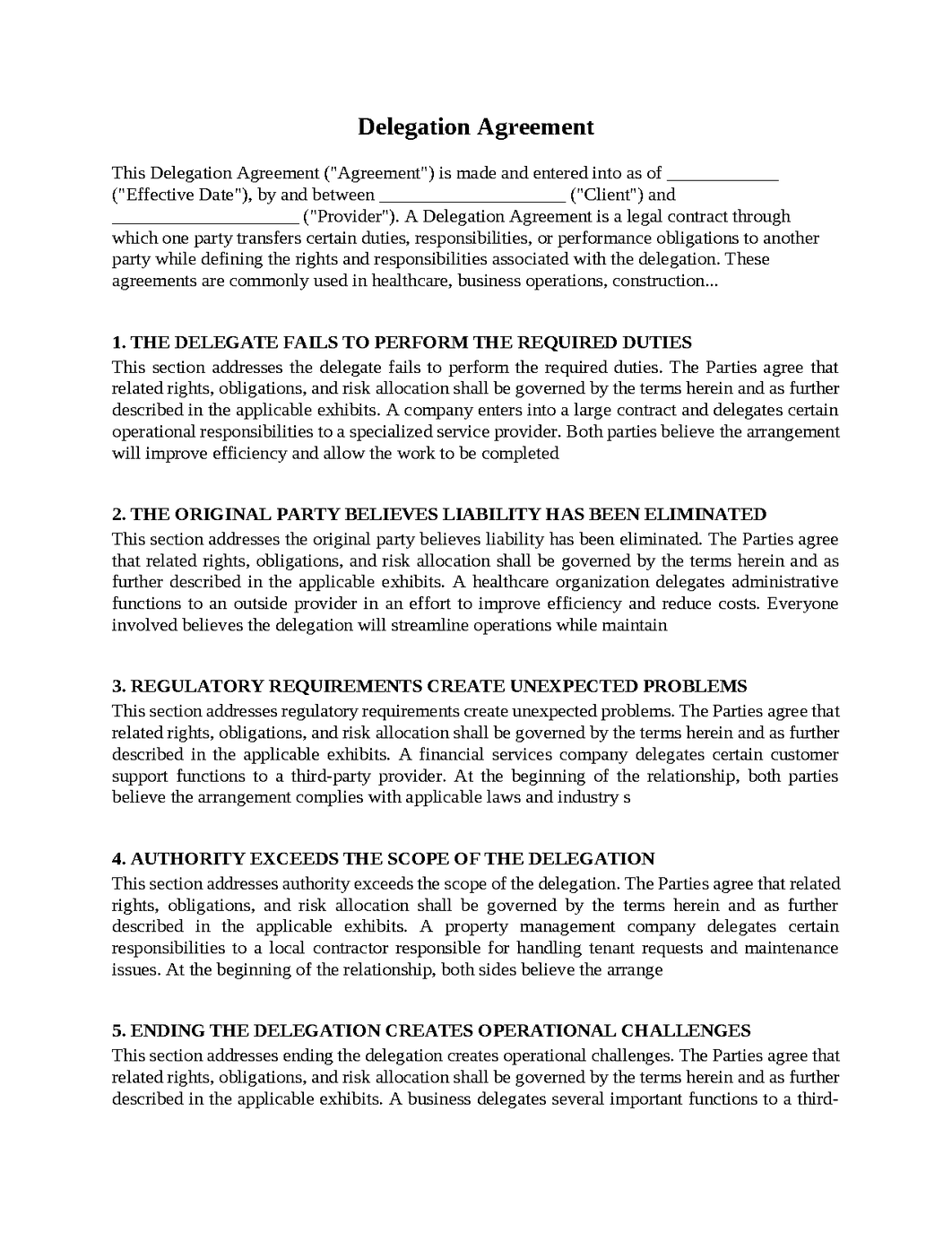
Delegation Agreement
A Delegation Agreement is a legal contract through which one party transfers certain duties, responsibilities, or performance obligations to another party while defining the rights and responsibilities associated with the delegation. These agreements are commonly used in healthcare, business operations, construction projects, service contracts, government programs, professional practices, and commercial transactions involving multiple parties. A Delegation Agreement typically addresses the scope of delegated duties, standards of performance, oversight requirements, liability allocation, compensation, and procedures for terminating the arrangement. Because delegation often involves multiple parties with interconnected obligations, disputes can arise when expectations regarding authority and accountability are not documented clearly. A carefully drafted Delegation Agreement helps establish certainty and ensure that responsibilities are carried out effectively.
The Delegate Fails to Perform the Required Duties
A company enters into a large contract and delegates certain operational responsibilities to a specialized service provider. Both parties believe the arrangement will improve efficiency and allow the work to be completed by individuals with the necessary expertise.
Initially, the relationship functions smoothly and the delegated tasks are completed without significant issues. As workloads increase, however, deadlines begin slipping and important responsibilities are not performed according to expectations. Customers and business partners begin raising concerns about delays and declining service quality.
The company believes the delegate should be responsible for any losses caused by the failures because the delegated duties were clearly assigned. The delegate argues that unforeseen circumstances and changing requirements made performance more difficult than originally anticipated. As frustrations increase, both parties begin disputing responsibility for the resulting damages and operational problems.
To help avoid this problem, a Delegation Agreement should clearly define the delegated duties and establish performance standards and remedies for failures to perform.
The Original Party Believes Liability Has Been Eliminated
A healthcare organization delegates administrative functions to an outside provider in an effort to improve efficiency and reduce costs. Everyone involved believes the delegation will streamline operations while maintaining high standards of service.
As the relationship develops, errors committed by the outside provider begin affecting patients and regulatory compliance. Complaints and potential claims arise, creating concerns about who should bear responsibility for the mistakes.
The healthcare organization believes the delegation shifted responsibility to the service provider and expects the provider to handle the consequences. The provider argues that the organization retained certain supervisory obligations and cannot avoid liability merely because duties were delegated. As regulators and customers become involved, both sides begin reevaluating their assumptions regarding accountability.
To help prevent these issues, a Delegation Agreement should clearly address liability and establish which responsibilities remain with the original party after duties have been delegated.
Regulatory Requirements Create Unexpected Problems
A financial services company delegates certain customer support functions to a third-party provider. At the beginning of the relationship, both parties believe the arrangement complies with applicable laws and industry standards.
As regulations evolve, government agencies begin scrutinizing the activities performed by the delegate. Questions emerge regarding licensing requirements, reporting obligations, and whether the delegated functions satisfy legal standards.
The company believes the provider should remain responsible for ensuring compliance with rules affecting its services. The provider believes regulatory obligations ultimately belong to the company because it maintains the customer relationship and benefits from the activities being performed. As examinations and audits increase, uncertainty grows regarding which party bears responsibility for correcting deficiencies.
To help avoid these problems, a Delegation Agreement should clearly establish compliance obligations and identify the responsibilities of each party with respect to applicable laws and regulations.
Authority Exceeds the Scope of the Delegation
A property management company delegates certain responsibilities to a local contractor responsible for handling tenant requests and maintenance issues. At the beginning of the relationship, both sides believe the arrangement will improve responsiveness and customer satisfaction.
Over time, the contractor begins making decisions involving expenditures and contractual commitments that exceed what the property owner originally contemplated. Tenants assume the contractor possesses broad authority because of the responsibilities delegated to it.
The owner believes the contractor exceeded its authority and should bear responsibility for unauthorized actions. The contractor believes its decisions were necessary to satisfy tenant expectations and maintain operations. As financial consequences become more significant, disagreements emerge regarding the limits of the delegated authority.
To help prevent these issues, a Delegation Agreement should clearly define the scope of authority granted to the delegate and establish procedures for obtaining approval before taking actions outside those limits.
Ending the Delegation Creates Operational Challenges
A business delegates several important functions to a third-party provider for many years. Over time, the delegate becomes deeply integrated into the company's operations, and both parties assume the relationship will continue indefinitely.
Eventually, changing priorities lead the company to bring the responsibilities back in-house. Although both sides initially expect a smooth transition, disagreements emerge regarding records, customer communications, unfinished projects, and the amount of assistance required after termination.
The company believes continued cooperation is necessary to prevent disruptions and ensure a successful transition. The delegate believes its obligations should end promptly so that resources can be redirected elsewhere. As discussions become more difficult, both parties realize that separating years of integrated operations is far more complicated than they originally anticipated.
To help avoid this problem, a Delegation Agreement should clearly establish termination procedures and identify the obligations that survive the end of the relationship.
Delegation Agreements are valuable tools that allow organizations to assign responsibilities efficiently while relying on specialized expertise and resources. However, issues involving performance failures, continuing liability, regulatory obligations, excessive authority, and termination challenges can become significant sources of conflict when expectations are not documented clearly. A carefully drafted Delegation Agreement provides a structured framework for allocating responsibilities and protecting the interests of everyone involved. When prepared thoughtfully, it can reduce uncertainty, improve operational efficiency, strengthen business relationships, and provide the foundation necessary for successful delegation arrangements.

Get started with Upsign today!
Easily send, sign and track your documents