

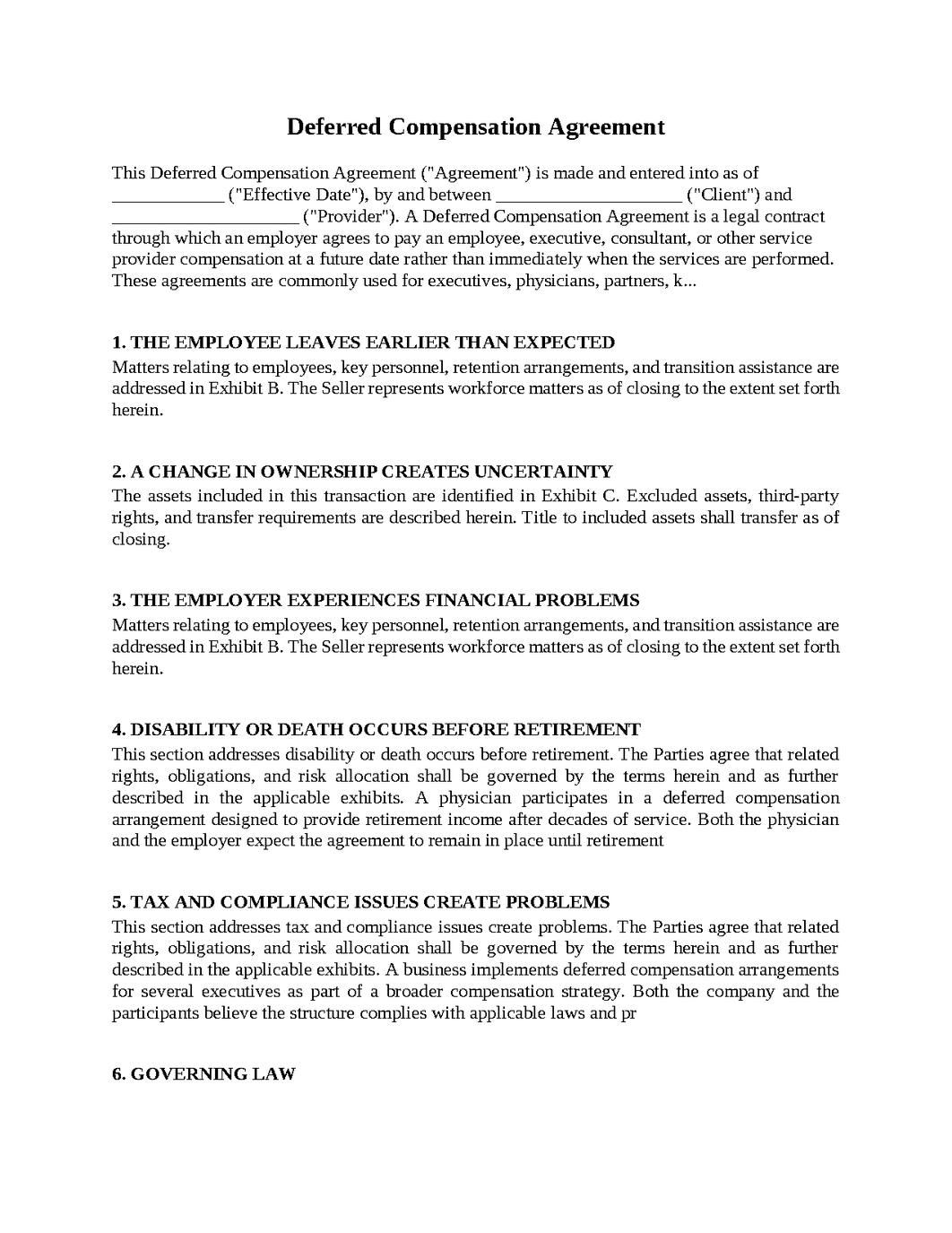
Deferred Compensation Agreement
A Deferred Compensation Agreement is a legal contract through which an employer agrees to pay an employee, executive, consultant, or other service provider compensation at a future date rather than immediately when the services are performed. These agreements are commonly used for executives, physicians, partners, key employees, consultants, and business owners who wish to delay income for retirement planning, tax purposes, or long-term incentive arrangements. A Deferred Compensation Agreement typically addresses the amount of deferred compensation, vesting schedules, payment events, forfeiture provisions, death and disability rights, and the circumstances under which payments may be accelerated or delayed. Because deferred compensation arrangements often span many years and involve substantial sums of money, disputes can arise when expectations regarding eligibility and payment obligations are not documented clearly. A carefully drafted Deferred Compensation Agreement helps establish certainty and protect the interests of both employers and participants.
The Employee Leaves Earlier Than Expected
A company offers a deferred compensation plan to a senior executive as part of a long-term retention strategy. Both parties expect the executive to remain with the organization for many years and view the arrangement as a reward for continued service and loyalty.
During the first several years, the relationship remains productive and the deferred balance grows steadily. Eventually, however, the executive receives an attractive opportunity with another company and decides to resign before reaching the anticipated retirement date.
The executive believes the compensation was earned through years of service and should be paid regardless of continued employment. The company believes certain benefits were conditioned upon satisfying vesting requirements and maintaining employment through specified milestones. As discussions become more difficult, both sides begin interpreting the agreement differently and questioning which amounts, if any, remain payable.
To help avoid this problem, a Deferred Compensation Agreement should clearly define vesting requirements and establish the consequences associated with voluntary resignation or early termination.
A Change in Ownership Creates Uncertainty
A closely held company establishes deferred compensation arrangements for several members of its leadership team. At the time the agreements are signed, everyone expects the business to remain independently owned and assumes payments will occur according to the original schedule.
Years later, the company is acquired by another organization. New management begins reviewing compensation obligations and evaluating how existing agreements fit within the acquiring company's compensation philosophy.
The executives believe the deferred benefits represent binding obligations that should survive the ownership transition. The new owners believe certain provisions should be renegotiated or modified to align with the company's broader compensation structure. As the transaction closes and new policies are introduced, uncertainty grows regarding the future treatment of deferred balances and payment schedules.
To help prevent these issues, a Deferred Compensation Agreement should clearly address changes in ownership and establish how deferred benefits will be handled following mergers, acquisitions, or reorganizations.
The Employer Experiences Financial Problems
A successful business establishes deferred compensation plans to reward key personnel and encourage long-term retention. Everyone assumes the company will remain financially healthy and capable of satisfying future obligations.
Unexpected market conditions and operational challenges eventually reduce profitability. Cash flow becomes strained, and management begins evaluating ways to preserve the business while meeting existing obligations.
Participants believe the deferred compensation represents an important part of their overall earnings and expect the company to honor its commitments. Management argues that preserving the business requires flexibility and believes extraordinary financial circumstances justify modifications to payment schedules. As uncertainty surrounding the company's future increases, employees become concerned about whether the promised compensation will ever be received.
To help avoid these problems, a Deferred Compensation Agreement should clearly explain the nature of the obligations and address the risks associated with the employer's financial condition.
Disability or Death Occurs Before Retirement
A physician participates in a deferred compensation arrangement designed to provide retirement income after decades of service. Both the physician and the employer expect the agreement to remain in place until retirement and assume payments will begin according to the established schedule.
Unexpected health problems force the physician to stop working years earlier than anticipated. Family members and advisors begin reviewing the agreement to determine how disability and survivor benefits should be handled.
The physician believes years of contributions and service justify immediate access to the deferred amounts. The employer believes the agreement contains limitations that affect the timing and amount of payments. Following the physician's death, additional questions emerge regarding beneficiary rights and whether surviving family members are entitled to the full value of the benefits.
To help prevent these issues, a Deferred Compensation Agreement should clearly establish the rights of participants and beneficiaries in the event of disability or death.
Tax and Compliance Issues Create Problems
A business implements deferred compensation arrangements for several executives as part of a broader compensation strategy. Both the company and the participants believe the structure complies with applicable laws and provides valuable tax advantages.
As regulations evolve and new reporting requirements emerge, advisors identify potential compliance issues involving payment timing and administrative procedures. Concerns arise that mistakes could result in unexpected taxes and penalties.
The executives believe the company should be responsible for ensuring the arrangements comply with applicable requirements. Management argues that participants also bear responsibility for understanding the consequences of their compensation decisions. As tax advisors become involved, disagreements emerge regarding who should bear the costs associated with correcting the problems.
To help avoid these issues, a Deferred Compensation Agreement should clearly address compliance requirements and establish procedures designed to minimize the risk of unintended tax consequences.
Deferred Compensation Agreements are valuable tools for rewarding key individuals and encouraging long-term commitment. However, issues involving early departures, ownership changes, financial distress, disability, and tax compliance can become significant sources of conflict when expectations are not documented clearly. A carefully drafted Deferred Compensation Agreement provides a structured framework for defining rights and obligations over long periods of time. When prepared thoughtfully, it can reduce uncertainty, strengthen retention, support succession planning, and provide participants with greater confidence regarding their future financial security.

Get started with Upsign today!
Easily send, sign and track your documents