

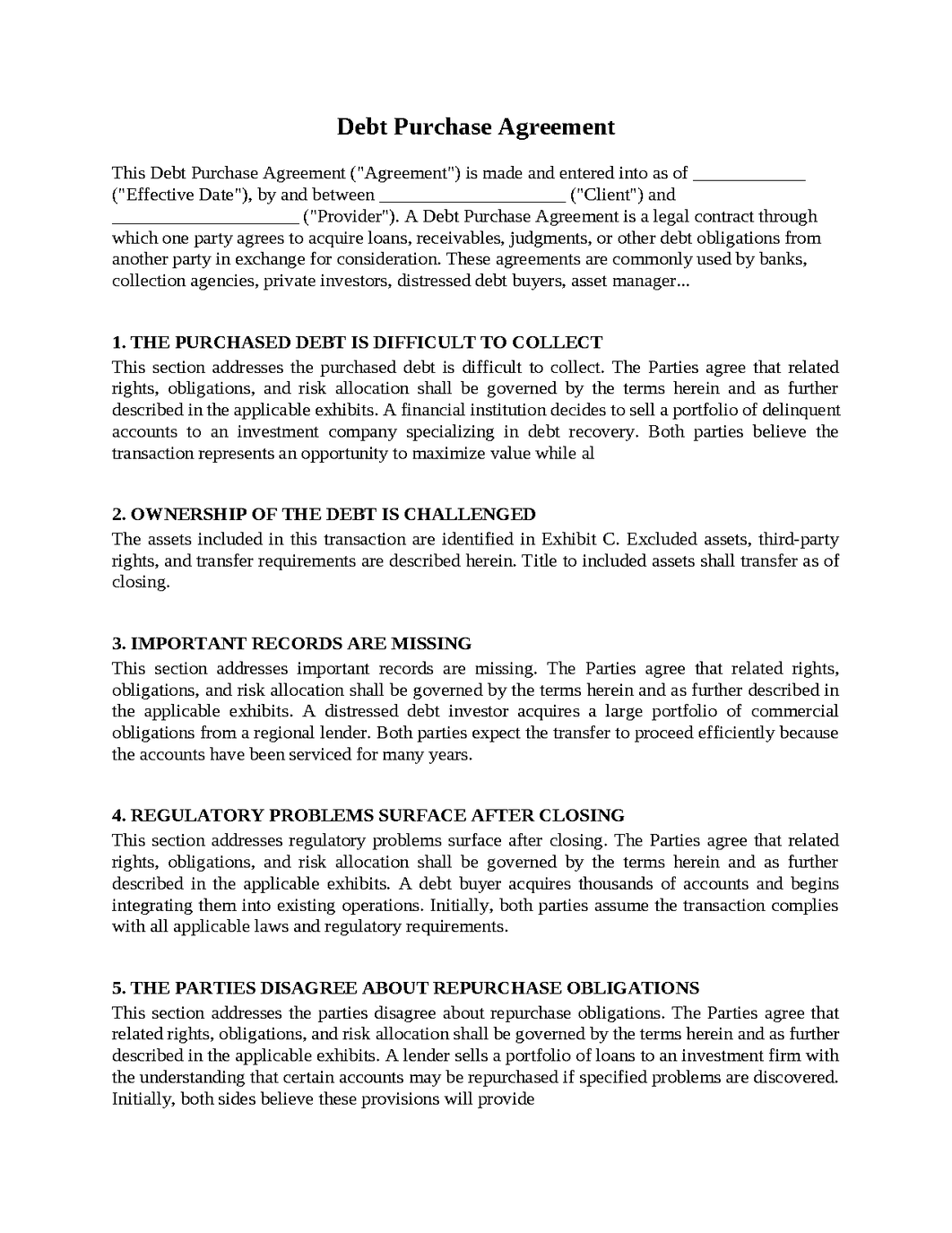
Debt Purchase Agreement
A Debt Purchase Agreement is a legal contract through which one party agrees to acquire loans, receivables, judgments, or other debt obligations from another party in exchange for consideration. These agreements are commonly used by banks, collection agencies, private investors, distressed debt buyers, asset managers, factoring companies, and financial institutions seeking to transfer or acquire portfolios of financial assets. A Debt Purchase Agreement typically addresses the debts being transferred, purchase price, representations and warranties, servicing rights, documentation requirements, and the allocation of risks associated with collection and enforcement. Because debt portfolios often contain incomplete records and uncertain recoverability, disputes can arise when expectations regarding asset quality and ownership are not documented clearly. A carefully drafted Debt Purchase Agreement helps establish certainty and facilitate the orderly transfer of financial assets.
The Purchased Debt Is Difficult to Collect
A financial institution decides to sell a portfolio of delinquent accounts to an investment company specializing in debt recovery. Both parties believe the transaction represents an opportunity to maximize value while allowing the seller to focus on other priorities.
After the purchase closes, the buyer begins collection efforts and discovers that many debtors are insolvent or have already filed bankruptcy. Recoveries fall well below expectations, and the anticipated returns become increasingly difficult to achieve.
The buyer believes the seller overstated the quality and collectability of the portfolio. The seller argues that the discounted purchase price reflected the uncertain nature of the accounts and that no guarantees regarding recoveries were provided. As losses increase, disagreements emerge regarding whether the risks associated with the portfolio were adequately disclosed before the transaction occurred.
To help avoid this problem, a Debt Purchase Agreement should clearly address representations concerning the debt portfolio and allocate the risks associated with collection and recoverability.
Ownership of the Debt Is Challenged
A company purchases a portfolio of consumer accounts from another lender and begins servicing the obligations. At the time of the transaction, both parties believe the transfer documents adequately establish ownership of the debts.
As collection efforts begin, several borrowers challenge the authority of the purchaser and request proof demonstrating how ownership transferred from the original creditor. Questions arise regarding assignments, endorsements, and historical account records.
The purchaser believes the transaction documents provide sufficient evidence to establish ownership. The borrowers argue that the chain of title is incomplete and that additional documentation is necessary before collection efforts may proceed. As disputes multiply, the purchaser becomes increasingly concerned about the costs and delays associated with enforcing the obligations.
To help prevent these issues, a Debt Purchase Agreement should clearly document the transfer of ownership and establish procedures for maintaining records that support collection and enforcement activities.
Important Records Are Missing
A distressed debt investor acquires a large portfolio of commercial obligations from a regional lender. Both parties expect the transfer to proceed efficiently because the accounts have been serviced for many years.
After taking possession of the portfolio, the purchaser discovers that certain loan files, payment histories, and supporting documents are incomplete or stored across multiple systems. The missing information makes it difficult to evaluate the accounts and pursue collection efforts.
The buyer believes complete records should have been provided as part of the transaction. The seller argues that older accounts often contain gaps in documentation and that the purchase price reflected those risks. As additional deficiencies are discovered, frustrations increase and both sides begin questioning whether the assets delivered match what was originally contemplated.
To help avoid this problem, a Debt Purchase Agreement should clearly identify the records that must accompany the transfer and establish remedies for missing or incomplete documentation.
Regulatory Problems Surface After Closing
A debt buyer acquires thousands of accounts and begins integrating them into existing operations. Initially, both parties assume the transaction complies with all applicable laws and regulatory requirements.
Months later, government agencies begin examining collection practices and historical servicing activities associated with the accounts. Questions arise regarding disclosures, licensing requirements, and prior compliance issues that existed before the transfer occurred.
The purchaser believes the seller should remain responsible for regulatory problems tied to historical conduct. The seller believes the buyer accepted the accounts with knowledge of the applicable legal environment and argues that future compliance is the buyer's responsibility. As investigations become more expensive and time-consuming, both sides begin disputing how liability should be allocated.
To help prevent these issues, a Debt Purchase Agreement should clearly address regulatory compliance and establish indemnification provisions governing pre-closing and post-closing conduct.
The Parties Disagree About Repurchase Obligations
A lender sells a portfolio of loans to an investment firm with the understanding that certain accounts may be repurchased if specified problems are discovered. Initially, both sides believe these provisions will provide protection without creating unnecessary complications.
After closing, the purchaser identifies accounts that allegedly fail to satisfy the standards described in the agreement. The purchaser demands that the seller repurchase the affected obligations and reimburse associated losses.
The seller believes the accounts satisfy the agreed criteria and argues that the buyer is attempting to shift ordinary business risks back to the original owner. The purchaser insists that the deficiencies materially affect the value of the portfolio and justify repurchase rights. As the financial consequences become larger, the parties begin interpreting the agreement differently and challenging each other's assumptions.
To help avoid these problems, a Debt Purchase Agreement should clearly define repurchase obligations and establish procedures for resolving disputes regarding defective or nonconforming accounts.
Debt Purchase Agreements are important tools that allow financial institutions and investors to transfer and acquire portfolios of debt obligations efficiently. However, issues involving collectability, ownership, missing records, regulatory liabilities, and repurchase rights can become significant sources of conflict when expectations are not documented clearly. A carefully drafted Debt Purchase Agreement provides a structured framework for allocating risks and defining the responsibilities of both buyers and sellers. When prepared thoughtfully, it can reduce uncertainty, support successful transactions, preserve valuable relationships, and provide the confidence necessary for complex debt acquisitions.

Get started with Upsign today!
Easily send, sign and track your documents